

A Real Lesson From the Workshop Floor
Early in my career as a heavy equipment technician, I learned a lesson that stayed with me for the rest of my working life.
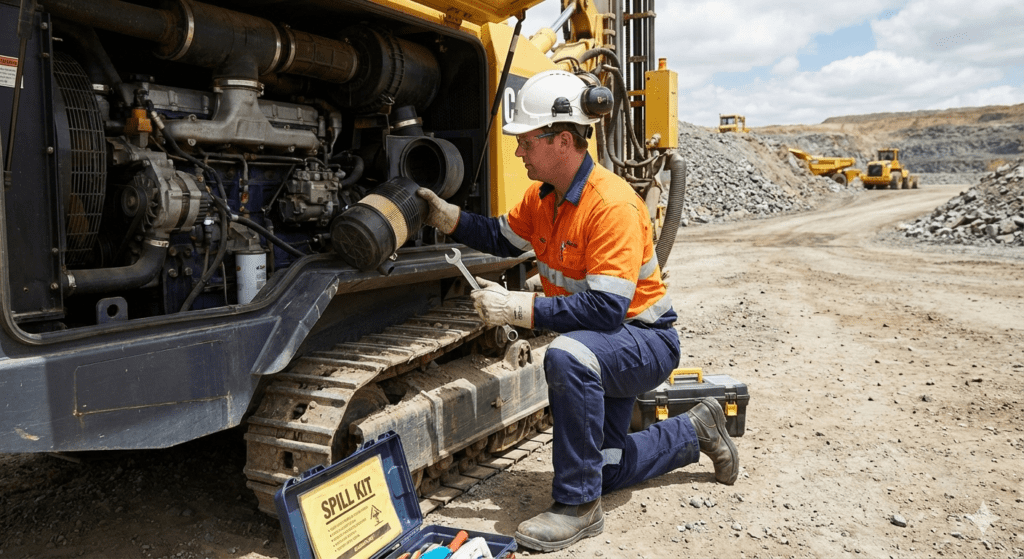
I was working on a surface drill rig (MD 6200). The machine had a burst main air pipe, and I was in the process of replacing it. At the same time, an auto electrician was working on the air compressor, changing a sensor.
It was a normal day in the workshop. Busy. Noisy. Multiple jobs happening at once.
Then I made a mistake.
What Went Wrong
While the repair was still in progress, I was called away to attend to a small breakdown on another machine. I left the drill rig before the job was fully secured.
Shortly after, the electrician started the machine to test his work.
Because the air system was not isolated, compressed air blasted through the open pipe.
The result:
- Cabin windows were damaged
- Hard hats were scratched badly
- One artisan and the operator were knocked by flying debris
Luckily, no one was seriously injured. That alone was a warning strong enough.
The Real Problem (Not the Broken Pipe)
The problem was not the burst air pipe.
The real mistakes were:
- ❌ No lockout and tagout
- ❌ No joint risk assessment
- ❌ Poor communication between trades
- ❌ Assumptions instead of confirmation
I assumed everyone knew the machine was unsafe to start.
They assumed the repair was complete.
Assumptions have no place in a workshop.
Why Lockout and Tagout Is Non-Negotiable
Lockout and tagout is not paperwork.
It is not management policy.
It is life protection.
Every time you work on:
- Diesel engines
- Air systems
- Hydraulics
- Electrical systems
👉 The machine must be locked out and tagged
This ensures:
- Nobody can start the machine
- Everyone knows work is in progress
- Responsibility is clearly assigned
One lock can save a life.
Working as a Team in the Workshop
Modern workshops bring together many trades:
- Diesel mechanics
- Auto electricians
- Welders
- Fitters
- Operators
If one person is unsafe, everyone is unsafe.
Before starting any job:
- Talk as a team
- Agree on who is working where
- Identify risks together
- Confirm isolation points
Five minutes of communication can prevent years of regret.
Lessons for Apprentice Technicians
If you are an apprentice, learn this early:
- Never rush a job
- Never leave a machine unsecured
- Never assume someone else knows
- Always isolate before working
- Always communicate clearly
Experience is expensive.
Learning from others is cheaper — and safer.
Why These Lessons Matter in African Workshops
In many African working environments:
- Workshops are busy
- Equipment is old
- Spares are limited
- Pressure to keep machines running is high
That is exactly why safety matters more, not less.
One injury can stop a project.
One fatal mistake can destroy families.
Final Thoughts
That day, I was lucky.
But luck is not a safety system.
What made me a better technician was not the repair — it was the lesson.
Respect the machine.
Respect your team.
Follow procedures.
Go home safe.
Call to Action
If you are an apprentice or young technician:
- Learn the basics properly
- Work safely
- Ask questions
- Never be afraid to stop unsafe work
Follow ModernTradeSkills for real-world lessons from the workshop — not just theory.