

Diesel Engine ECU & ECM Explained
Modern diesel engines no longer rely only on mechanical systems. Today, the Engine Control Module (ECM) — often called the ECU — is the brain of the engine. It monitors operating conditions, makes decisions, and protects the engine from damage.
For apprentice diesel technicians, understanding the ECU is essential for diagnosing modern trucks, excavators, generators, and mining equipment.
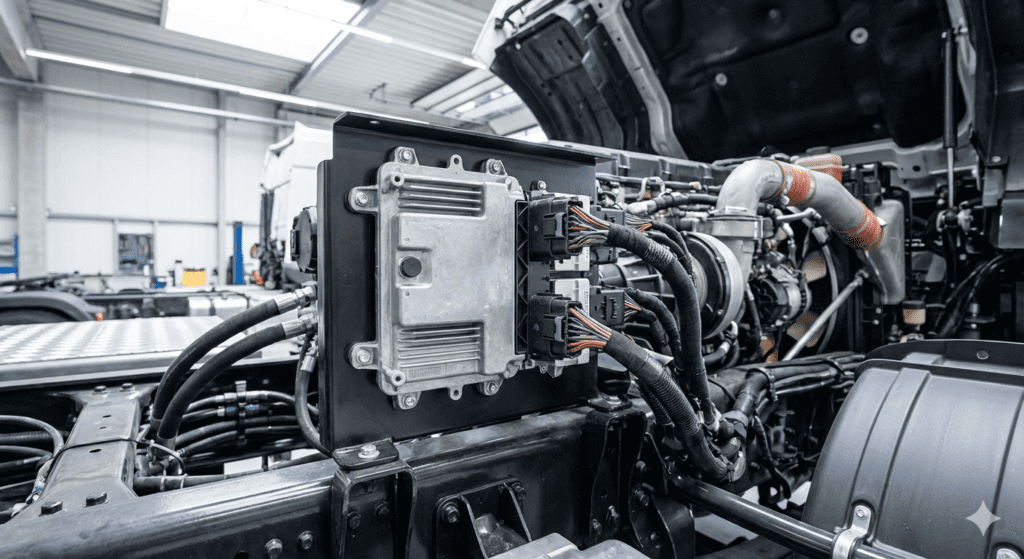
What Is a Diesel Engine ECU / ECM?
The ECU (Electronic Control Unit) or ECM (Engine Control Module) is a computer that controls engine operation. It receives information from sensors, processes the data, and sends commands to engine components.
In simple terms:
- Sensors talk to the ECU
- The ECU thinks
- Actuators do the work
Why Diesel Engines Use ECUs
Diesel engines use ECUs to:
- Improve fuel efficiency
- Reduce emissions
- Protect engine components
- Control power and torque
- Diagnose faults
Modern engines cannot meet performance and emission standards without electronic control.
ECU Inputs: What the ECU Reads
The ECU constantly receives signals from sensors, including:
- Coolant temperature sensor
- Oil pressure sensor
- Boost / MAP sensor
- Intake air temperature sensor
- Fuel pressure sensor
- Crankshaft and camshaft sensors
- Exhaust and emission sensors (EGT, NOx, DPF pressure)
These inputs allow the ECU to know exactly how the engine is operating at any moment.
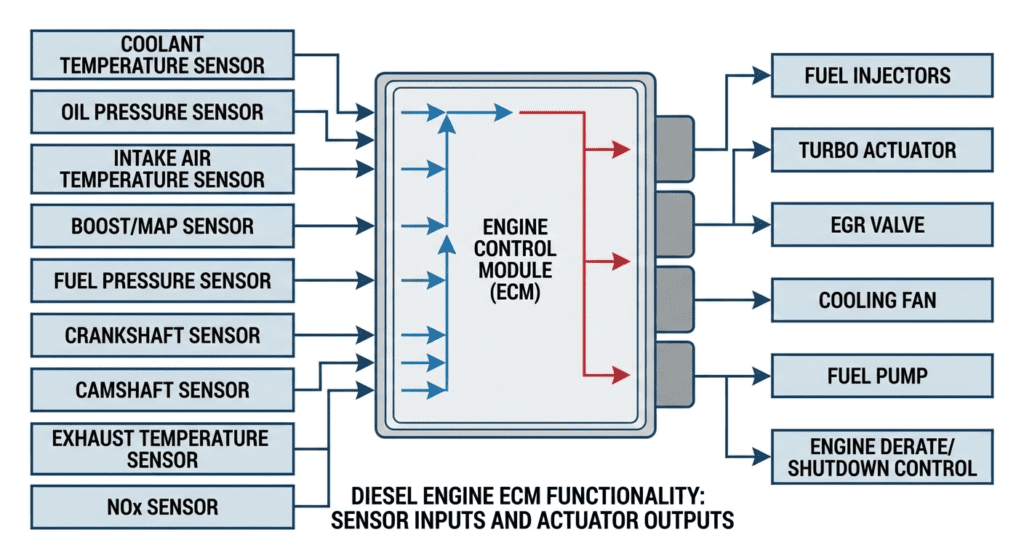
ECU Outputs: What the ECU Controls
Based on sensor data, the ECU controls:
- Fuel injectors (timing and quantity)
- Electronic unit injectors (EUI)
- Turbocharger actuators
- EGR valves
- Cooling fans
- Exhaust aftertreatment systems
- Engine derate and shutdown functions
This control happens in milliseconds.
How the ECU Protects the Engine
Engine protection is one of the ECU’s most important jobs.
If unsafe conditions are detected, the ECU may:
- Turn on warning lights
- Reduce engine power (derate)
- Shut down the engine
Common protection triggers include:
- Low oil pressure
- High coolant temperature
- High exhaust temperature
- Sensor failure
- Electrical faults
ECU and Diagnostics
When faults occur, the ECU stores:
- Fault codes
- Event data
- Freeze-frame information
Technicians retrieve this information using diagnostic tools. This allows faster and more accurate troubleshooting than mechanical engines.
Common ECU-Related Problems in the Workshop
Apprentices often see:
- Loose or corroded ECU connectors
- Damaged wiring harnesses
- Low battery voltage causing false faults
- Sensor failures misdiagnosed as ECU faults
👉 Important: ECUs rarely fail. Always test sensors, wiring, and power supply before replacing an ECU.
ECU Location and Environment
ECUs are usually mounted:
- On the engine
- On the frame
- Inside sealed compartments
They must be protected from:
- Heat
- Water
- Vibration
- Dust
Poor mounting or damaged seals can cause intermittent faults.
African Working Conditions: ECU Challenges
In African environments, ECUs face:
- High temperatures
- Dust and moisture
- Voltage spikes from poor batteries
- Jump-start damage
Good electrical maintenance is critical for ECU reliability.
Apprentice Safety and Best Practices
- Disconnect batteries before ECU work
- Never weld on equipment without isolating the ECU
- Use correct diagnostic procedures
- Avoid unnecessary ECU replacement
Conclusion: Why ECU Knowledge Matters
Understanding how diesel engine ECUs work separates parts changers from real technicians. As engines become more electronic, ECU knowledge becomes essential for career growth, diagnostics, and global work readiness.
Learn the inputs. Understand the outputs. Respect the protections.