

AI vs Traditional Diagnostics: Which Is Better for Diesel Technicians?
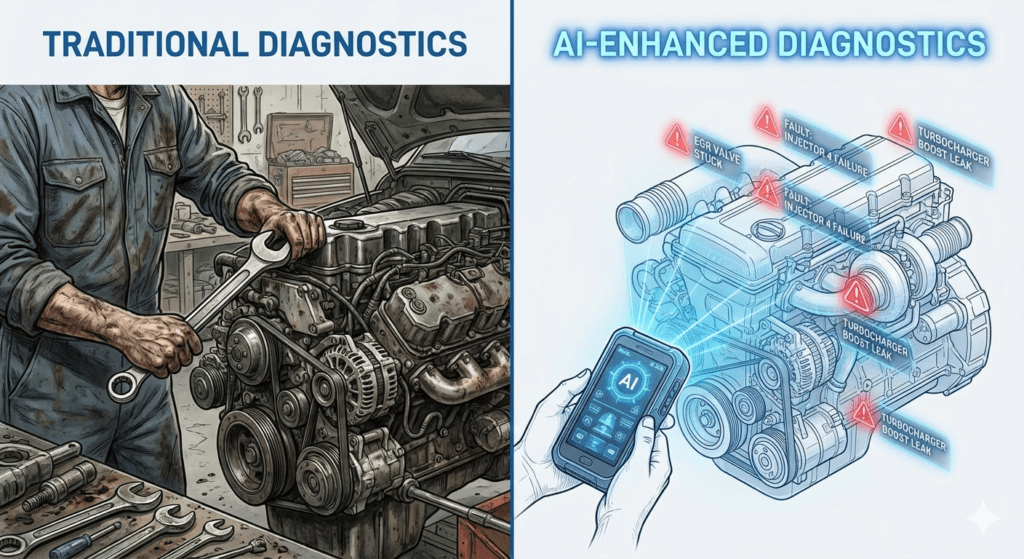
Introduction: The Diagnostic Debate in Modern Workshops
Diesel diagnostics has changed dramatically over the past two decades. What was once solved with experience, basic tools, and methodical testing is now supported by scan tools, live data, and increasingly, Artificial Intelligence (AI).
Many technicians ask a valid question:
Is AI really better than traditional diagnostics, or is it just another tool?
The answer is not “one or the other.” The best workshops use both. This article compares AI vs traditional diagnosis methods, explaining their strengths, weaknesses, and where each approach works best.
1. What Traditional Diagnostics Involves
Core Elements of Traditional Diagnostics
Traditional diagnostics rely on:
- Technician experience
- Visual inspections
- Mechanical testing
- Multimeters and pressure gauges
- Logical step-by-step fault isolation
This approach is built on understanding how systems work, not just what the scan tool says.
Strengths of Traditional Diagnostics
- Works even without electronics
- Builds deep system understanding
- Reliable for mechanical failures
- Essential for older engines and machines
Limitations
- Time-consuming on complex systems
- Relies heavily on individual experience
- Difficult for intermittent or electronic faults
2. What AI-Based Diagnostics Brings to the Table
How AI Diagnostics Work
AI diagnostic systems analyze:
- Fault codes and freeze-frame data
- Live sensor values
- Historical failure patterns
- Known OEM repair outcomes
They identify probable causes, not just symptoms.
Strengths of AI Diagnostics
- Faster fault identification
- Excellent for electronic and emissions systems
- Reduces guesswork
- Helps less-experienced technicians
Limitations
- Depends on data quality
- May miss purely mechanical failures
- Cannot replace physical inspection
3. Speed: AI vs Traditional Diagnostics
Traditional Approach
- Manual testing
- Component-by-component checks
- Logical elimination
Effective but often slow.
AI Approach
- Rapid pattern recognition
- Immediate fault probability ranking
Winner: AI
For speed—especially on electronic faults—AI diagnostics clearly outperform traditional methods.
4. Accuracy: Which Gets It Right More Often?
Traditional Diagnostics Accuracy
Highly accurate when performed by an experienced technician, especially for:
- Mechanical wear
- Physical damage
- Abnormal noises
AI Diagnostics Accuracy
Highly accurate for:
- Sensor-related faults
- Network communication issues
- Emissions and control logic problems
Reality Check
Accuracy depends on:
- Technician judgment
- Data quality
- Proper verification
Neither method is foolproof on its own.
5. Skill and Experience Factor
Traditional Diagnostics
- Rewards experience
- Takes years to master
- Difficult to scale across teams
AI Diagnostics
- Reduces the learning curve
- Acts as a diagnostic assistant
- Helps standardize processes
Impact on Workshops
AI helps junior technicians perform better while senior technicians:
- Validate results
- Handle complex mechanical issues
6. Cost Implications
Traditional Diagnostics Costs
- Lower tool costs
- Higher labor time
- Risk of trial-and-error part replacement
AI Diagnostics Costs
- Software subscriptions
- Advanced scan tools
- Lower labor time
- Fewer incorrect part replacements
Long-Term View
AI diagnostics often reduce overall repair costs, especially in high-volume workshops.
7. Intermittent and Complex Faults
Traditional Challenges
Intermittent faults:
- Disappear during testing
- Waste hours of labor
AI Advantage
AI detects patterns across:
- Time
- Conditions
- Multiple vehicles
This makes AI far superior for intermittent faults.
8. Diagnostic Transparency and Trust
Technician Concern
Some technicians distrust AI because:
- It doesn’t explain its logic clearly
- It feels like “black box” diagnostics
Best Practice
Use AI suggestions as:
- A starting point
- A guide, not a verdict
Always verify with:
- Physical tests
- Visual inspection
9. Where Traditional Diagnostics Will Always Win
Traditional methods are unbeatable for:
- Mechanical failures
- Visual damage
- Noise and vibration analysis
- Non-electronic systems
No AI can replace:
- Listening to an engine
- Feeling vibration
- Smelling overheating components
10. The Best Diagnostic Approach: Hybrid Diagnostics
The Smart Workshop Method
The most effective approach is hybrid diagnostics:
- Use AI to narrow down causes
- Apply traditional testing to confirm
- Repair with confidence
Benefits
- Faster diagnosis
- Higher accuracy
- Reduced comebacks
- Better training outcomes
11. What This Means for Diesel Technicians
For Apprentices
- Use AI to learn system behavior
- Develop traditional skills in parallel
For Experienced Technicians
- Use AI to save time
- Focus expertise where it matters
For Workshop Managers
- Standardize diagnostics
- Improve productivity
- Reduce costs
Conclusion: It’s Not AI vs Technicians—It’s AI + Technicians
AI diagnostics are not a replacement for traditional diagnostic skills. They are an extension of them.
The future belongs to technicians who can:
- Understand systems
- Use AI intelligently
- Verify results professionally
The real question is no longer “AI or traditional?”
It is “How well can you combine both?”
Shopview has a great article on this subject.