

How Heavy Equipment Trade Shows Influence Workshop Investment Decisions

For many people, heavy equipment trade shows are impressive exhibitions of new machines.
For workshop managers and fleet owners, they are something far more important:
They are investment signals.
Events such as CONEXPO-CON/AGG, bauma, and MINExpo International do not just showcase equipment — they reveal where the industry is committing capital, engineering resources, and long-term direction.
If you manage a workshop or oversee a fleet, ignoring these signals can lead to reactive spending, downtime, and lost competitiveness.
Let’s break this down strategically.
1️⃣ Tooling Investment Signals
When you walk through a major OEM booth and see:
- Hybrid excavators
- Battery-electric mining trucks
- Advanced telematics dashboards
- High-voltage safety zones
You are not just looking at equipment. You are looking at future tooling requirements.
For example:
A new hybrid powertrain may require:
- Insulated high-voltage tools
- Updated diagnostic interfaces
- Battery isolation testing equipment
- Specialized lifting systems
If your workshop budget cycle runs annually, trade shows give you a 2–3 year preview of what tooling must be phased in.
Smart managers do not wait for breakdowns to expose gaps.
2️⃣ Diagnostic Software & Subscription Costs
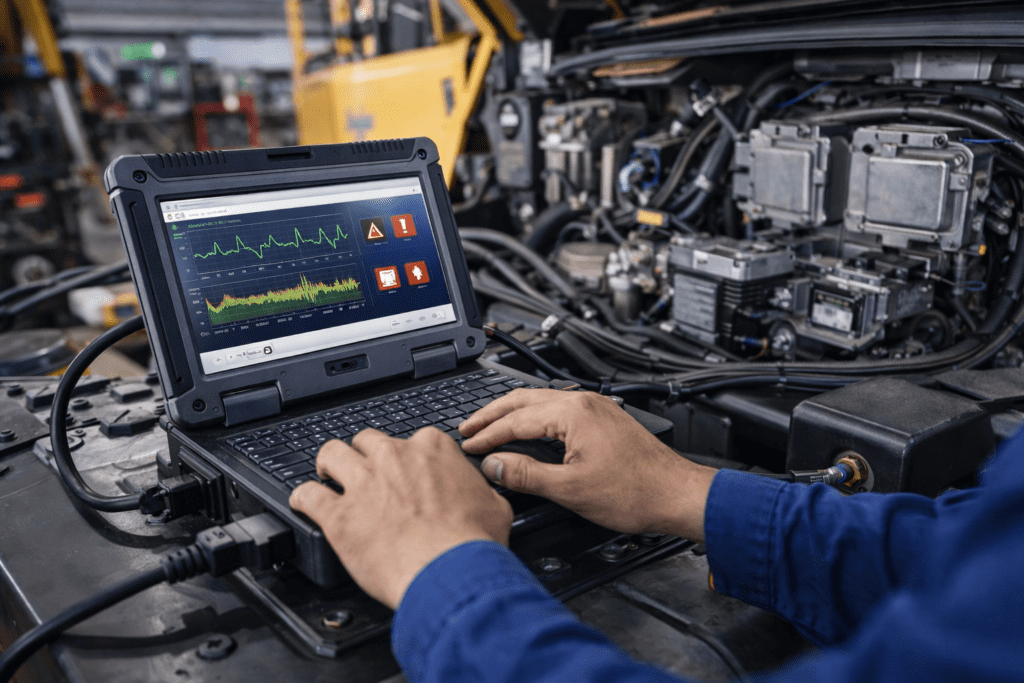
Modern equipment increasingly relies on:
- OEM diagnostic platforms
- Cloud-based data access
- Subscription-based telematics services
- Remote troubleshooting integration
At global events, OEMs heavily promote digital ecosystems.
This is a signal.
Workshops must begin budgeting for:
- Annual software licenses
- Laptop and tablet upgrades
- Cybersecurity awareness
- Technician software training time
The cost of not budgeting for diagnostics often exceeds the cost of preparing early.
3️⃣ Infrastructure Upgrades
Electrification and hybrid systems introduce infrastructure demands.
Trade shows increasingly display:
- Charging stations
- Battery handling systems
- Thermal management modules
- Inverter and converter cooling systems
These are not minor additions.
They may require:
- Electrical system upgrades in the workshop
- Designated high-voltage work areas
- Fire safety revisions
- Updated lockout-tagout procedures
Investment decisions must consider infrastructure — not just tooling.
4️⃣ Training as a Capital Investment
One of the most overlooked costs in workshop modernization is training.
At major trade shows, OEMs promote:
- Certification programs
- Digital training portals
- Simulation-based maintenance training
- High-voltage qualification courses
When OEMs scale training visibility, it indicates complexity is rising.
Managers must treat training as:
Not an expense — but a capital investment in workshop capability.
Technicians who understand evolving systems reduce diagnostic time, misdiagnosis, and rework.
5️⃣ Fleet Replacement Strategy Signals
Trade shows also reveal:
- Which models are being phased out
- Which power systems are becoming standard
- Which technologies are receiving large R&D investment
If an OEM reduces emphasis on a legacy platform, that is a signal.
Fleet managers should ask:
- Will parts availability change in five years?
- Is resale value likely to drop?
- Should replacement cycles be adjusted?
Trade shows provide early warning signs for long-term fleet strategy.
6️⃣ Emissions & Regulatory Direction
Events like bauma often emphasize emissions compliance and alternative fuels.
Even if local regulations are less strict today, regulatory alignment often follows global trends.
Investment planning should consider:
- DEF storage upgrades
- Emissions cleaning equipment
- Sensor diagnostic training
- Future Stage V alignment
Workshops that plan early avoid compliance crises later.
7️⃣ Competitive Benchmarking
Trade shows allow workshops to compare:
- Competitor fleet modernization
- Technology adoption rates
- Automation integration
- Data analytics utilization
If competitors adopt predictive maintenance systems while you rely solely on reactive repair, your cost structure will eventually suffer.
Investment decisions must consider competitive positioning — not just internal comfort.
A Practical Workshop Investment Checklist
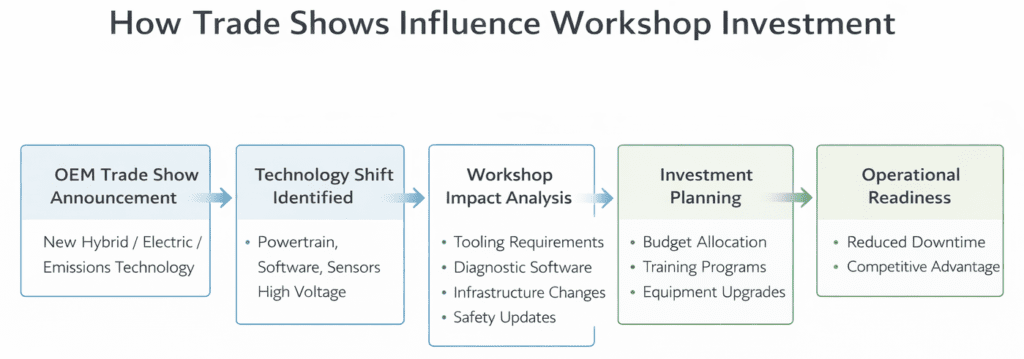
After reviewing heavy equipment trade show trends, managers should evaluate:
✔ Do we have updated diagnostic tools?
✔ Are technicians trained in hybrid and electronic systems?
✔ Is our workshop electrically compliant for high-voltage work?
✔ Are we budgeting for software subscriptions?
✔ Is our fleet strategy aligned with OEM direction?
If the answer to multiple questions is “no,” investment planning should begin.
The Risk of Ignoring Trade Show Signals
Workshops that ignore global OEM trends often face:
- Emergency tooling purchases
- Technician skill gaps
- Longer diagnostic time
- Increased downtime
- Higher warranty disputes
Preparation reduces operational shock.
Final Perspective
Heavy equipment trade shows are not just technology showcases.
They are forward-looking financial indicators.
For technicians, they signal skill development needs.
For managers, they signal investment timing.
For fleet owners, they signal modernization direction.
The question is not whether new technology will arrive.
The question is whether your workshop will be ready when it does.
FAQ Section
How do heavy equipment trade shows affect workshop budgets?
They reveal upcoming technology shifts that require new tools, training, software subscriptions, and infrastructure upgrades.
Should small workshops pay attention to global trade shows?
Yes. Even if adoption is delayed locally, preparation time improves financial stability and reduces future reactive costs.
How far ahead do trade shows forecast technology changes?
Typically 2–5 years ahead of widespread market adoption.