

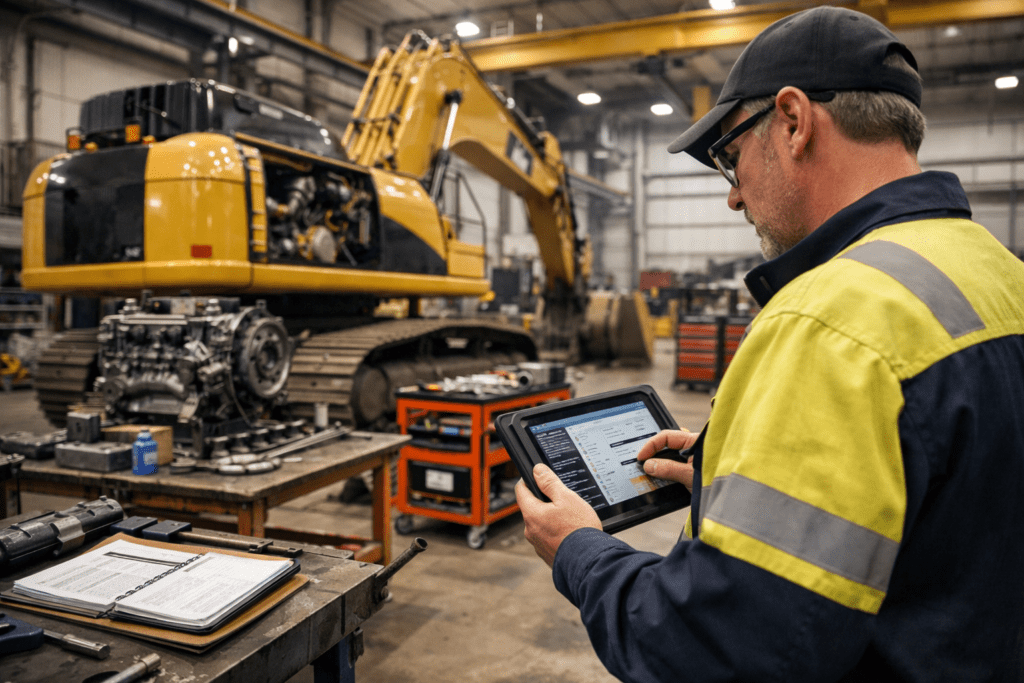
Heavy equipment workshop systems failures rarely begin with catastrophic mistakes.
They begin with small system weaknesses.
A missed verification step.
An undocumented deviation.
An assumption during diagnostics.
A rebuild process shortcut that “usually works.”
Over time, these gaps compound into repeat failures, rework, downtime, and operational risk.
In mining and construction environments where equipment uptime directly affects production targets, weak heavy equipment workshop systems carry significant financial consequences.
The problem is rarely technical capability.
It is systems integrity.
The Real Cause of Heavy Equipment Workshop Systems Repeat Failures
Most maintenance teams are technically skilled.
But technical skill alone does not guarantee reliability.
Repeat failures often originate from:
- Inconsistent inspection frameworks
- Unstructured diagnostic processes
- Lack of accountability during rebuild stages
- Poor documentation discipline
- Absence of independent verification before commissioning
When systems are weak, even good technicians produce inconsistent outcomes.
Reliability is not built through effort alone — it is built through structure.
Field-Level Skill vs System-Level Thinking
There is a difference between:
Repairing equipment
and
Designing maintenance systems that prevent failure.
Field-level skill focuses on:
• Component repair
• Assembly accuracy
• Torque values
• Measurements
System-level thinking focuses on:
• Workflow discipline
• Process verification
• Diagnostic accountability
• Risk identification
• Commissioning readiness
Workshops that operate at systems level reduce repeat breakdowns significantly.
Why Rebuilds Often Fail After Commissioning
Many rebuilds pass visual inspection.
They pass static checks.
They appear compliant.
Failures occur later because:
- Process deviations were not documented
- Contamination controls were inconsistent
- Diagnostic assumptions were not validated
- Verification checklists were incomplete
- No structured stage-gate review was implemented
These are system failures — not technician failures.
Fleet Reliability Begins in the Workshop
Fleet reliability is not built in the field.
It begins in:
- Maintenance planning
- Inspection protocols
- Documentation discipline
- Diagnostic process clarity
- Structured rebuild verification
When workshop systems are optimized, fleet reliability improves naturally.
When systems are reactive, downtime increases.
The Role of Independent Oversight
Internal teams are essential.
Independent structured review adds:
- Objective risk identification
- Process gap visibility
- Documentation discipline
- Accountability reinforcement
- Commissioning confidence
The goal is not criticism.
It is prevention.
In high-value mining and construction operations, prevention is always cheaper than failure.
Moving From Repair Culture to Reliability Culture
A repair culture reacts to breakdowns.
A reliability culture prevents them.
The transition requires:
• Structured workshop audits
• Diagnostic discipline
• KPI alignment
• Clear accountability
• Independent verification during high-risk rebuilds
Modern heavy equipment operations cannot rely solely on experience.
They require systems.
Frequently Asked Questions: Heavy Equipment Workshop Systems
What are heavy equipment workshop systems?
Heavy equipment workshop systems refer to the structured processes, inspection protocols, diagnostic workflows, documentation discipline, and accountability frameworks that govern how maintenance and rebuild work is performed.
Strong workshop systems ensure consistency, reduce repeat failures, and improve fleet reliability across mining and construction operations.
Why do heavy equipment rebuild failures repeat?
Rebuild failures often repeat due to system-level weaknesses rather than lack of skill.
Common causes include:
- Inconsistent inspection procedures
- Poor documentation of deviations
- Incomplete contamination control
- Diagnostic assumptions not verified
- Lack of structured commissioning review
Without structured workshop systems, small gaps compound into repeat breakdowns and costly downtime.
How do workshop systems affect fleet reliability?
Fleet reliability begins in the workshop.
When maintenance systems are structured, documented, and consistently verified, equipment returns to service with reduced risk exposure.
Strong workshop systems lead to:
- Improved rebuild integrity
- Fewer repeat failures
- Better diagnostic discipline
- Increased commissioning confidence
- More predictable equipment performance
Fleet reliability is not accidental — it is system-driven.
What is the difference between repair work and maintenance systems thinking?
Repair work focuses on fixing a specific component or failure.
Maintenance systems thinking focuses on preventing repeat failures by strengthening:
- Process control
- Inspection accountability
- Diagnostic verification
- Documentation standards
- Workflow discipline
Workshops operating at systems level reduce operational risk significantly compared to reactive repair environments.
When should a workshop conduct a systems audit?
A workshop should consider a structured systems audit when:
- Experiencing repeat rebuild failures
- Facing unexplained downtime trends
- Expanding operations or adding new technicians
- Preparing for commissioning high-value assets
- Seeking reliability improvement at management level
Early system evaluation prevents long-term operational cost escalation.
Can heavy equipment workshop systems be improved without major investment?
Yes.
Many reliability improvements come from process clarity rather than capital investment.
Improvements often involve:
- Clearer verification checklists
- Defined stage-gate rebuild reviews
- Diagnostic workflow standardization
- Improved documentation discipline
- Structured accountability alignment
Systems improvement typically delivers high return relative to co
Final Thought
These heavy equipment workshop system challenges are common across mining operations in Africa, Australia, the Middle East, and global fleet environments.
If repeat failures are occurring, the issue is rarely a lack of skill.
It is usually a lack of structure.
Workshops that modernize their maintenance systems reduce risk, protect asset value, and strengthen operational confidence.
Structured systems thinking is no longer optional in mining and heavy equipment environments.
It is operational survival.