

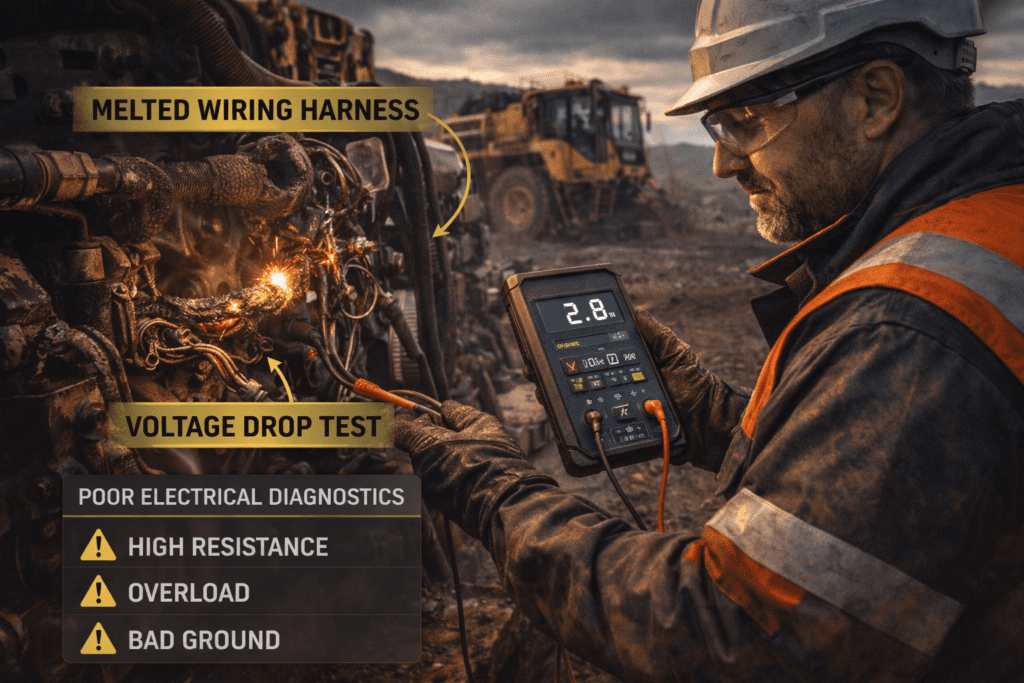
Wiring harness failures in heavy equipment are often blamed on “bad wiring,” vibration, or harsh mining conditions.
But in most cases, wiring harness failures in heavy equipment are caused by poor electrical diagnostics — not defective harnesses.
When electrical systems are misdiagnosed, technicians replace components instead of identifying the true root cause. The result?
- Wiring harness melting
- Connector burnout
- Repeated short circuits
- Sensor instability
- Expensive downtime
Electrical failures are rarely random.
They are predictable when tested correctly.
Why Wiring Harness Failures in Heavy Equipment Are Increasing
Modern mining equipment now includes:
- Multiple electronic control modules (ECM)
- CAN bus communication systems
- DEF dosing electronics
- Aftertreatment sensors
- High-current solenoids
- Electronic fuel systems
This increased electrical complexity means improper testing leads to:
- Voltage overload
- Ground faults
- High resistance heating
- Signal distortion
Poor diagnostic discipline directly causes repeat electrical failures.
Common Causes of Wiring Harness Failures in Heavy Equipment
Understanding root causes prevents unnecessary harness replacement.
1️⃣ Poor Voltage Drop Testing
One of the biggest mistakes in electrical troubleshooting heavy machinery is failing to perform proper voltage drop testing.
Instead, technicians:
- Check continuity only
- Replace components without load testing
- Ignore resistance under operating conditions
High resistance connections generate heat.
Heat causes:
- Insulation breakdown
- Connector melting
- Harness hardening
- Terminal corrosion
Continuity tests alone do not reveal high-resistance faults.
Voltage drop must be measured under load.
2️⃣ Ground Circuit Neglect
Ground faults are a major contributor to wiring harness melting causes.
Loose or corroded grounds lead to:
- Voltage imbalance
- Current backfeeding
- Overheating
- ECM instability
Before replacing a harness:
- Verify ground resistance
- Clean grounding points
- Inspect frame bonding
- Measure voltage drop across grounds
Electrical diagnostics mining equipment must begin with ground verification.
3️⃣ Overcurrent Conditions
Wiring harness failures heavy equipment cases often involve:
- Shorted solenoids
- Failing actuators
- Internally damaged sensors
- Improperly installed aftermarket components
When a component draws excessive current:
The harness overheats.
Replacing the harness without identifying the overcurrent source guarantees repeat failure.
4️⃣ Improper Repair Practices
Temporary repairs often lead to long-term damage.
Examples:
- Twisted wire repairs
- Incorrect crimping
- Mismatched wire gauge
- Poor insulation sealing
- Unsupported splices
Mining vibration amplifies weak repairs.
Professional harness repair must follow OEM standards.
5️⃣ Environmental Stress Misdiagnosed
Dust and vibration are blamed frequently.
However:
- Vibration alone does not melt wiring
- Dust alone does not cause overcurrent
Environmental stress reveals underlying electrical weakness.
If a harness fails repeatedly in the same area:
Investigate current draw and voltage drop — not just physical routing.
Structured Electrical Diagnostic Process
To prevent wiring harness failures in heavy equipment, apply structured diagnostics.
Step 1 – Confirm the Complaint
- What component failed?
- Was there visible melting?
- Did the ECM log overcurrent codes?
- Was derate active?
Document before clearing codes.
Step 2 – Measure Voltage Drop Under Load
Perform voltage drop testing on:
- Power supply circuits
- Ground circuits
- High-current solenoid feeds
- Injector circuits
Measure during operation — not static.
High resistance equals heat.
Heat equals harness damage.
Step 3 – Measure Current Draw
Use a clamp meter to verify:
- Solenoid current draw
- Actuator consumption
- Starter circuit load
- Aftertreatment heater current
Compare readings to OEM specification.
Excess current causes insulation breakdown.
Step 4 – Inspect Connector Integrity
Check:
- Terminal tension
- Corrosion
- Pin alignment
- Moisture ingress
- Locking tab integrity
Loose terminals create resistance and heat.
Electrical Diagnostic Checklist
| Diagnostic Area | What to Verify |
|---|---|
| Voltage Drop | Under-load measurement |
| Ground Integrity | Low resistance & clean bonding |
| Current Draw | Within OEM specification |
| Connector Condition | No corrosion or loose pins |
| Wire Gauge | Proper specification |
| Harness Routing | No stress or pinch points |
Using a structured checklist prevents repeat wiring harness failures in heavy equipment.
Why Harness Replacement Alone Fails
If wiring harness failures heavy equipment cases repeat:
The harness is not the root cause.
Common hidden causes:
- Overcurrent solenoids
- Improper alternator output
- Voltage regulator failure
- ECM grounding instability
- Improper jump-start procedures
Electrical systems must be tested as complete circuits — not isolated wires.
Mining Environment Considerations
Open pit mining environments introduce:
- Extreme vibration
- Dust accumulation
- Heat cycling
- Long idle times
- Heavy current demand
These factors amplify poor electrical diagnostics.
Maintenance discipline must match system complexity.
Frequently Asked Questions
What causes wiring harness melting in heavy equipment?
High resistance connections and overcurrent conditions are the most common causes.
Is continuity testing enough?
No. Voltage drop testing under load is required.
Can a bad ground cause harness failure?
Yes. Poor grounding leads to voltage imbalance and overheating.
How do I prevent repeat wiring harness failures?
Apply structured diagnostics:
- Measure voltage drop
- Verify current draw
- Inspect grounds
- Confirm connector integrity
- Avoid assumption-based replacement
Final Insight
Wiring harness failures in heavy equipment are rarely caused by “bad wiring.”
They are caused by poor electrical diagnostics.
Professional workshops measure voltage, current, and resistance under load before replacing components.
Electrical failures are predictable when tested correctly.
Without structured diagnostics, harness replacement becomes an expensive cycle.
Need Help With Recurring Electrical Failures?
Modern Trade Skills provides structured electrical diagnostics and root cause analysis consulting for mining and heavy equipment operations.
If your fleet is experiencing repeat wiring harness failures, request a diagnostic review through the Consulting page.