

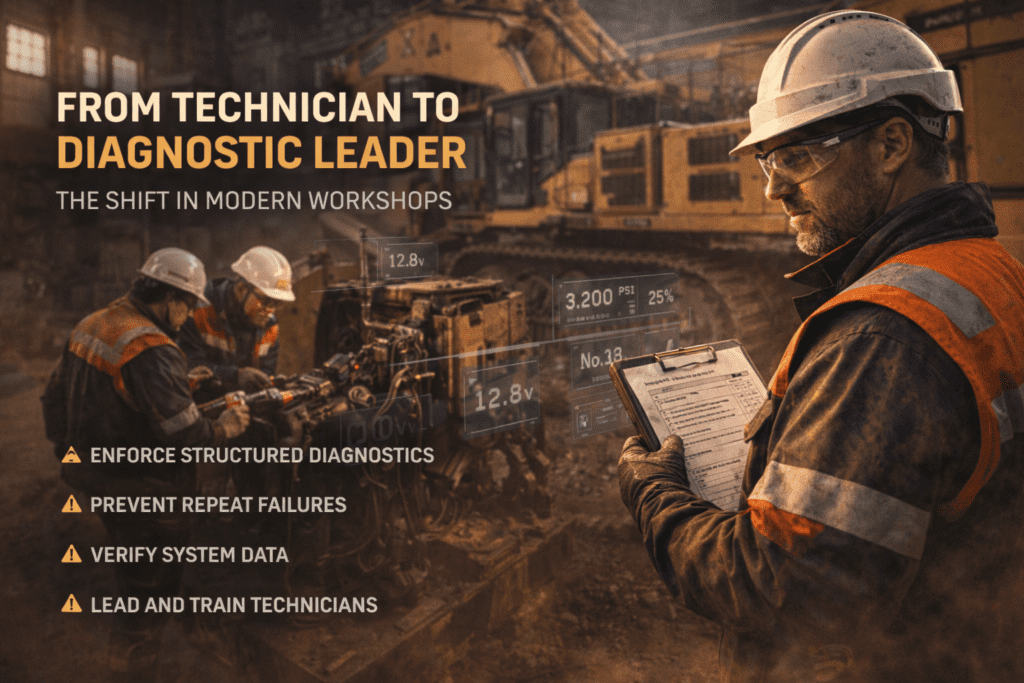
The modern heavy equipment workshop is changing.
Technical skill alone is no longer enough.
Today, the difference between an average technician and a diagnostic leader in heavy equipment workshops is not experience alone — it is structured thinking, system awareness, and leadership discipline.
The shift from technician to diagnostic leader defines the future of mining and heavy equipment maintenance.
The Old Model: Component Replacement
In traditional workshops, technicians were valued for:
- Fast fault finding
- Mechanical skill
- Experience-based decisions
- Component replacement speed
But as equipment evolved, so did failure patterns.
Tier 4 Final systems, CAN networks, hydraulic electronics, and advanced diagnostics changed the game.
Modern failures are system-driven — not component-driven.
The New Model: Diagnostic Leadership
A diagnostic leader in heavy equipment workshops does more than repair machines.
He or she:
- Enforces structured diagnostics
- Demands measured verification
- Prevents repeat failures
- Analyzes system interaction
- Coaches junior technicians
- Documents root causes
This is a leadership role — not just a technical one.
Why Modern Workshops Require Diagnostic Leaders
Mining equipment today integrates:
- Electronic control modules
- Emissions systems
- High-pressure hydraulic systems
- Complex electrical networks
- Data-driven monitoring
Without leadership enforcing structured diagnostics, workshops fall into:
- Assumption-based replacement
- Repeat turbo failures
- Recurring hydraulic pump damage
- Wiring harness melting
- Emissions system cycling
Diagnostic leadership eliminates reactive maintenance culture.
The Shift: From Tools to Systems Thinking
A technician focuses on:
What component failed?
A diagnostic leader asks:
What system condition caused this failure?
This shift changes everything.
Instead of reacting to symptoms, diagnostic leaders investigate root causes.
Instead of replacing parts quickly, they verify operating conditions.
Instead of clearing fault codes, they analyze data patterns.
Core Traits of a Diagnostic Leader in Heavy Equipment Workshops
1️⃣ Data Discipline
Diagnostic leaders insist on:
- Voltage drop testing
- Pressure verification
- Live data monitoring
- Oil sampling
- Load testing
Measured values must be obtained before conclusions are drawn.
2️⃣ Process Enforcement
Modern workshop leadership requires:
- Diagnostic checklists
- Failure documentation
- Post-repair verification
- Root cause logging
- Standardized troubleshooting steps
Without process enforcement, structured diagnostics collapse.
3️⃣ Mentorship and Culture Building
Diagnostic leaders:
- Train technicians in measurement discipline
- Correct shortcut behavior
- Promote systems thinking
- Encourage accountability
- Model calm troubleshooting under pressure
Leadership changes culture.
4️⃣ Operational Awareness
Mining workshop management must understand:
- Duty cycles
- Idle patterns
- Load variations
- Environmental stress
- Operator habits
Many failures originate from operational behavior.
Diagnostic leaders connect workshop findings to site conditions.
Technician vs Diagnostic Leader
| Technician | Diagnostic Leader |
|---|---|
| Fixes components | Investigates systems |
| Reacts to failure | Prevents repeat failure |
| Works individually | Leads team diagnostics |
| Focuses on repair | Focuses on root cause |
| Measures sometimes | Measures every time |
The transition from technician to diagnostic leader heavy equipment workshops is a mindset shift.
Why Repeat Failures Reveal Weak Leadership
If a workshop experiences:
- Repeated turbocharger failure
- Recurring hydraulic pump damage
- Wiring harness burnout
- Persistent Tier 4 Final failures
The issue is rarely technical ability alone.
It is diagnostic leadership.
Modern workshop leadership enforces:
- No assumption-based replacement
- No undocumented repairs
- No unverified system testing
Leadership determines reliability.
Building Diagnostic Leaders in Mining Workshops
To develop diagnostic leadership:
- Implement structured diagnostic processes
- Train technicians in measurement techniques
- Introduce failure analysis reviews
- Standardize troubleshooting documentation
- Review repeat failure patterns monthly
Leadership is developed intentionally.
It does not happen automatically with years of experience.
The Future of Heavy Equipment Maintenance Leadership
As equipment becomes more electronic and regulated:
Diagnostic leadership becomes essential.
Workshops that adopt structured diagnostics will:
- Reduce downtime
- Increase component lifespan
- Improve technician skill level
- Lower maintenance costs
- Build stronger reliability culture
Those that do not will continue cycling parts.
Frequently Asked Questions
What is a diagnostic leader in heavy equipment workshops?
A diagnostic leader enforces structured troubleshooting, verifies system data, and prevents repeat failures through disciplined process management.
How does a technician become a diagnostic leader?
By developing system-level thinking, enforcing measurement discipline, mentoring others, and implementing structured diagnostics.
Why is diagnostic leadership important in mining equipment maintenance?
Because modern equipment is system-integrated and requires coordinated troubleshooting across mechanical, hydraulic, electrical, and electronic systems.
Can experience alone create a diagnostic leader?
No. Experience must be combined with structured process discipline and leadership enforcement.
Final Insight
The shift from technician to diagnostic leader in heavy equipment workshops is not about rank.
It is about responsibility.
Modern mining maintenance requires:
- Systems thinking
- Data discipline
- Process enforcement
- Cultural leadership
Technicians repair machines.
Diagnostic leaders prevent repeat failure.
Need Help Developing Structured Diagnostic Culture?
Modern Trade Skills provides structured diagnostic framework development and workshop leadership consulting for mining operations.
If your workshop is struggling with repeat failures or inconsistent troubleshooting standards, request a diagnostic process review through the Consulting page.