

Diesel Engine Sensors
Why Sensors Matter in Modern Diesel Engines
Modern diesel engines rely heavily on sensors to monitor operating conditions in real time. These sensors protect the engine from damage, improve efficiency, and support accurate diagnostics. When a sensor fails or gives incorrect data, the engine may derate, shut down, or suffer serious damage.
Key Diesel Engine Sensors Explained
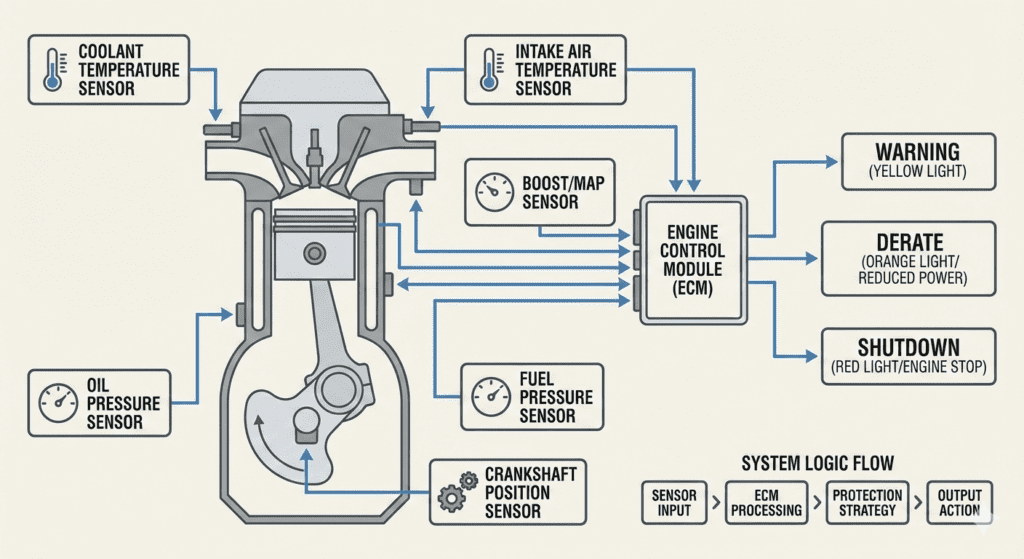
1. Coolant Temperature Sensor
- Monitors engine temperature
- Prevents overheating
- Triggers warnings, derate, or shutdown if limits are exceeded
Common faults: False overheating alarms, hard starting, engine shutdown
2. Oil Pressure Sensor
- Monitors lubrication system health
- Protects bearings, crankshaft, and camshaft
Engine protection response:
Low oil pressure → warning → derate → shutdown
3. Intake Air Temperature (IAT) Sensor
- Measures air temperature entering the engine
- Helps ECM adjust fuel delivery
Fault symptoms: Poor fuel economy, black smoke, reduced power
4. Boost / Manifold Absolute Pressure (MAP) Sensor
- Measures turbocharger boost pressure
- Ensures correct air-to-fuel ratio
Failure effect: Engine derate, loss of power, fault codes
5. Fuel Pressure Sensor
- Monitors low- or high-pressure fuel systems
- Protects injectors and fuel pump
Protection action: Fuel pressure out of range → engine derate or shutdown
6. Speed & Position Sensors (Crankshaft / Camshaft)
- Control injection timing and engine synchronization
Failure result: No start, misfire, or engine stall
Exhaust and Emission Sensors (Modern Diesel Engines)
Modern diesel engines use exhaust and emission sensors to meet environmental regulations while protecting engine and aftertreatment components. These sensors work together with the ECM to control combustion efficiency, exhaust temperature, and emission output.
Understanding exhaust and emission sensors is essential for technicians working on Tier 3, Tier 4, Euro 4–6, and EPA-compliant diesel engines.
7. Exhaust Gas Temperature (EGT) Sensors
EGT sensors monitor exhaust heat before and after the turbocharger, Diesel Oxidation Catalyst (DOC), Diesel Particulate Filter (DPF), and SCR system.
Purpose:
- Protect turbochargers from excessive heat
- Control DPF regeneration
- Prevent aftertreatment damage
Common Symptoms of Failure:
- Engine derate
- Regeneration faults
- False overheat warnings
8. Differential Pressure Sensor (DPF Pressure Sensor)
This sensor measures the pressure difference across the Diesel Particulate Filter.
Purpose:
- Detect soot loading in the DPF
- Trigger active or passive regeneration
- Prevent exhaust restriction
Failure Indicators:
- Frequent or failed regenerations
- Loss of power
- DPF warning lights
9. NOx Sensors
NOx sensors measure nitrogen oxide levels before and after the SCR catalyst.
Purpose:
- Control DEF injection
- Verify SCR efficiency
- Ensure emission compliance
Failure Symptoms:
- DEF-related fault codes
- Engine derate or shutdown
- Increased DEF consumption
10. Oxygen (Lambda) Sensor
Though more common in gasoline engines, oxygen sensors are used in some modern diesel applications to fine-tune combustion and emissions.
Purpose:
- Monitor air–fuel ratio
- Improve combustion efficiency
- Reduce exhaust emissions
11. Exhaust Back Pressure Sensor
This sensor monitors pressure in the exhaust system.
Purpose:
- Detect exhaust blockages
- Assist turbo and EGR control
- Protect the engine from excessive back pressure
Why Exhaust Sensors Are Part of Engine Protection
Exhaust and emission sensors are not just for environmental compliance — they actively protect:
- Turbochargers
- Valves and pistons
- Aftertreatment components
- The engine itself
When exhaust conditions become unsafe, the ECM may initiate:
- Engine derate
- Regeneration lockout
- Engine shutdown
Technician Tips for Emission Sensor Diagnostics
- Inspect sensor wiring near hot exhaust components
- Check for soot, moisture, and heat damage
- Verify sensor data with a diagnostic tool
- Never bypass emission sensors — this causes severe ECM faults
Engine Protection Strategies
When sensors detect abnormal conditions, the ECM may:
- Display warning lights
- Limit engine power (derate)
- Shut down the engine to prevent catastrophic damage
These systems are critical in mining, construction, and heavy-duty applications where engine failure is costly.
Best Practices for Technicians
- Always inspect wiring and connectors before replacing sensors
- Compare sensor data with known specifications
- Use diagnostic tools to confirm faults
- Never bypass engine protection systems
Why Apprentices Must Master Sensor Systems
Understanding sensors helps technicians:
- Diagnose faults faster
- Prevent unnecessary part replacement
- Protect engines from failure
- Work confidently with modern electronically controlled diesel engines.