

Tier 4 Final And Stage V Emission Systems Explained for Heavy Equipment Technicians
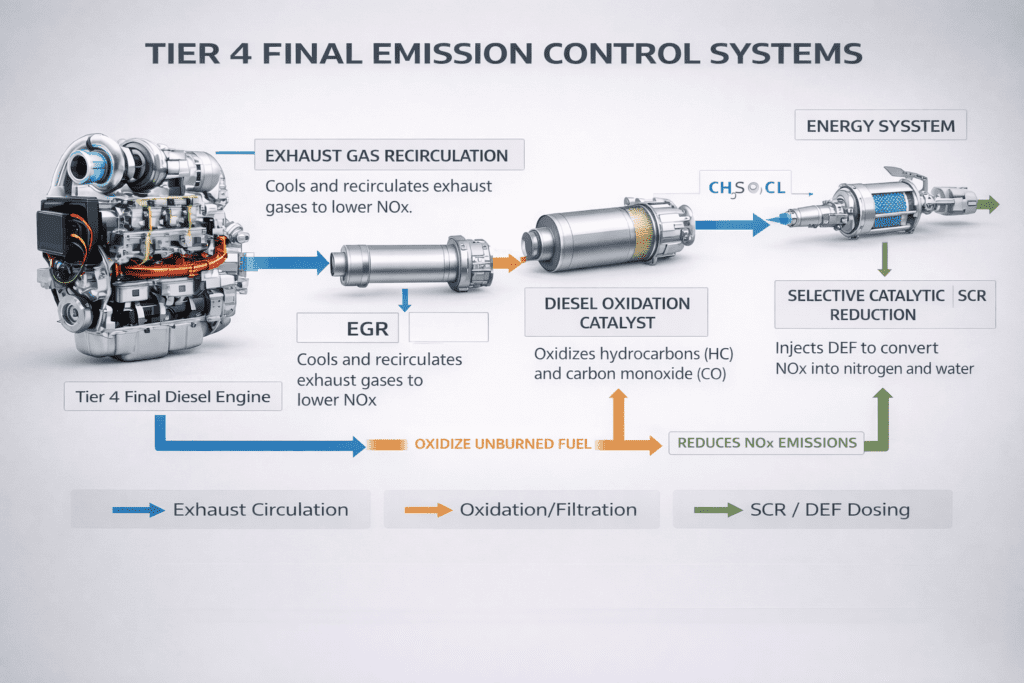
Introduction
Modern heavy equipment no longer runs on “simple diesel.”
Machines built by manufacturers like Caterpillar, Komatsu, and Volvo Construction Equipment now use advanced emissions systems to meet strict environmental regulations.
Two major global standards dominate today’s market:
- Tier 4 Final (primarily North America)
- Stage V (European Union and global markets)
For technicians, these systems introduce:
- EGR
- DOC
- DPF
- SCR
- DEF dosing
- NOx sensors
- Engine derate strategies
Understanding how these systems work — and fail — is critical to modern heavy equipment diagnostics.
1️⃣ What Is Tier 4 Final?
Tier 4 Final is a U.S. EPA emission systems regulation designed to reduce:
- Nitrogen Oxides (NOx)
- Particulate Matter (PM)
Compared to older Tier 3 engines, Tier 4 Final emission systems drastically reduced emissions by requiring aftertreatment systems.
To comply, manufacturers introduced:
- Cooled EGR
- Diesel Oxidation Catalysts (DOC)
- Diesel Particulate Filters (DPF)
- Selective Catalytic Reduction (SCR)
This transformed diesel engines into integrated emission-controlled systems.
2️⃣ What Is Stage V Emission System?
Stage V is the European equivalent of Tier 4 Final but even stricter.
Stage V:
- Tightens particulate number (PN) limits
- Requires DPF on nearly all diesel engines
- Expands regulation to smaller engine categories
Technicians working internationally must understand both systems — especially those seeking expat opportunities.
3️⃣ Core Components of Tier 4 Final / Stage V Emission Systems
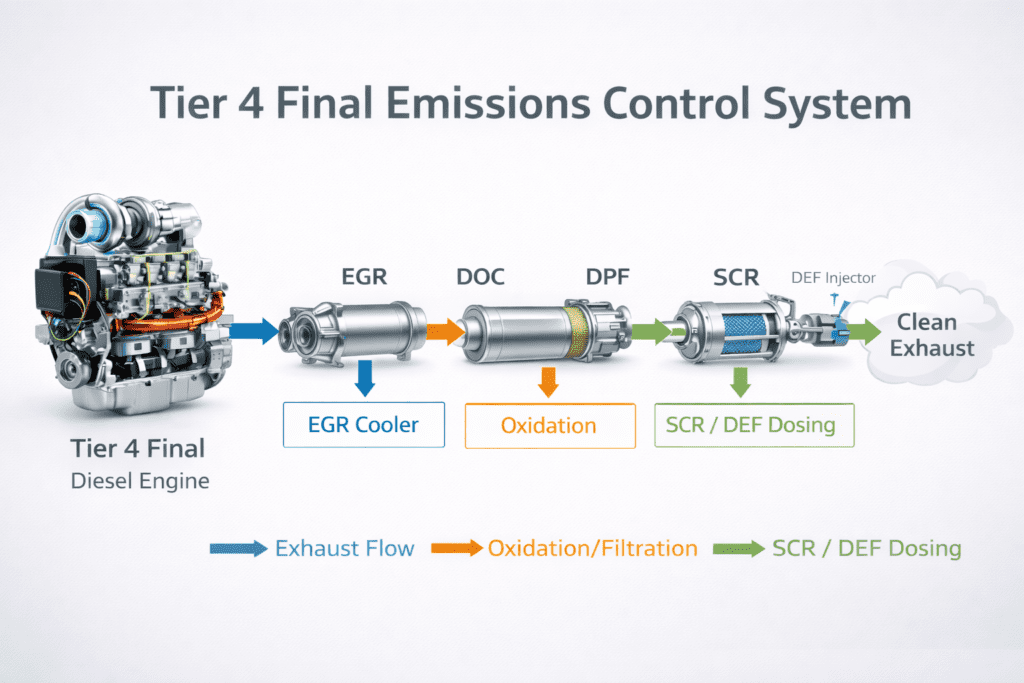
🔄 EGR (Exhaust Gas Recirculation)
Purpose:
- Reduces combustion temperature
- Lowers NOx formation
Common failures:
- Carbon buildup
- Stuck EGR valve
- Cooler leaks
- Fault codes related to flow imbalance
Symptoms:
- Rough running
- Excessive soot
- Engine derate
🔥 DOC (Diesel Oxidation Catalyst)
Purpose:
- Oxidizes unburned fuel
- Assists DPF regeneration
Failure causes:
- Contamination
- Thermal damage
- Fuel quality issues
🧱 DPF (Diesel Particulate Filter)
Purpose:
- Captures soot particles
Regeneration types:
- Passive
- Active
- Forced
Common technician issues:
- Excessive regeneration
- Plugged DPF
- Failed regen due to sensor faults
- Operator misuse (short duty cycles)
This is one of the most common service problems in modern fleets.
💧 SCR (Selective Catalytic Reduction)
Purpose:
- Injects Diesel Exhaust Fluid (DEF) to reduce NOx
Components include:
- DEF tank
- DEF pump
- Dosing injector
- NOx sensors
- SCR catalyst
Common failures:
- Crystallized DEF
- Blocked injector
- Failed NOx sensors
- Wiring corrosion
Improper DEF quality is a major cause of SCR issues.
4️⃣ Engine Derate Strategies
Modern engines protect emissions systems by derating power.
Derate can be triggered by:
- Failed NOx sensor
- DPF overload
- DEF system malfunction
- Temperature imbalance
- ECU detection of improper regen
Symptoms:
- Reduced power
- Limited RPM
- Machine shutdown warnings
Technicians must understand derate logic before replacing components unnecessarily.
5️⃣ Diagnostic Approach for Emissions Systems
Instead of guessing, follow a structured approach:
Step 1: Retrieve Fault Codes
Use OEM diagnostic software.
Step 2: Verify Sensor Data
Check:
- Exhaust temperature readings
- Differential pressure
- NOx values
- DEF pressure
Step 3: Inspect Physically
- Check wiring
- Look for leaks
- Inspect connectors
- Verify DEF quality
Step 4: Confirm Root Cause
Avoid replacing parts without confirming system failure.
6️⃣ Common Real-World Failure Scenarios
Scenario 1: Repeated DPF Regeneration
Cause:
- Low engine load
- Faulty temp sensor
- Excessive soot production
Scenario 2: DEF System Derate
Cause:
- Crystallization
- Frozen DEF
- Faulty dosing module
Scenario 3: NOx Sensor Failure
Cause:
- Heat damage
- Wiring corrosion
- Software calibration issue
Understanding system relationships prevents repeat failures.
7️⃣ Why Tier 4 Final & Stage V Matter for Your Career
Technicians who understand emissions systems:
✔ Command higher pay
✔ Qualify for OEM roles
✔ Work in international markets
✔ Handle advanced diagnostics
✔ Avoid being “parts changers”
The future of heavy equipment is emissions-integrated.
Ignoring emissions knowledge limits your career growth.
Conclusion
Tier 4 Final and Stage V systems have permanently changed diesel technology.
Modern heavy equipment engines are now:
- Mechanically complex
- Electronically controlled
- Emissions-integrated
- Sensor-dependent
Technicians must think beyond the engine block and understand the complete aftertreatment system.
In Day 4, we will break down the Common Rail Fuel System and high-pressure injection diagnostics