

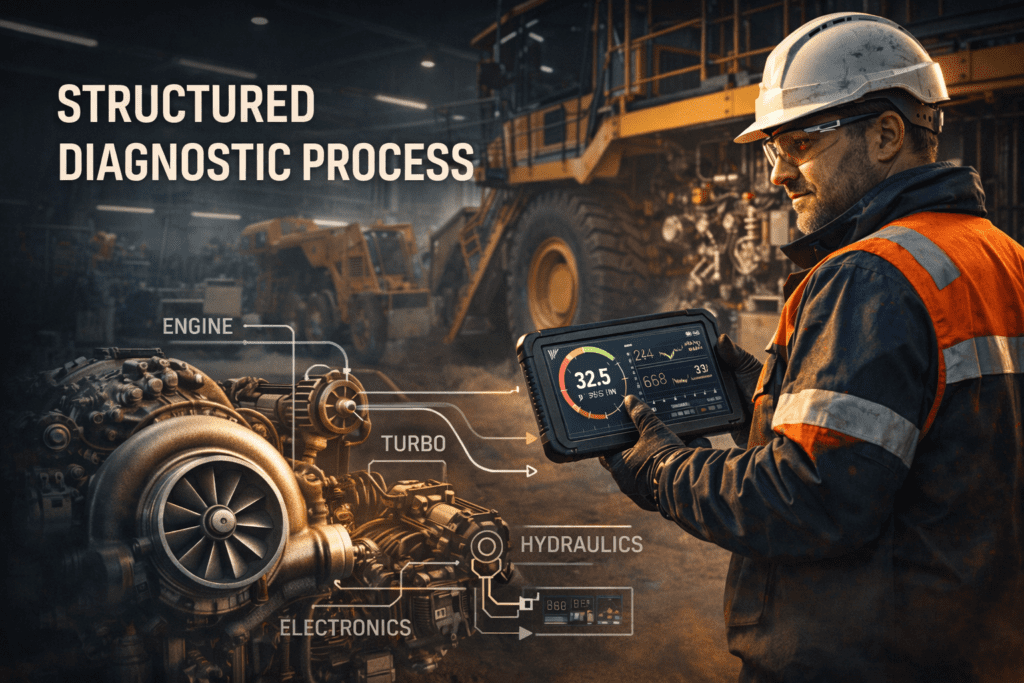
In modern mining and heavy equipment workshops, repeat failure is rarely caused by defective components.
It is caused by weak diagnostic discipline.
A professional heavy equipment diagnostic process is structured, measured, and system-based.
This article outlines a practical framework for eliminating guesswork and preventing recurring diesel and hydraulic failures.
Why Structured Diagnostics Matter in Heavy Equipment
Mining and construction machines operate under:
- Extreme load cycles
- High dust environments
- Long idle times
- Emissions-controlled engine systems
- Electronic control modules
Random troubleshooting no longer works.
Without structured troubleshooting, workshops experience:
- Turbocharger repeat failure
- Wiring harness damage
- Hydraulic pump destruction
- Transmission clutch burn
- Electrical system instability
These are not component problems.
They are process problems.
The Problem with Assumption-Based Troubleshooting
In many workshops, diagnostics follow this pattern:
- Identify visible symptom
- Replace suspected component
- Restart machine
- Return to operation
If the machine fails again, another component is replaced.
This is not root cause analysis.
It is parts substitution.
Structured troubleshooting diesel systems requires measured verification before replacement.
The Modern Heavy Equipment Diagnostic Process
Below is a practical framework designed for mining and industrial workshops.
Step 1 – Confirm the Complaint
Before touching the machine:
- What exactly failed?
- Under what operating condition?
- Was the failure gradual or sudden?
- Was load applied at the time?
- Were warning codes active?
The reported fault must be clearly defined.
Operating conditions must be confirmed.
Technicians must verify that the observed condition matches the initial complaint.
Without confirmation, diagnostics begin in the wrong direction.
Step 2 – Gather Measured Data
Professional diagnostics require numbers — not assumptions.
Obtain:
- Oil pressure (idle and load)
- Fuel pressure
- Boost pressure
- Exhaust backpressure
- Hydraulic system pressure
- Voltage and resistance readings
- Fault code history
Measured values must be obtained before conclusions are drawn.
Diagnostic tools must be used where applicable.
Modern equipment requires electronic analysis alongside mechanical inspection.
Step 3 – Analyze System Interaction
Heavy equipment systems do not operate independently.
For example:
- Low oil pressure affects turbochargers.
- Boost leaks affect exhaust temperature.
- Electrical faults affect fuel delivery.
- Hydraulic contamination affects pump lifespan.
Instead of asking:
Which component failed?
Ask:
What system condition caused this failure?
Root cause analysis begins at the system level.
Step 4 – Test Suspected Components Under Load
Assumption-based replacement is not permitted.
Before removing a component:
- Test it under operating conditions.
- Compare readings against manufacturer specifications.
- Verify supporting systems are within tolerance.
A failed turbo may be a symptom of:
- Oil contamination
- Intake restriction
- Exhaust blockage
- Crankcase pressure issues
Replacing it without testing ensures repeat failure.
Step 5 – Verify Operating Environment
Mining equipment operates in harsh conditions.
Confirm:
- Air filtration integrity
- Maintenance interval adherence
- Operator shutdown procedures
- Load patterns
- Ambient dust exposure
Environmental conditions influence failure patterns significantly.
Benefits of a Structured Diagnostic Framework
When workshops implement a structured heavy equipment diagnostic process:
- Repeat failures decrease
- Component lifespan increases
- Maintenance costs reduce
- Downtime improves
- Technician confidence increases
- Supervisor oversight strengthens
Structured troubleshooting diesel engines is not slower.
It is more efficient long term.
Leadership and Diagnostic Culture
The diagnostic process is not only technical.
It is managerial.
Supervisors must enforce:
- Data recording
- Measurement before replacement
- Documentation of failure patterns
- Post-repair verification tests
Without management support, structured diagnostics collapse into guesswork.
Professional workshops operate on discipline.
Case Pattern: Turbocharger Repeat Failure
In many mining workshops:
Turbo fails → Replace turbo → Fail again → Replace again.
When applying structured diagnostics:
Oil pressure measured → Found low under load → Oil restriction discovered → Root cause corrected → Turbo lifespan restored.
The component was not defective.
The system was.
Diagnostic Process vs Parts Replacement
| Parts Replacement | Structured Diagnostics |
|---|---|
| Symptom-driven | Data-driven |
| Assumption-based | Measured verification |
| Reactive | System-focused |
| Short-term fix | Long-term solution |
| High repeat failure | Controlled reliability |
Frequently Asked Questions
What is a heavy equipment diagnostic process?
It is a structured method of identifying system-level root causes using measured data before replacing components.
Why do mining workshops experience repeat failures?
Because supporting systems are not tested before replacement.
Is structured troubleshooting slower?
Initially yes.
Long term — it reduces downtime and repeat failures significantly.
Does this apply to Tier 4 and Stage V equipment?
Yes. Modern emissions systems make structured diagnostics even more critical.
Final Insight
Heavy equipment failures are rarely random.
They are predictable when measured correctly.
The difference between average workshops and professional operations is not experience alone.
It is process discipline.
If your workshop is experiencing repeat failures, the solution is not more parts.
It is structured diagnostics.
Need a Diagnostic Framework Review?
Modern Trade Skills provides structured troubleshooting and root cause analysis consulting for mining and heavy equipment workshops.
If your operation is experiencing repeat failures or rising maintenance costs, request a diagnostic process review through the Consulting page.