

Understanding Heavy Equipment Powertrain Systems: How Engine Power Reaches the Ground
Introduction
A diesel engine alone does not move a machine.
In heavy equipment, engine power must travel through a carefully engineered heavy equipment powertrain system before it reaches the wheels, tracks, or hydraulic components.
Machines from manufacturers like Caterpillar, Komatsu, and Volvo Construction Equipment use integrated powertrains that combine:
- Diesel engines
- Torque converters
- Transmissions
- Differentials
- Final drives
- Hydraulic pumps
Understanding this system is critical for accurate diagnostics and preventing repeat failures.
This guide explains how heavy equipment powertrain systems work — from crankshaft to ground contact.
1️⃣ What Is a Powertrain?
A heavy equipment powertrain system is the complete system that transfers engine power to perform useful work.
In heavy equipment, this may include:
- Mechanical drive systems (wheel loaders, trucks)
- Hydrostatic drive systems (skid steers)
- Diesel-electric systems (mining haul trucks)
- Engine-driven hydraulic systems (excavators)
The type of powertrain depends on machine application.
2️⃣ Mechanical Power Flow (Wheel Loaders & Trucks)
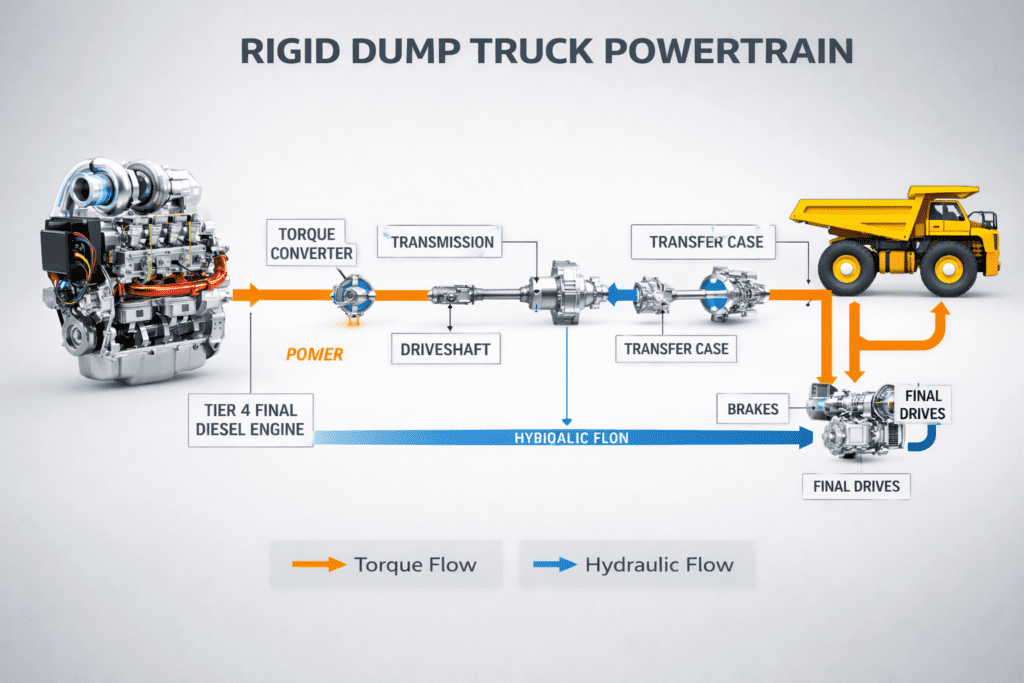
In mechanically driven machines, power flows like this:
Engine → Torque Converter → Transmission → Driveshaft → Differential → Final Drive → Wheels
🔧 Engine
Produces rotational torque.
🔄 Torque Converter
Multiplies torque and allows smooth load engagement.
Common issues:
- Slipping under load
- Overheating
- Low stall speed performance
⚙️ Transmission
Controls gear ratios to match load demand.
Failure symptoms:
- Harsh shifting
- Delayed engagement
- Loss of drive in certain gears
🛞 Final Drives
Increase torque before reaching wheels.
Common failures:
- Bearing damage
- Gear tooth wear
- Oil contamination
Technicians must inspect power flow stage by stage.
3️⃣ Hydrostatic Power Systems (Compact Equipment)
Hydrostatic systems use:
Engine → Hydraulic Pump → Hydraulic Motor → Final Drive
Instead of mechanical gears, hydraulic pressure transfers energy.
Advantages:
- Smooth speed control
- Strong low-speed torque
- Precise movement
Common problems:
- Weak travel
- Overheating hydraulic oil
- Pump cavitation
- Case drain leakage
Diagnostics must focus on:
- System pressure
- Flow rates
- Pump efficiency
4️⃣ Diesel-Electric Powertrains (Mining Equipment)
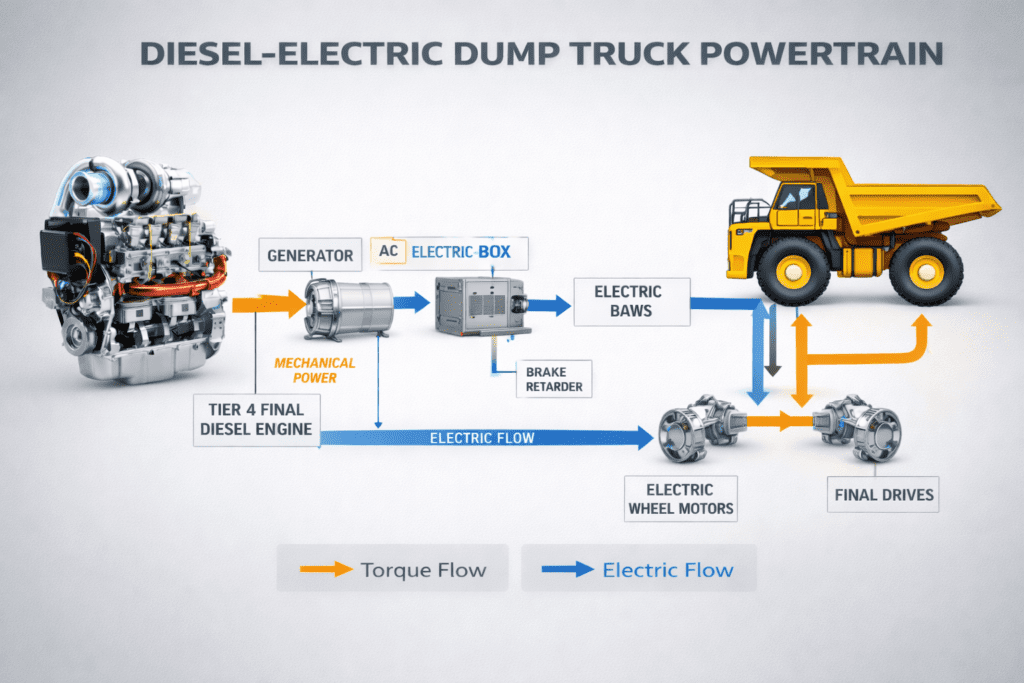
Large mining trucks use diesel-electric systems.
Power flow:
Engine → Generator → Electric Motors → Final Drives
The engine does not directly drive the wheels.
Advantages:
- Massive torque output
- Reduced mechanical wear
- Better control under heavy load
Technicians working in mining environments must understand:
- Generator output testing
- Motor insulation testing
- High-voltage safety
- Control module integration
This is the future direction of large-scale equipment.
5️⃣ Powertrain Integration with Hydraulics
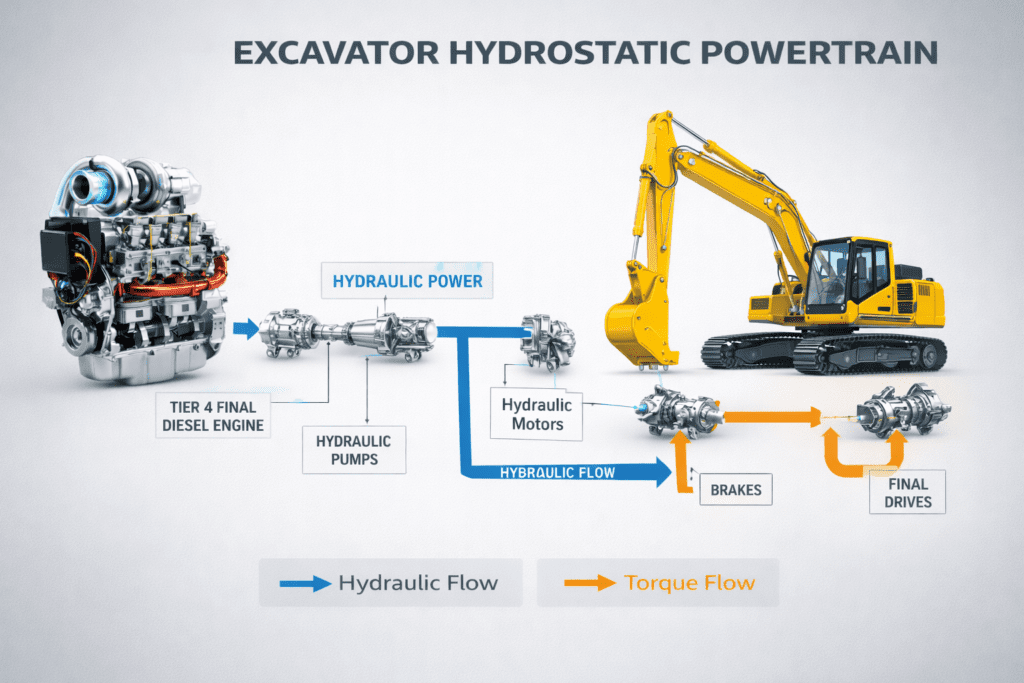
In machines like excavators:
The engine powers hydraulic pumps directly.
Hydraulic pumps convert rotational energy into:
- Boom movement
- Arm movement
- Swing motors
- Travel motors
Low engine power complaints are often:
NOT engine failures
But hydraulic load issues.
Example:
- Stuck relief valve
- Internal pump wear
- Excessive hydraulic leakage
Technicians must think in systems — not components.
6️⃣ Electronic Control of Modern Powertrains
Modern heavy equipment powertrains are electronically controlled.
Control modules manage:
- Shift timing
- Torque converter lock-up
- Traction control
- Engine load balancing
- Derate strategies
Systems communicate via CAN Bus networks.
If a sensor fails, the machine may:
- Limit speed
- Prevent gear changes
- Enter limp mode
Electrical diagnostics are now part of powertrain troubleshooting.
7️⃣ Common Powertrain Failure Symptoms
| Symptom | Possible Causes |
|---|---|
| Machine won’t move | Transmission failure, torque converter issue |
| Weak pushing power | Engine derate, hydraulic load issue |
| Overheating | Cooling failure, torque converter slip |
| Jerky movement | Electronic control fault |
| Noise under load | Final drive damage |
Root cause analysis is critical.
Changing parts without system diagnosis leads to repeat failures.
8️⃣ Why Powertrain Knowledge Is Critical for Technicians
Understanding the powertrain helps you:
- Diagnose correctly
- Prevent unnecessary engine rebuilds
- Identify hydraulic load issues
- Recognize derate conditions
- Communicate better with supervisors
In modern heavy equipment, everything is connected.
A power complaint is rarely just one component.
Conclusion
Heavy equipment powertrains transfer engine torque through:
- Mechanical systems
- Hydraulic systems
- Electric drive systems
- Electronic control modules
Modern technicians must understand:
- Torque multiplication
- Gear ratios
- Hydraulic efficiency
- Electrical communication
The engine produces power.
The powertrain delivers it.
In the next article, we will break down Tier 4 Final & Stage V emissions systems and how they impact engine performance.