
Monday to Saturday - 8:00 -17:30

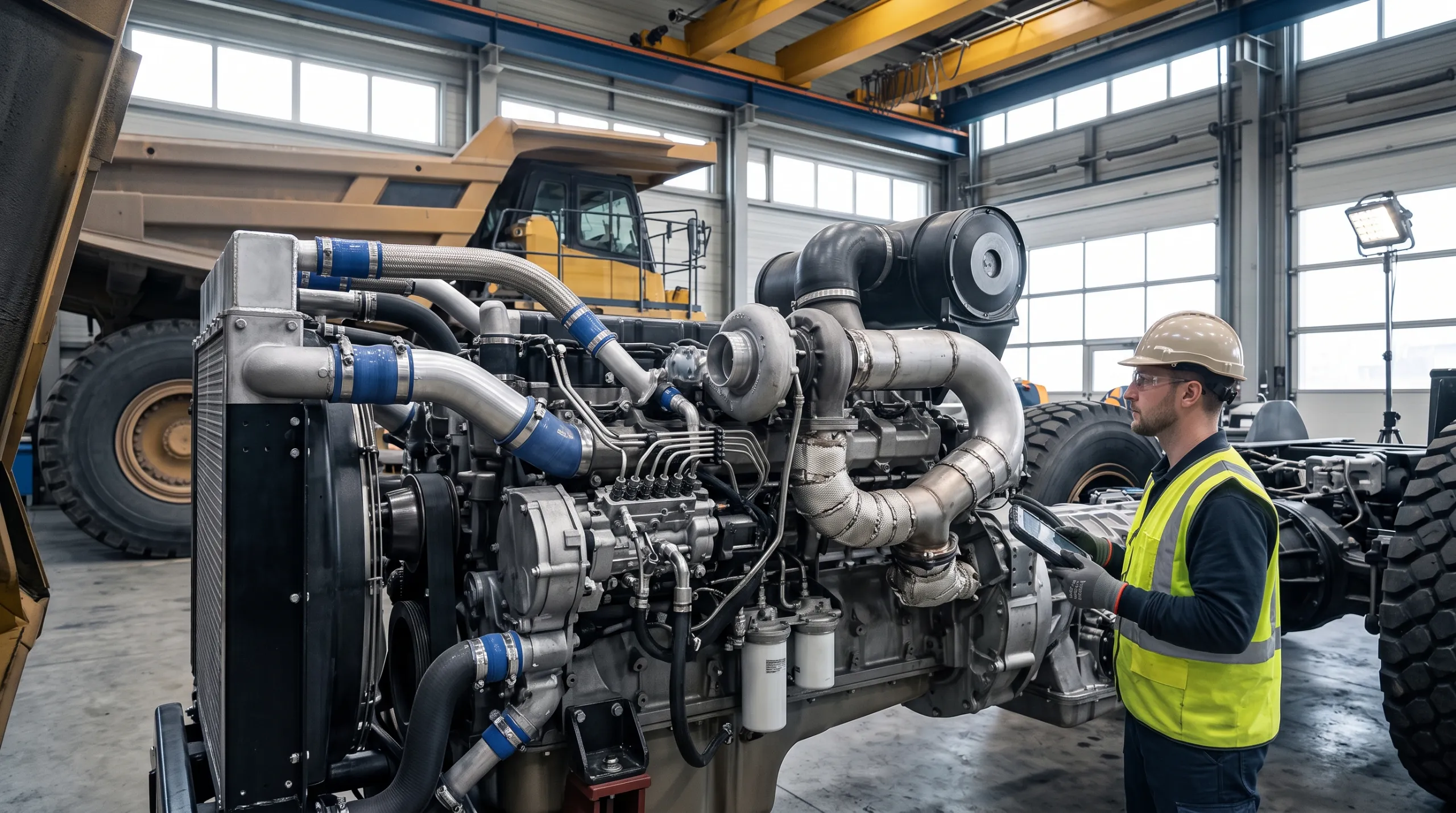
Picture a haul truck slowly climbing a steep ramp under a massive payload, or a large hydraulic excavator digging through hard rock. Where does the force required to perform that work actually come from?
The process begins with chemical energy stored in diesel fuel and ends as mechanical, hydraulic, or electrical work. Understanding how Modern Diesel Engines manage this energy transformation is fundamental for any developing heavy equipment technician.
This guide explains how engine power is created, controlled, and ultimately transferred to the machine to perform useful work.
Why Heavy Equipment Uses Diesel Engines
Historically, diesel engines have been one of the primary power sources for heavy machinery. There are several practical reasons why this engine design has remained so important in mining, construction, earthmoving, agriculture, and other industrial applications.
Diesel fuel stores a large amount of energy in a relatively compact volume, which makes it practical for equipment that must operate for long periods between refuelling.
Heavy-duty modern diesel engines are commonly designed to provide strong torque across the low-to-mid engine-speed range, which suits machines working under sustained load.
Diesel engines use compression ignition and generally operate with relatively high compression ratios. Their design can provide good thermal efficiency when operating under heavy loads.
Heavy-duty engine blocks, crankshafts, bearings, pistons, connecting rods, and cooling systems are engineered for demanding industrial duty cycles.
While hybrid, battery-electric, and other alternative power systems are increasingly being used in some applications, modern diesel engines remain an important part of much of today’s global heavy-equipment fleet.
The Four-Stroke Diesel Cycle
Every technician should understand the basic cycle that allows a modern diesel engine to convert fuel energy into mechanical work.
Most heavy-duty four-stroke diesel engines operate through four stages:
Intake → Compression → Power → Exhaust
Intake
The piston moves downward while the intake valve is open, allowing fresh air to enter the cylinder.
Where turbocharging is used, the incoming air may already have been compressed before reaching the intake manifold.
Compression
The intake valves close and the piston moves upward.
The trapped air is compressed into a much smaller space. This compression raises the temperature of the air inside the cylinder.
Power
Near the end of the compression stroke, diesel fuel is injected into the hot compressed air.
The fuel atomizes, mixes with oxygen, and begins to burn.
Combustion raises cylinder pressure, forcing the piston downward and producing the power stroke.
This is where the chemical energy stored in the fuel begins its transformation into mechanical energy.
Exhaust
The exhaust valve opens and the piston moves upward again, forcing the spent combustion gases out of the cylinder and into the exhaust system.
Where a turbocharger is fitted, some of the energy in the exhaust gas is used to drive the turbocharger turbine.
The cycle then begins again.
From Combustion to Crankshaft Torque
Understanding the four-stroke cycle is only the beginning.
The technician must also understand how pressure inside the cylinder becomes useful rotary motion.
Cylinder Pressure → Piston Force → Connecting Rod → Crankshaft Torque → Engine Output
Combustion does not directly turn the wheels of a truck or move the bucket of an excavator.
First, combustion pressure acts on the top of the piston.
The piston transfers this force through the connecting rod to the crankshaft.
The crankshaft converts the piston’s reciprocating movement into rotary motion.
That rotary motion provides the engine’s mechanical output.
A flywheel connected to the crankshaft helps smooth the individual power pulses and provides a connection point for transferring engine output to the machine powertrain.
This is an important concept:
The engine’s job is to convert fuel energy into controlled rotary mechanical power.
What happens to that power afterward depends on the design of the machine.
Air: The Engine Must Breathe
Modern diesel engines require sufficient clean air to burn fuel effectively.
The general air path may look like this:
Atmosphere → Air Cleaner → Turbocharger Compressor, where fitted → Charge-Air Cooler, where fitted → Intake Manifold → Cylinder
Air Filtration
Mining and construction environments often contain large amounts of dust.
Air-cleaning systems are therefore critical because abrasive contamination entering the engine can damage cylinders, piston rings, turbochargers, and other components.
Turbocharging
A turbocharger compresses incoming air so that a greater mass of air can enter the cylinders.
Charge-Air Cooling
Compressing air increases its temperature.
Where fitted, a charge-air cooler removes some of this heat before the air reaches the cylinders.
Cooler compressed air is denser and can contain more oxygen mass within a given volume.
More usable oxygen allows the engine control system to support additional fuel delivery and power production while remaining within designed operating limits.
Restrictions such as dirty air filters, damaged intake hoses, or charge-air leaks can reduce the amount of air reaching the engine and contribute to poor performance.
How Turbocharging Helps Produce More Power
A turbocharger uses energy from the engine’s exhaust gases.
Exhaust gas flows through the turbine side of the turbocharger and rotates a turbine wheel.
The turbine wheel is connected by a shaft to a compressor wheel on the intake side.
As the turbine rotates, the compressor also rotates and compresses fresh intake air before it enters the engine.
Because a greater mass of air can enter the cylinders, the engine can burn more fuel efficiently and produce more power within its operating limits.
Turbocharger arrangements vary depending on engine design.
They may include:
- fixed-geometry turbochargers
- wastegated turbochargers
- variable-geometry turbochargers
- multiple turbocharger arrangements
Variable-geometry turbochargers change the effective turbine flow area to control turbocharger response across different engine operating conditions.
The exact turbocharger design and control strategy depend on the engine manufacturer and application.
How Diesel Fuel Reaches the Cylinder
Fuel must be delivered at the correct time and quantity, and at sufficient pressure for the injection system to atomize and distribute it effectively.
A simplified fuel pathway is:
Fuel Tank → Water Separation / Filtration → Supply System → Pressure Generation → Injector → Combustion Chamber
Heavy-equipment engines use different fuel-system designs depending on their age, manufacturer, application, and emissions requirements.
Mechanical Injection
Mechanical fuel systems use mechanically driven pumps and governors to generate injection pressure, meter fuel, and control injection timing.
These systems remain common on many older machines still operating around the world.
Unit Injector Systems
Unit injector systems combine the pumping element and injector into one assembly.
Depending on the design, a camshaft may provide the mechanical force required to create injection pressure.
Electronic Unit Injector systems add electronic control over the injection event.
Hydraulic-Electronic Unit Injectors
Hydraulic-Electronic Unit Injector systems, commonly known as HEUI systems, use pressurized engine oil to provide the hydraulic force required to generate injection pressure inside the injector.
Electronic controls determine when injection occurs.
High-Pressure Common Rail
High-Pressure Common Rail systems use a high-pressure pump to supply fuel to a shared rail.
Electronically controlled injectors then meter fuel from that rail into individual cylinders.
Common rail is widely used on many newer, modern diesel engines, but it is not the only fuel-system design technicians will encounter.
Regardless of architecture, modern precision fuel systems depend on clean, water-free fuel and filtration that meets the engine manufacturer’s specifications.
Modern Electronic Fuel Control
On electronically controlled modern diesel engines, the Engine Control Module, commonly called the ECM or ECU, manages engine functions using sensor inputs and programmed control strategies.
Depending on the engine, the control module may monitor parameters such as:
- engine speed
- coolant temperature
- oil pressure
- accelerator or throttle demand
- intake manifold or boost pressure
- fuel pressure
- atmospheric conditions
- machine load information
Using this information, the ECM may control functions such as:
- fuel quantity
- injection timing
- injector actuation
- turbocharger control where applicable
- emissions-related functions where applicable
- engine protection and derating strategies
The exact control strategy varies between manufacturers and applications.
Technicians must therefore use the correct OEM technical information when diagnosing a particular machine.
A fault code can point toward an abnormal condition, but it does not automatically identify the failed component.
Cooling and Lubrication Keep the Modern Diesel Engines Alive
Combustion produces useful mechanical power, but it also creates significant heat and mechanical loading.
Without effective cooling and lubrication, the engine cannot survive sustained heavy-duty operation.
Cooling
The cooling system transfers unwanted heat away from engine components.
Depending on engine design, the system may include:
- coolant
- water pump
- thermostat
- radiator
- cooling fan
- oil cooler
- coolant passages through the block and cylinder head
The water pump circulates coolant through the engine.
The thermostat helps regulate operating temperature by controlling coolant flow according to system design.
The radiator transfers heat from the coolant to surrounding air.
If an engine operates outside its designed temperature range, reliability and component life can be affected.
Some heavy-duty engines use wet cylinder liners. These engines may require correctly maintained coolant chemistry to protect against corrosion and cavitation.
The exact coolant specification and maintenance procedure must come from the engine manufacturer.
Lubrication
The lubrication system supplies oil to critical moving components.
Engine oil may perform several functions:
- reducing friction
- helping remove heat
- carrying contaminants toward the filtration system
- protecting metal surfaces
- lubricating bearings and valve-train components
- cooling pistons where oil jets are used
- lubricating turbochargers where applicable
Under suitable operating conditions, components such as crankshaft journals can operate on a hydrodynamic oil film rather than direct metal-to-metal contact.
Correct oil specification, oil level, filtration, pressure, and maintenance intervals are therefore critical to engine reliability.
How Engine Power Reaches the Machine
This is one of the most important concepts for a developing technician.
Modern Diesel Engines produce rotary mechanical power at the crankshaft, but different machines use that power in different ways.
1. Mechanical Drivetrain
A simplified mechanical drivetrain may look like this:
Engine → Torque Converter or Clutch → Transmission → Driveshaft → Differential / Final Drives → Wheels
Many haul trucks, wheel loaders, graders, and other mobile machines use variations of mechanical or hydromechanical drivetrains.
The transmission and final drive systems change the relationship between engine speed, machine speed, and available torque.
The exact arrangement depends on machine design.
2. Hydraulic Systems
A simplified hydraulic power path may look like this:
Engine → Hydraulic Pump → Hydraulic Flow and Pressure → Control Valves → Cylinders or Motors → Machine Movement
Excavators, drills, loaders, cranes, and many other machines depend heavily on hydraulics.
Modern diesel engines do not directly raise an excavator boom.
Instead, the engine drives one or more hydraulic pumps.
Those pumps convert mechanical input power into hydraulic power.
Control valves then direct hydraulic energy to cylinders and motors that perform the required work.
This is why a machine can suffer poor digging or lifting performance even when the diesel engine itself is operating correctly.
3. Diesel-Electric Drive
Some large mining haul trucks use diesel-electric drive systems.
A simplified energy pathway is:
Engine → Alternator / Generator → Electrical Power → Traction Motors → Machine Movement
The modern diesel engines drive alternators or generators.
Electrical power is then supplied through the machine’s electrical drive system to traction motors that propel the truck.
The engine still provides the original mechanical power, but electricity becomes the method used to transfer that power to the drive wheels.
Torque and Power: What Is the Difference?
Technicians frequently hear the words torque and power.
They are related, but they do not mean the same thing.
Torque is twisting effort applied to a rotating shaft.
Power describes the rate at which work can be performed.
A heavy-equipment machine does not depend on engine torque alone.
Useful machine performance depends on several interacting factors, including:
- engine torque
- engine speed
- transmission gearing
- hydraulic or electrical conversion
- machine control strategies
- traction
- implement design
- the physical load being applied
Understanding this prevents technicians from blaming the engine every time a machine feels weak.
What Happens When the Operator Demands More Power?
Consider an excavator working in hard material.
The operator commands the bucket to curl into the face.
The hydraulic system encounters increased resistance.
Machine load rises.
Depending on the machine design, the engine and hydraulic controllers detect changes in operating conditions and respond accordingly.
The engine-control system may adjust fuel delivery to maintain the required engine speed and output.
Exhaust energy and turbocharger airflow may also change as engine load increases.
At the same time, the hydraulic system uses the available engine power to provide the flow and pressure required by the working circuit.
Cooling demand and fuel consumption may also increase as the machine performs more work.
The exact response depends on the engine, hydraulic pump-control strategy, electronic controls, and machine manufacturer.
The important principle is that engine and machine systems work together to respond to changing load.
“The Machine Has No Power” Does Not Always Mean an Engine Fault
One of the most important lessons for a developing technician is this:
A low-power complaint is a machine-system complaint until testing proves where the loss occurs.
Possible causes of a low-power complaint can include:
- restricted engine air supply
- fuel-delivery problems
- charge-air leaks
- engine derating
- turbocharger problems
- transmission faults
- hydraulic problems
- drivetrain resistance
- electrical or control-system faults
- operator technique
- extreme application conditions
A technician should therefore ask:
Is the engine failing to produce power, or is the machine failing to transfer the available engine power?
That question can completely change the direction of a diagnosis.
It is also a core Modern Trade Skills diagnostic principle.
Chief Engineer’s Diagnostic Case: The Turbocharger Was Not the Problem
During an actual field diagnosis, a wheel loader operator reported that the machine lacked power while digging into a pile. An exhaust-temperature warning was also appearing.
Initial testing showed that boost pressure was lower than expected when the machine was working under load.
At this stage, it would have been easy to condemn the turbocharger.
A parts-changing approach might have resulted in an expensive turbocharger replacement without proving that the turbocharger itself had failed.
Instead, the complete charge-air system was tested.
Using an appropriate regulated test method and following safe pressure-testing practices, the charge-air circuit was checked for leakage.
The problem was found at the charge-air cooler.
A split seam in the cooler allowed compressed air to escape before it could reach the engine.
The turbocharger was producing airflow, but part of that airflow was being lost between the turbocharger and the engine intake.
After the charge-air leak was repaired and machine operation was validated, boost performance and digging power were restored.
The lesson was simple:
The symptom was low engine power.
The root cause was an air-system leak.
The turbocharger was not the problem.
This case demonstrates why technicians must test complete systems instead of replacing the component that appears most closely connected to the symptom.
Pressure testing of charge-air systems must always follow appropriate OEM procedures, tooling requirements, and safe pressure limits.
Common Causes of Modern Diesel Engines Power Loss
When a diesel engine genuinely fails to produce the required power, the cause may come from several systems.
Air System Problems
Examples include:
- restricted air filters
- collapsed or damaged intake hoses
- charge-air leaks
- damaged charge-air coolers
Fuel System Problems
Examples include:
- contaminated fuel
- water in fuel
- restricted fuel supply
- damaged pumps
- injector faults
- incorrect fuel pressure
Turbocharger Problems
Possible issues include:
- damaged compressor or turbine components
- lubrication problems
- actuator faults
- control problems
- excessive restriction elsewhere in the air or exhaust system
Cooling and Lubrication Problems
High temperature, low oil pressure, or other protection-related conditions may cause the engine-control system to limit available power.
Electrical and Electronic Problems
Possible causes include:
- failed sensors
- damaged wiring
- poor electrical connections
- controller communication faults
- incorrect sensor information
- active engine-protection strategies
Exhaust Restrictions
Where applicable, restrictions in the exhaust or aftertreatment system can also affect engine performance.
The important point is that low power is a symptom, not a diagnosis.
What Modern Diesel Engines Mean for Technicians
Heavy-equipment technicians increasingly need both mechanical and electronic diagnostic skills.
A modern technician should understand:
- mechanical engine fundamentals
- fuel systems
- air systems
- turbocharging
- cooling systems
- lubrication
- electrical schematics
- sensors
- actuators
- diagnostic software
- live data
- machine communication systems
- disciplined physical testing
Being good with tools is no longer enough.
Being good with a diagnostic laptop is also not enough.
The laptop does not replace the wrench, and the wrench does not replace the laptop.
Both are diagnostic tools.
Professional diagnostic ability comes from understanding the system, gathering evidence, performing appropriate tests, and identifying the root cause before replacing components.
That is what Modern Trade Skills means by:
Developing Diagnostic Leaders, Not Parts Changers.
Frequently Asked Questions About Modern Diesel Engines
1. Why are modern diesel engines widely used in heavy equipment?
Modern Diesel engines combine good fuel efficiency under heavy load, strong torque characteristics at relatively low engine speeds, durable industrial construction, and an established global fuel and service infrastructure.
2. How do modern diesel engines ignite fuel without spark plugs?
A diesel engine uses compression ignition.
The piston compresses the intake air, raising its temperature. Fuel is then injected into this hot compressed air, where it begins to burn without requiring a conventional spark plug.
3. What does a turbocharger do?
A turbocharger uses energy from the exhaust gases to drive a turbine connected to an intake compressor.
The compressor increases the mass of air entering the engine, allowing the engine to burn more fuel efficiently and produce additional power within its operating limits.
4. Why does a charge-air cooler help engine performance?
Air becomes hotter when compressed.
A charge-air cooler removes some of that heat before the air enters the engine.
Cooler compressed air is denser and can provide more oxygen mass, which can support cleaner combustion and higher power output within the engine’s operating limits.
5. What is common-rail fuel injection?
High-Pressure Common Rail is a fuel-system design in which a high-pressure pump supplies fuel to a shared rail.
Electronically controlled injectors then meter fuel from that rail into individual engine cylinders.
6. Do all modern diesel engines use common rail?
No.
Technicians working on global heavy-equipment fleets may encounter mechanical injection systems, unit injector systems, HEUI systems, common-rail systems, and other manufacturer-specific designs.
7. What is the difference between torque and power?
Torque is twisting effort applied to a shaft.
Power describes how quickly work can be performed.
Machine performance depends on both, together with gearing, hydraulic or electrical systems, controls, and operating load.
8. Can a hydraulic fault make an operator think the engine has low power?
Yes.
A hydraulic pump, valve, control, or other hydraulic-system problem can cause weak digging, lifting, or travel performance even when the diesel engine is producing normal power.
This is why technicians must determine whether the problem is power production or power transfer.
9. Why are modern diesel engines electronically controlled?
Electronic controls allow manufacturers to precisely manage fuel delivery, engine protection, performance, emissions functions where required, and the engine’s response to changing operating conditions.
Final Message: Follow the Energy
When you stand beside a piece of heavy equipment, learn to see more than individual components.
See an energy pathway:
Fuel → Combustion → Piston Force → Crankshaft Torque → Machine Power System → Useful Work
When the machine develops a performance problem, follow that pathway.
Ask:
Where is energy being created?
Where is it being controlled?
Where is it being transferred?
Where is it being restricted?
Where is it being lost?
A developing technician who learns to ask those questions is beginning to move beyond component replacement and toward true systems diagnosis.
That is systems thinking.
That is the beginning of becoming a Diagnostic Leader.
References and Further Reading
For machine-specific specifications, diagnostic procedures, pressure limits, fluid requirements, and repair procedures, technicians should consult the appropriate manufacturer’s Operation and Maintenance Manual, service information, and technical documentation.
Useful technical reference organizations and manufacturers include:
- SAE International for diesel-engine and powertrain engineering resources
- engine and equipment manufacturer technical literature such as Cummins
- applicable government environmental agencies for emissions requirements
- OEM service documentation for specific engine and machine systems. Komatsu has a good explanation.
Modern Trade Skills Institutional Reference
Modern Trade Skills Handbook Version 1.0
Institutional reference for the Modern Trade Skills Diagnostic Leader philosophy, systems-thinking framework, and technician-development principles.