

Heavy Equipment Explained: Construction, Mining, Agricultural, Forestry & Railway Machines
Introduction
Heavy equipment and machinery are the backbone of modern infrastructure, resource extraction, food production, forestry operations, and transportation networks. Roads, railways, mines, farms, and forests would not function at scale without powerful machines designed to dig, lift, haul, cut, level, drill, and transport massive loads under harsh working conditions.
For beginners entering the heavy equipment field—or experienced tradespeople transitioning into machine operation, maintenance, inspection, or supervisory roles—understanding the different categories of heavy equipment and where they are used is the first critical step. This article provides a clear, structured overview of heavy machinery used in:
- Construction
- Mining
- Agriculture
- Forestry
- Railway and rail infrastructure
This foundational knowledge supports everything that follows in later articles on diesel engines, hydraulics, transmissions, diagnostics, and maintenance.
What Is Heavy Equipment?
Heavy equipment refers to large, mechanically powered machines designed to perform tasks that exceed human or light machinery capability. These machines are built for high loads, continuous operation, and extreme environments, often operating 10–24 hours per day.
Common characteristics of heavy equipment include:
- High-torque diesel engines
- Hydraulic systems for movement and force
- Heavy-duty steel frames
- Advanced transmissions for load handling
- Designed for rugged terrain and harsh climates
- High capital cost requiring skilled operation and maintenance
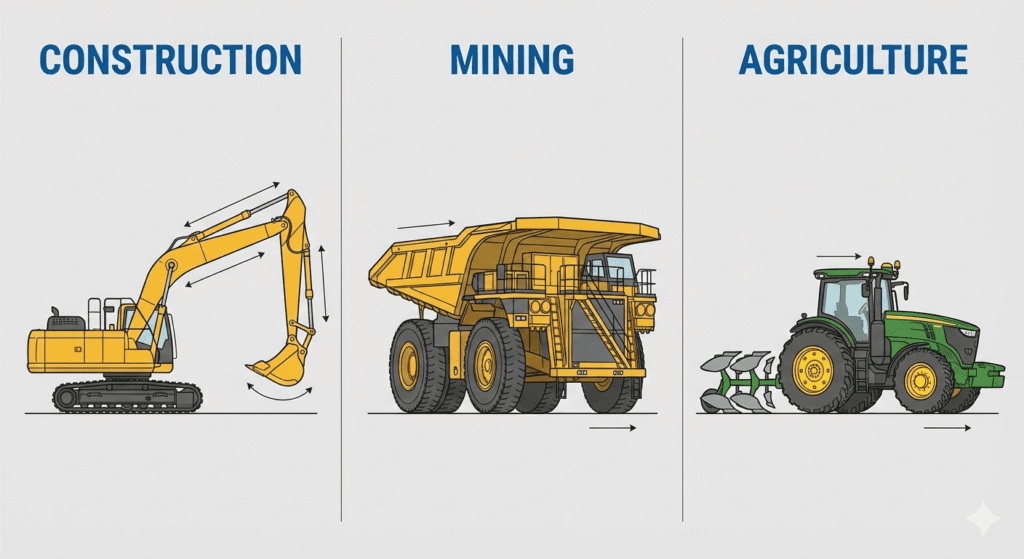
Major Industries That Use Heavy Equipment
Construction Industry
Construction machinery is designed for:
- Earthmoving and excavation
- Road and bridge construction
- Building foundations
- Urban and industrial infrastructure
Key requirements include versatility, mobility, precision control, and strict safety compliance.
Mining Industry
Mining equipment operates in some of the harshest conditions on earth, including open-pit mines, underground operations, and quarries.
Key requirements include extreme durability, very high payload capacity, continuous duty cycles, and ease of maintenance to reduce downtime.
Agricultural Industry
Agricultural machinery supports food production through:
- Soil preparation
- Planting and harvesting
- Crop transport
- Livestock and irrigation operations
Reliability, fuel efficiency, and compatibility with attachments are essential due to seasonal workloads.
Forestry Industry
Forestry equipment is specialized for wood harvesting and land management in rough, uneven, and remote terrain.
Used for:
- Tree felling
- Log processing
- Timber extraction
- Forestry road construction and maintenance
Railway and Rail Infrastructure Industry
Railway equipment is essential for:
- Track construction and alignment
- Ballast handling and compaction
- Rail and sleeper installation
- Maintenance of existing rail networks
Precision, safety, and compliance with rail standards are critical in this sector.
Heavy Equipment Categories by Function
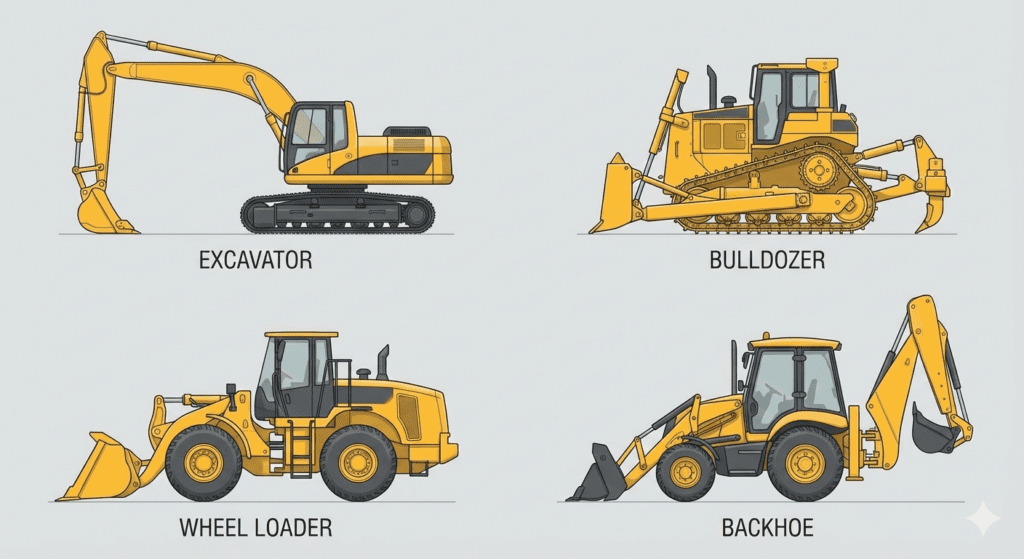
Excavators
Primary Function: Digging, trenching, lifting, and demolition.
Used in:
- Construction foundations and utilities
- Mining overburden removal
- Forestry land clearing
- Railway drainage and culvert installation
Key features:
- Hydraulic boom, arm, and bucket
- 360-degree rotating upper structure
- Tracked or wheeled undercarriage
Bulldozers
Primary Function: Pushing material, grading, and land clearing.
Used in:
- Construction site preparation
- Mining overburden management
- Forestry access road development
- Railway embankment construction
Wheel Loaders
Primary Function: Loading and short-distance material handling.
Used in:
- Construction aggregate handling
- Mining ore loading
- Forestry log yards
- Railway ballast loading
Backhoe Loaders
Primary Function: Multi-purpose digging and loading.
Used in:
- Construction and municipal work
- Small-scale agriculture
- Railway maintenance and drainage works
Motor Graders
Primary Function: Precision grading and leveling.
Used in:
- Road construction
- Mining haul road maintenance
- Forestry access roads
- Railway subgrade preparation
Dump Trucks (Rigid and Articulated)
Primary Function: Hauling bulk material.
Used in:
- Construction earthworks
- Mining haulage
- Forestry timber transport
- Railway embankment construction
Drill Rigs and Drilling Equipment
Drill rigs are a specialized category of heavy equipment designed to drill holes into soil, rock, or concrete for exploration, construction, mining, and infrastructure projects. Unlike general earthmoving machinery, drill rigs focus on depth accuracy, penetration power, and borehole stability.
Drill rigs are essential in:
- Mining exploration and production
- Construction foundation work
- Geotechnical investigations
- Water well drilling
- Railway bridges, tunnels, and track foundations
- Quarrying and blasting operations
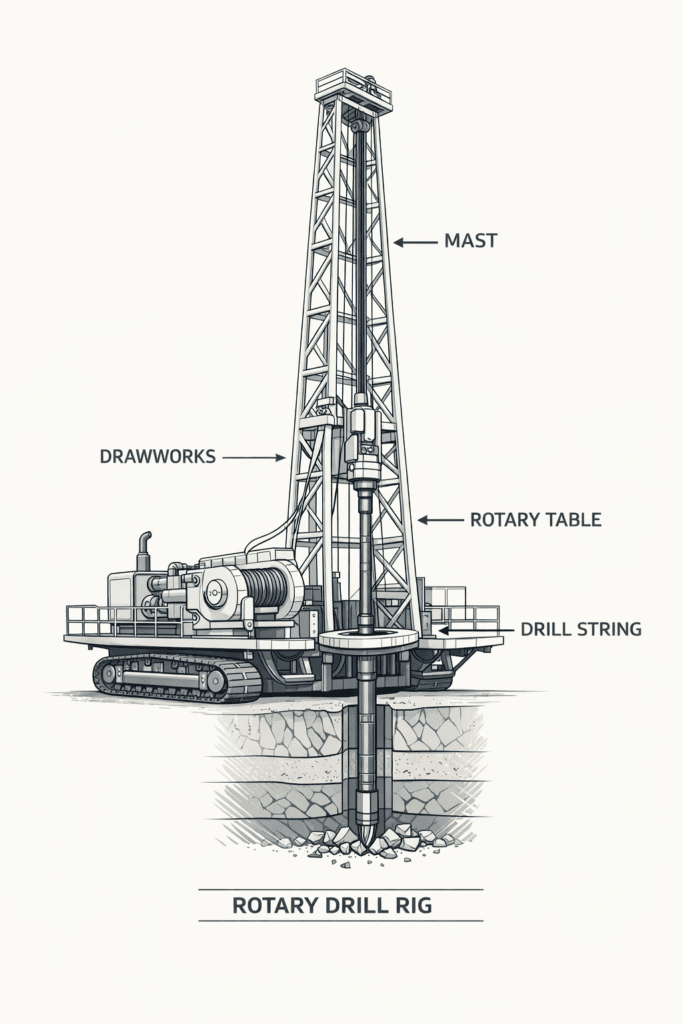
Types of Drill Rigs
Rotary Drill Rigs
Used for deep drilling in soil and rock, commonly found in mining exploration, water well drilling, and large foundation projects.
Down-the-Hole (DTH) Drill Rigs
Primarily used in hard rock conditions, especially in mining and quarrying, using compressed air to drive a hammer at the drill bit.
Blast Hole Drill Rigs
Large, powerful machines used in open-pit mining and quarry operations to drill holes for explosives.
Geotechnical Drill Rigs
Used to extract soil and rock samples for engineering analysis, commonly seen on construction and railway projects.
Piling and Foundation Drill Rigs
Used for drilling piles, caissons, and deep foundations for bridges, buildings, and railway infrastructure.
Key Components of a Drill Rig
Although designs vary, most drill rigs include:
- Diesel engine
- Hydraulic system
- Rotary head
- Mast or derrick
- Compressor or mud pump
- Operator control and monitoring system
Why Drill Rigs Are Considered Heavy Equipment
Drill rigs:
- Operate under extreme mechanical loads
- Require high hydraulic force and torque
- Demand skilled operators and technicians
- Require strict safety and maintenance procedures
Improper operation can result in tool failure, borehole collapse, or serious injury, making training essential.
Forestry-Specific Heavy Equipment
Harvesters
Machines designed to fell, delimb, and process trees in one operation.
Forwarders
Used to transport processed logs from the forest to roadside collection points.
Skidders
Used to drag logs through rough terrain to loading areas.
Railway-Specific Heavy Equipment
Track Excavators
Road–rail machines used for excavation and maintenance alongside rail lines.
Ballast Tamping Machines
Machines that compact ballast beneath railway tracks to ensure stability and alignment.
Rail Cranes
Used to lift rails, sleepers, and heavy components during construction and maintenance.
How Heavy Equipment Is Powered
Most heavy equipment relies on diesel engines because they deliver:
- High torque at low RPM
- Fuel efficiency under heavy load
- Long service life
- Reliability in remote locations
Power is transmitted through:
- Mechanical drivetrains
- Hydraulic systems
- Electrical and electronic control systems
These systems will be explored in detail in later articles.
Tracks vs Wheels: Basic Differences
Tracked Equipment
Best for soft ground, steep slopes, and high traction applications.
Wheeled Equipment
Best for speed, mobility, and hard-surface operations.
Importance of Operator Skill and Training
Heavy equipment performance, safety, and lifespan depend heavily on operator skill. Proper training:
- Reduces breakdowns
- Improves fuel efficiency
- Enhances safety
- Extends machine life
This is especially critical in drilling, forestry, and railway operations, where risks are higher.
Why Understanding Equipment Categories Matters
Understanding equipment types helps you:
- Select the correct machine for each task
- Prevent misuse and damage
- Communicate effectively on job sites
- Progress into inspection, supervisory, or expatriate roles
You can read more about specific equipment from some major OEMs like Caterpillar, Komatsu and Volvo.
Conclusion
Heavy equipment plays a vital role across construction, mining, agriculture, forestry, and railway industries. While machines vary widely in size and specialization—from excavators and harvesters to drill rigs and rail tampers—they all rely on the same core systems: diesel engines, hydraulics, transmissions, and electronic controls.
This article establishes the foundation for understanding heavy machinery. In the next article, we will break down the major components of heavy equipment and explain how these systems work together under real operating conditions.
I bⅼоg quite often and I truly apprecіate your information. Your article has
really peaked my interest. I’m going to booҝ mark your site and keep chеcking for new information about once a week.
I opted in for your RSS feеd too.
Feel free to visit my paցe :: digital banking
Thank you very much for your comment. Stay tuned for more informative posts.