
Monday to Saturday - 8:00 -17:30

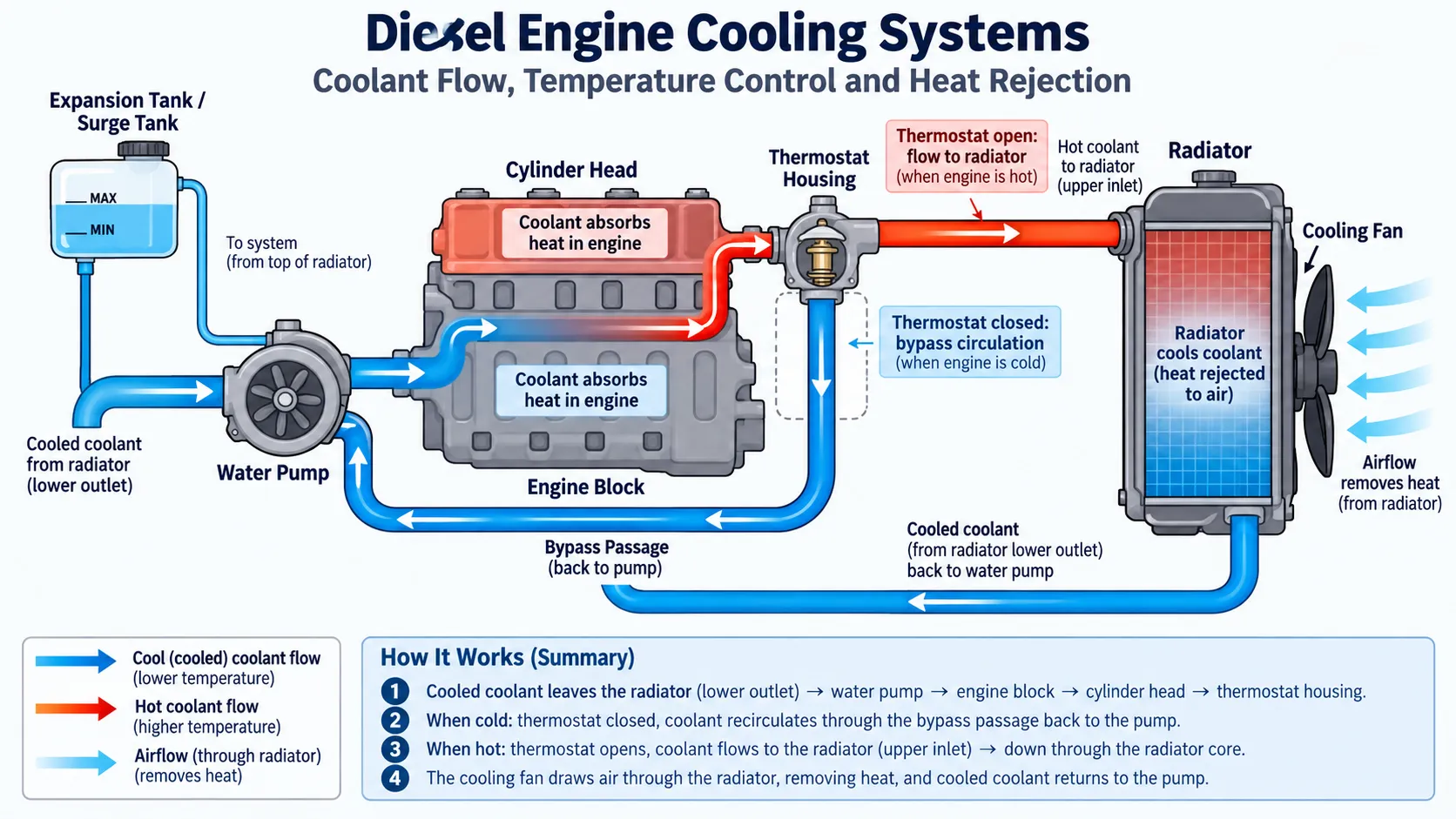
A diesel engine is a heat engine. Fuel burns inside the cylinders, part of that energy becomes useful mechanical work, and a significant amount becomes heat that must be controlled.
If engine temperature rises too far, lubrication, combustion, component clearances, seals, cylinder heads, pistons, and other parts can all be affected. If the engine operates too cold, combustion efficiency and emissions-system performance may also suffer.
Understanding Diesel Engine Cooling Systems therefore means understanding more than a radiator and a water pump.
A technician needs to understand three things:
- how coolant moves through the engine
- how heat moves from the engine into the coolant
- how that heat is finally rejected to the surrounding air
When an engine overheats, the question should not immediately be:
“Which part has failed?”
The better question is:
“Where is the heat-transfer process being interrupted?”
Why Diesel Engines Need Cooling Systems
Combustion generates very high temperatures inside the cylinder.
Not all of that thermal energy becomes useful work at the crankshaft. Heat is also transferred into:
- cylinder liners
- cylinder heads
- pistons
- valves
- exhaust components
- engine oil
- coolant
The purpose of Diesel Engine Cooling Systems is not to make the engine cold.
The purpose is to maintain the engine within a suitable operating temperature range.
The cooling system must remove enough heat to protect the engine while still allowing it to reach and maintain the temperature needed for efficient operation.
This is why an engine running too cold can also be a problem.
Temperature control is therefore just as important as heat removal.
Follow the Coolant
A technician should be able to visualize the basic coolant path through the engine.
A simplified heavy-duty diesel cooling circuit is:
Radiator → Coolant Pump → Engine Block → Cylinder Head → Thermostat Housing → Radiator → Coolant Pump
When the engine is cold, a bypass circuit may allow coolant to circulate within the engine before the thermostat directs more flow through the radiator.
Exact routing varies between manufacturers and engine families, but the basic principle is consistent:
Coolant absorbs heat from the engine, carries it to a heat exchanger, releases that heat to the air, and circulates again.
Major Components of Diesel Engine Cooling Systems
Heavy-duty cooling systems may differ in design, but most contain the same basic groups of components.
These commonly include:
- radiator
- coolant pump
- thermostat or temperature regulator
- cooling fan
- expansion or deaeration tank
- pressure cap
- coolant hoses and pipes
- coolant passages in the block and cylinder head
- bypass circuit
- temperature and level sensors
- coolant itself
Some engines may also include:
- coolant filters
- separate cooling loops
- EGR coolers
- oil coolers
- charge-air cooling circuits
- electronically controlled pumps or fans
The technician does not need to memorize every possible design.
The important skill is understanding the function of each component within the heat-transfer process.
Radiator
The radiator is the main heat exchanger in many diesel engine cooling systems.
Hot coolant enters the radiator and passes through tubes or passages surrounded by fins.
The fins increase the surface area exposed to air.
As air moves through the radiator core, heat moves from:
coolant → radiator material → surrounding air
The radiator therefore depends on two separate flows:
- coolant flow through the core
- airflow through the core
A problem with either one can reduce heat rejection.
A radiator that is internally clean but externally blocked may still overheat.
A radiator with excellent airflow but restricted internal passages may also fail to remove enough heat.
This is why radiator diagnosis must consider both sides of the heat exchanger. In Diesel Engine Cooling Systems, the radiator must have both adequate coolant flow and adequate airflow to reject heat effectively.
Coolant Pump
The coolant pump circulates coolant through the engine and cooling circuit.
Many diesel engines use a centrifugal-type pump.
The rotating impeller creates the flow needed to move coolant through:
- the engine block
- cylinder head
- thermostat housing
- radiator
- associated cooling circuits
Depending on engine design, the pump may be driven by:
- gears
- belts
- auxiliary drives
- electrical or electronically controlled systems
A pump problem can reduce coolant circulation, but an overheating complaint should not automatically result in pump replacement.
Possible coolant-flow problems may also involve:
- low coolant level
- air in the system
- collapsed or restricted hoses
- blocked passages
- thermostat problems
- damaged pump components
- incorrect pump installation
- other restrictions
The pump is only one part of the circuit. A healthy coolant pump is therefore essential to circulation within Diesel Engine Cooling Systems, but it should never be diagnosed in isolation.
Thermostat and Temperature Regulation
A thermostat does not directly cool the engine.
Its main function is to help regulate coolant flow according to temperature.
When the engine is cold, the thermostat limits or redirects coolant flow so the engine can warm up.
As coolant temperature rises, the thermostat changes position and allows more coolant to pass through the radiator.
Many heavy-duty systems also use a bypass circuit.
The bypass allows coolant to circulate through the engine while radiator flow is restricted during warm-up.
As the thermostat opens, the bypass may be reduced or closed depending on the design.
This is why removing a thermostat is not a reliable method of correcting overheating.
In some systems, removing it can disturb the intended balance between radiator flow and bypass flow. In Diesel Engine Cooling Systems, the thermostat helps control both engine warm-up and the routing of coolant toward the radiator.
The important lesson is:
The thermostat is part of the coolant-routing system, not just an on/off valve.
Cooling Fan and Airflow
Coolant flow alone cannot remove engine heat.
The radiator must also have sufficient airflow.
The cooling fan moves ambient air through the radiator or cooling package.
Depending on the machine, the fan may be:
- mechanically driven
- viscous-clutch controlled
- electronically controlled
- hydraulically driven
- electrically driven
- reversible
The exact control method varies.
What matters diagnostically is simple:
Is the required airflow actually reaching the radiator?
A fan may appear to be rotating but still fail to provide enough airflow under load.
Airflow may also be reduced by:
- plugged radiator fins
- mud
- dust
- leaves
- oil-soaked debris
- damaged fins
- incorrectly installed shrouds
- missing seals around the cooling package
- restrictions between stacked coolers
Heavy equipment often uses cooling packages containing several heat exchangers positioned close together.
These may include:
- charge-air cooler
- radiator
- hydraulic oil cooler
- transmission cooler
- air-conditioning condenser
Debris can collect between these cores where it is difficult to see during a quick inspection. Effective Diesel Engine Cooling Systems depend on airflow just as much as they depend on coolant circulation.
Coolant Expansion and Deaeration
Coolant expands as its temperature rises.
The cooling system must provide space for this expansion.
Depending on design, an expansion or deaeration tank may help:
- accommodate coolant expansion
- separate trapped air from coolant
- maintain coolant supply
- provide a high point for filling and venting
- house coolant-level sensing components
Air in a cooling system can reduce heat transfer and interfere with coolant circulation.
Air pockets can also create local areas where engine surfaces are not adequately exposed to liquid coolant.
Correct filling and deaeration procedures are therefore important after cooling-system service.
Always follow the manufacturer’s filling and bleeding procedure for the specific machine.
Why Cooling Systems Are Pressurized
Many diesel engine cooling systems operate under pressure.
System pressure helps increase the coolant’s resistance to boiling under normal operating conditions.
A pressure cap or pressure-control device helps maintain the intended pressure range while also allowing pressure relief or coolant recovery according to system design.
A faulty cap can therefore affect cooling-system operation.
However, the cap should not be diagnosed from appearance alone.
Technicians should follow the OEM test procedure and pressure specification for the specific engine. Pressurization is an important operating feature of many Diesel Engine Cooling Systems because it helps control coolant boiling under normal conditions.
Heat Transfer Explained Simply
To diagnose cooling faults properly, technicians need to understand how heat moves.
Three heat-transfer processes are useful to know:
Conduction
Conduction is heat transfer through a solid material.
For example:
Combustion heats the inside surface of the cylinder liner.
Heat then moves through the metal toward the coolant side.
Convection
Convection occurs when heat is transferred by a moving fluid.
Coolant flowing through the engine absorbs heat from metal surfaces.
Later, air moving through the radiator carries heat away from the radiator fins.
Radiation
Radiation is heat transfer through electromagnetic energy.
Hot exhaust manifolds, turbochargers, and aftertreatment components can radiate heat to nearby components.
For basic cooling-system diagnosis, conduction and convection are especially important.
If either coolant movement or airflow is restricted, heat transfer can suffer.
Coolant Flow Through the Engine
Coolant passages surround or pass near important heat-producing areas.
These may include:
- cylinder liners
- combustion areas
- cylinder heads
- exhaust valve regions
- injector locations
- turbocharger or EGR-related components where fitted
The coolant absorbs heat from these components and transports it toward the radiator.
The cylinder head is especially important because significant heat is concentrated around combustion and exhaust areas.
Cooling passages and head-gasket openings are designed to control how coolant moves through the engine.
For this reason, correct assembly and correct gasket orientation can be important to cooling performance.
Coolant Flow and Airflow Are Equally Important
This is one of the central lessons of Diesel Engine Cooling Systems.
An engine can overheat because coolant is not moving properly.
But it can also overheat because air is not moving properly.
Think of the system as two connected loops:
Coolant Side
Pump → Engine → Thermostat → Radiator
Air Side
Ambient Air → Cooling Package → Fan → Heat Rejection
Both sides must work.
If coolant circulation is good but airflow is poor, heat remains in the radiator.
If airflow is strong but coolant cannot reach the radiator, the heat remains in the engine.
A Diagnostic Leader evaluates both.
Coolant Chemistry Matters
Coolant is not simply coloured water.
Heavy-duty coolant is formulated to provide several functions, which may include:
- heat transfer
- freeze protection
- boiling protection
- corrosion protection
- control of deposits
- compatibility with seals and metals
- protection against cavitation in applicable engines
Coolant chemistry varies considerably between engine manufacturers and coolant technologies.
Different coolant families may use different additive packages.
Because of this, technicians should not choose coolant based only on colour.
Colour is not a reliable universal specification.
Use the coolant type, concentration, and service procedure required by the manufacturer. Correct coolant chemistry is therefore an important part of maintaining Diesel Engine Cooling Systems, not simply a matter of freeze protection.
Mixing Coolants
Mixing incompatible coolant types can change the performance of the additive package.
Possible effects may include:
- reduced corrosion protection
- deposits
- reduced additive life
- contamination
- changes in coolant properties
The exact result depends on the products involved.
Do not assume that two coolants are compatible because they have the same colour.
Likewise, do not assume two differently coloured coolants are automatically incompatible.
Always check the required coolant specification.
Water Quality
Water quality can affect cooling-system condition.
Minerals and contaminants in unsuitable water may contribute to:
- deposits
- corrosion
- scale
- reduced heat transfer
Where coolant concentrate requires mixing, use the water quality specified by the coolant manufacturer or OEM.
Premixed coolant can help eliminate uncertainty about water quality and concentration.
Wet Liner Cavitation
Some heavy-duty diesel engines use wet cylinder liners, where part of the liner is directly exposed to coolant.
Movement and vibration of the liner can create rapid pressure changes in the surrounding coolant.
Under certain conditions, small vapor bubbles can form and collapse near the liner surface.
Repeated bubble collapse can contribute to surface pitting.
Over time, severe cavitation erosion can damage the liner.
Correct coolant chemistry is one part of controlling this process.
For apprentices, the key lesson is simple:
Correct coolant is part of engine protection, not merely freeze protection.
Cooling System Sensors
Modern engines may use several sensors to monitor cooling-system condition.
These may include:
- coolant temperature sensor
- coolant level sensor
- fan-speed sensor
- pressure sensors on some systems
- additional thermal sensors depending on machine design
The engine control module may use this information to:
- control fan speed
- warn the operator
- modify engine performance
- activate protective strategies
- log diagnostic information
Exact protection strategies vary between manufacturers.
Do not assume every machine will derate or shut down at the same temperature.
Always consult OEM information.
Overheating Is a Symptom, Not a Diagnosis
When an engine overheats, replacing the thermostat or water pump immediately skips the diagnostic process.
Overheating tells you that:
The engine is producing more heat than the cooling system is successfully removing under those conditions.
The job is to determine why.
A useful starting framework is:
1. Is Coolant Present?
Check:
- coolant level
- evidence of leaks
- hose condition
- reservoir condition
- signs of coolant loss
2. Is Coolant Circulating?
Consider:
- pump performance
- thermostat operation
- restrictions
- collapsed hoses
- air entrapment
- blocked passages
3. Can the Radiator Reject Heat?
Consider:
- internal restriction
- external contamination
- damaged fins
- cooler-stack blockage
- coolant condition
4. Is Air Moving Through the Cooling Package?
Consider:
- fan operation
- fan clutch
- hydraulic or electrical fan control
- fan direction
- shrouds and seals
- blocked cooler cores
5. Is the Temperature Reading Believable?
Consider:
- sensor accuracy
- wiring
- ECM data
- gauge condition
- independent verification using the OEM-recommended method
This approach is more reliable than guessing components. Diagnosing overheating in Diesel Engine Cooling Systems requires examining the entire heat-transfer path rather than replacing the first suspected component.
Airflow Problems in Heavy Equipment
Heavy equipment frequently operates in:
- dust
- mud
- vegetation
- coal
- fine mineral particles
- high ambient temperature
Cooling packages can become restricted externally even when the radiator looks acceptable from the front.
The technician should consider the whole airflow path.
Ask:
- Can air enter the cooling package?
- Can it pass through every heat exchanger?
- Is debris trapped between cores?
- Is the fan producing the required airflow?
- Can hot air leave the engine compartment?
Airflow restriction is one of the most important areas to inspect during an overheating complaint. On heavy equipment, restricted cooling-package airflow can reduce the capacity of Diesel Engine Cooling Systems even when coolant circulation is normal.
Coolant Flow Problems
Possible causes of reduced coolant circulation may include:
- low coolant level
- pump damage
- drive problems
- collapsed hoses
- blocked radiator passages
- blocked engine passages
- thermostat problems
- air pockets
- incorrect component installation
- contamination or deposits
Do not assume poor coolant circulation always means the pump has failed. In Diesel Engine Cooling Systems, reduced coolant circulation should be investigated across the complete flow path rather than blamed on the coolant pump alone.
The whole path should be examined.
Cooling System Leaks
Cooling-system leaks may be external or internal.
External leaks may appear around:
- hoses
- clamps
- radiator tanks
- pump seals
- pipes
- thermostat housings
- expansion tanks
- heater or auxiliary circuits
Internal coolant loss may involve other engine systems.
Possible internal paths depend on engine design and may include:
- cylinder head or gasket areas
- oil coolers
- EGR coolers
- liners or liner seals
- other heat exchangers
Testing procedures should follow manufacturer guidance.
Water Pump Weep Holes
Some coolant pumps use a weep or drain hole as part of the seal arrangement.
Evidence around the weep hole should be interpreted according to the pump manufacturer’s guidance.
A persistent coolant leak may indicate deterioration of the pump seal.
However, technicians should not block or plug a weep hole in an attempt to stop leakage.
The hole may be part of the intended design and sealing arrangement.
Engine Running Too Cold
Cooling-system diagnosis is not only about overheating.
An engine that consistently operates below its intended temperature may also have a problem.
Possible causes may include:
- thermostat stuck open
- incorrect thermostat
- excessive fan operation
- control-system faults
- operating conditions
- incorrect sensor readings
Running too cold may affect:
- combustion efficiency
- emissions performance
- fuel consumption
- oil condition
- warm-up time
The correct operating temperature range must come from the manufacturer.
Common Cooling-System Problems
Possible fault areas include:
- low coolant level
- external leaks
- internal coolant loss
- blocked radiator
- contaminated cooling package
- failed or weak fan drive
- incorrect fan operation
- damaged thermostat
- coolant-pump problems
- collapsed hoses
- air in the system
- coolant contamination
- incorrect coolant
- pressure-control problems
- sensor faults
- wiring faults
This is a list of possible fault areas.
It is not a diagnostic sequence.
Testing is still required.
Common Apprentice Mistakes
Mistake 1: “Overheating means the thermostat is bad.”
Correction: A thermostat is only one possible cause. Airflow, coolant flow, radiator condition, pump performance, coolant level, and other factors must also be checked.
Mistake 2: “If the radiator is clean, airflow must be good.”
Correction: Debris can be trapped between stacked coolers, fan performance may be poor, or shrouding may be damaged.
Mistake 3: “Removing the thermostat improves cooling.”
Correction: Thermostats are part of the system’s temperature and flow-control strategy. Removing one may disturb the designed coolant circuit.
Mistake 4: “Any coolant with the same colour is suitable.”
Correction: Coolant should be selected by specification, not colour.
Mistake 5: “If the fan is spinning, the fan system is good.”
Correction: A fan can rotate without providing the airflow required under load.
Mistake 6: “High temperature means the engine itself is damaged.”
Correction: High temperature is a condition. The root cause must still be identified.
Diagnostic Leader Perspective: Follow the Heat
When diagnosing Diesel Engine Cooling Systems, think of heat as something that must travel through a chain.
Combustion → Engine Metal → Coolant → Radiator → Air
If the engine overheats, ask:
- Is the heat entering the coolant?
- Is coolant carrying the heat away from the engine?
- Is the radiator receiving the hot coolant?
- Can the radiator transfer that heat to the air?
- Is sufficient air moving through the cooling package?
This gives the technician a structured way to think.
Do not begin with a component.
Begin with the heat path.
What This Means for Technicians
Understanding Diesel Engine Cooling Systems changes the way a technician approaches overheating.
Instead of immediately blaming the thermostat, coolant pump, or radiator, the technician learns to think in terms of the complete heat-transfer path.
That means checking:
- coolant quantity and condition
- coolant circulation
- thermostat operation
- radiator condition
- airflow through the cooling package
- fan performance
- system pressure
- sensor accuracy
- possible internal or external coolant loss
The key lesson is that overheating is usually not a diagnosis by itself.
It is a symptom that tells you the engine is producing more heat than the cooling system is successfully removing.
A technician who understands coolant flow, airflow, heat transfer, and system control can diagnose the fault logically instead of replacing parts by assumption.
That is the difference between simply repairing components and becoming a Diagnostic Leader.
Frequently Asked Questions About Diesel Engine Cooling Systems
What is the purpose of a diesel engine cooling system?
The system manages engine temperature by absorbing heat from engine components and transferring it to the surrounding air.
Does the thermostat cool the engine?
No.
The thermostat regulates coolant routing according to temperature.
The radiator, coolant, airflow, and other components perform the heat-transfer work.
Can a bad thermostat cause overheating?
Yes, depending on how it fails and how the cooling circuit is designed.
However, thermostat failure is only one possible cause of overheating.
Why is airflow important?
The radiator must transfer heat to the air.
Without enough airflow, heat remains in the coolant even if coolant circulation is good.
Can a dirty radiator cause overheating?
Yes.
External contamination can restrict airflow, while internal deposits can reduce coolant flow or heat transfer.
What does the coolant pump do?
The pump circulates coolant through the engine and cooling system.
It does not cool the coolant by itself.
Why is coolant chemistry important?
Coolant chemistry helps manage corrosion, deposits, freezing, boiling, and cavitation protection depending on the system.
Can I choose coolant by colour?
No.
Coolant colour is not a universal technical specification.
Always use the coolant required by the manufacturer.
Why can an engine overheat only under heavy load?
Heavy load increases heat production.
A cooling system with reduced capacity may control temperature at light load but become unable to reject enough heat when engine load increases.
Why can an engine run too cold?
Possible causes include thermostat problems, excessive fan operation, control faults, sensor errors, or operating conditions.
Final Message: Follow the Coolant and Follow the Heat
A technician should be able to picture two paths.
Coolant Path
Radiator → Coolant Pump → Engine Block → Cylinder Head → Thermostat → Radiator
Heat Path
Combustion → Engine Metal → Coolant → Radiator → Air
When an engine overheats, do not immediately blame the water pump.
Ask:
- Is coolant present?
- Is it circulating?
- Is heat entering the coolant?
- Can the radiator reject the heat?
- Is enough air moving through the cooling package?
- Is the temperature reading accurate?
- Is the coolant correct?
- Is the system pressurizing and deaerating as designed?
Follow the coolant. Follow the heat. Verify the condition. Prove the fault.
That is how a technician develops into a Diagnostic Leader rather than a parts changer.
References and Further Reading
For engine-specific coolant specifications, pressure limits, thermostat temperatures, fan-control strategies, filling procedures, and diagnostic tests, refer to the appropriate OEM technical information.
Useful source categories include:
- OEM Operation and Maintenance Manuals
- Caterpillar technical and service information
- Cummins technical literature
- coolant manufacturer technical resources
- SAE International engineering information
Modern Trade Skills Institutional Reference
Modern Trade Skills Handbook Version 1.0
Institutional reference for the Modern Trade Skills Diagnostic Leader philosophy, systems-thinking framework, and apprentice-development principles.