
Monday to Saturday - 8:00 -17:30

Modern heavy-equipment diesel engines must do more than produce power efficiently. They must also control pollutants created during combustion before those gases leave the exhaust system.
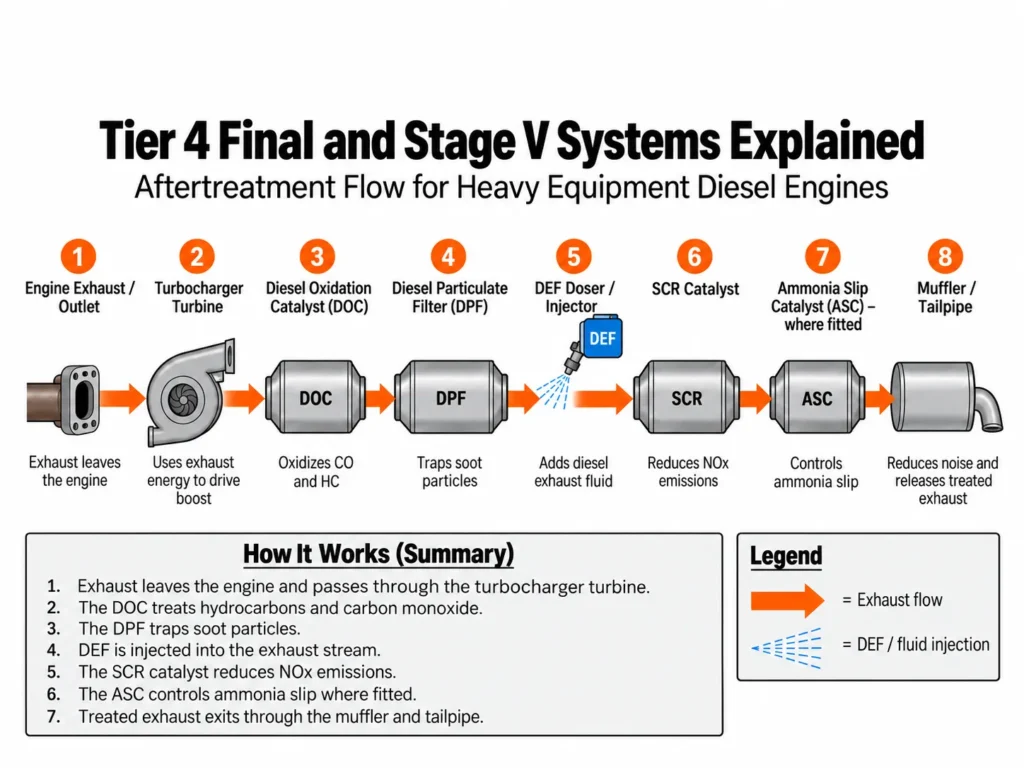
This is why Tier 4 Final and Stage V Systems have become an important part of modern diesel-engine technology.
For technicians, these systems introduce components that did not exist on many older machines:
- Diesel Oxidation Catalysts
- Diesel Particulate Filters
- Diesel Exhaust Fluid systems
- Selective Catalytic Reduction
- exhaust temperature sensors
- differential-pressure sensors
- NOx sensors
- electronic regeneration and inducement strategies
At first, the system can look complicated.
But the best way to understand it is the same way we approach other engine systems:
Follow the exhaust gas.
A simplified aftertreatment path is:
Engine → Turbocharger → DOC → DPF → DEF Doser / Mixing Section → SCR → ASC → Tailpipe
Sensors monitor what is happening along this path, while the ECM or aftertreatment controller decides when regeneration, DEF dosing, warnings, or protective actions are required.
Understanding this complete process turns emissions diagnostics from guesswork into systems thinking.
Why Tier 4 Final and Stage V Systems Exist
Diesel combustion produces useful power, but it can also produce unwanted exhaust constituents.
The main emissions controlled by modern diesel technology include:
- particulate matter
- nitrogen oxides
- carbon monoxide
- unburned hydrocarbons
Earlier diesel engines relied heavily on combustion-system improvements to reduce emissions.
As regulations became more demanding, manufacturers introduced additional technologies such as:
- electronic fuel control
- cooled EGR
- variable-geometry turbocharging
- DOC systems
- DPF systems
- SCR systems
- DEF dosing
Modern Tier 4 Final and Stage V Systems therefore combine engine control with exhaust aftertreatment.
The engine and aftertreatment system must work together.
A problem that begins in the intake, fuel, cooling, lubrication, or combustion system can eventually appear as an exhaust or emissions fault.
That relationship is extremely important for technicians.
Understanding the Emissions Problem
Two important diesel emissions are nitrogen oxides and particulate matter.
Nitrogen Oxides
Nitrogen oxides, commonly called NOx, are formed during high-temperature combustion.
Modern engines use a combination of combustion control, EGR strategies, and exhaust aftertreatment to manage NOx.
Particulate Matter
Particulate matter includes soot created during combustion.
Soot production may increase when combustion conditions are poor.
Possible contributing factors may include:
- insufficient air
- poor fuel atomization
- abnormal combustion
- boost leaks
- EGR-related problems
- engine mechanical problems
- unsuitable operating conditions
The DPF is designed to capture much of this particulate matter before it reaches the atmosphere.
Complete Tier 4 Final and Stage V Systems Overview
The easiest way to understand the system is to follow each aftertreatment component in sequence.
A typical path may be:
Engine Exhaust → Turbocharger → DOC → DPF → DEF Doser → Mixing Section → SCR → Ammonia Slip Catalyst → Tailpipe
Exact layouts vary between manufacturers.
Some components may be combined into one housing.
Some machines may use different sensor arrangements or control modules.
The key principle is that Tier 4 Final and Stage V Systems operate as a sequence.
Each stage prepares the exhaust gas for the next stage.
If one stage fails, the effects may appear farther downstream.
Diesel Oxidation Catalyst
The Diesel Oxidation Catalyst, or DOC, is commonly positioned near the beginning of the aftertreatment system.
It contains a catalytic substrate that promotes chemical reactions in the exhaust stream.
The DOC helps oxidize exhaust constituents such as:
- carbon monoxide
- unburned hydrocarbons
It can also contribute to the temperature conditions required for DPF regeneration.
This makes the DOC more than a passive exhaust component.
Its condition can influence how successfully downstream components operate.
A problem affecting the DOC may therefore contribute to repeated regeneration problems or poor aftertreatment performance.
Diesel Particulate Filter
The Diesel Particulate Filter, or DPF, is designed to capture particulate matter from the exhaust gas.
Unlike the DOC, which allows exhaust gas to flow through a catalytic structure, the DPF uses a wall-flow filter arrangement.
Exhaust gas passes through porous material while soot particles are retained inside the filter.
As soot accumulates, exhaust restriction increases.
The system must therefore periodically reduce the soot loading.
This process is called regeneration.
The DPF is one of the most important components in Tier 4 Final and Stage V Systems, but a DPF problem should never automatically be treated as a failed filter.
The technician must understand what has accumulated inside it and why.
Soot Loading vs Ash Loading
One of the most important distinctions in DPF diagnostics is the difference between soot and ash.
Soot
Soot is produced during combustion.
Under suitable conditions, regeneration can oxidize much of the accumulated soot.
Heavy or repeated soot loading may indicate an upstream problem such as:
- poor combustion
- intake restriction
- boost leakage
- fuel-system problems
- EGR problems
- low operating temperature
- repeated interrupted regenerations
Ash
Ash is non-combustible material that gradually accumulates inside the DPF.
Regeneration does not remove ash in the same way it removes soot.
Eventually, the filter may require approved cleaning or servicing according to the manufacturer’s requirements.
This distinction matters because repeatedly attempting regeneration on an ash-loaded DPF will not correct the underlying condition.
A Diagnostic Leader asks:
Is the filter loaded with soot, ash, or both?
What Is DPF Regeneration?
Regeneration is the process used to reduce accumulated soot inside the DPF.
Modern Tier 4 Final and Stage V Systems may use several regeneration strategies depending on engine design and operating conditions.
Passive Regeneration
Passive regeneration can occur when normal machine operation creates suitable exhaust conditions for soot oxidation.
The operator may not notice that this process is taking place.
Active Regeneration
If normal operating conditions are not sufficient, the engine management system may deliberately increase exhaust temperature to support soot oxidation.
This may involve manufacturer-specific fuel and thermal-management strategies.
Parked or Stationary Regeneration
Some machines may request a stationary regeneration when soot loading or operating conditions require the machine to be parked safely while the regeneration process takes place.
Technician-Commanded Regeneration
OEM diagnostic software may allow qualified technicians to command specific regeneration procedures when permitted by the control system.
This should never be treated as the automatic solution to every DPF fault.
Before commanding regeneration, the technician should understand:
- why the DPF loaded
- whether the sensor information is believable
- whether regeneration conditions are suitable
- whether an upstream fault is creating excessive soot
Regeneration Does Not Fix the Root Cause
A successful regeneration can reduce soot loading.
It does not necessarily repair the reason the soot accumulated.
For example, repeated soot loading could be related to:
- an intake-air leak
- low boost
- injector problems
- abnormal EGR operation
- excessive engine oil consumption
- unsuitable duty cycle
- temperature-control problems
- sensor faults
If the root cause remains, the DPF may load again.
This is why repeated regenerations without diagnosis can waste time and hide the actual problem.
Selective Catalytic Reduction
Selective Catalytic Reduction, or SCR, is used to reduce nitrogen oxide emissions.
In many Tier 4 Final and Stage V Systems, SCR operates downstream of the DPF.
The system introduces Diesel Exhaust Fluid into the exhaust stream.
Under suitable exhaust conditions, the DEF provides ammonia that participates in reactions inside the SCR catalyst.
The result is the conversion of NOx into less harmful exhaust products, primarily nitrogen and water.
For technicians, the important concept is not memorizing every chemical reaction.
It is understanding the process:
Correct DEF + Correct Dosing + Suitable Temperature + Healthy SCR Catalyst + Accurate Sensor Feedback = Effective NOx Reduction
If one part of that chain fails, SCR efficiency can suffer.
Diesel Exhaust Fluid
Diesel Exhaust Fluid, commonly called DEF, is a controlled urea-and-water solution used by the SCR system.
DEF cleanliness and quality are important.
The fluid should be stored, transferred, and handled according to the manufacturer’s requirements.
Contamination may interfere with:
- DEF pump operation
- injector operation
- dosing accuracy
- catalyst performance
Technicians should avoid using containers or transfer equipment that may contain:
- diesel fuel
- engine oil
- hydraulic oil
- dirt
- other chemicals
The DEF system is sensitive to contamination.
DEF System Architecture
A DEF system may include:
- DEF tank
- level sensing
- temperature sensing
- quality monitoring where fitted
- supply module or pump
- filtration
- heated lines
- dosing injector
- mixing or decomposition section
- electrical controls
The precise arrangement varies between manufacturers.
The DEF injector introduces fluid into the exhaust stream at a controlled rate.
Correct atomization and mixing are important because the fluid must interact properly with the hot exhaust before reaching the SCR catalyst.
When diagnosing Tier 4 Final and Stage V Systems, the DEF system should therefore be treated as a complete supply-and-dosing circuit.
DEF Crystallization
White crystalline deposits are sometimes found around DEF dosing components or inside the exhaust mixing section.
Crystallization can be associated with conditions such as:
- unsuitable exhaust temperature
- poor DEF atomization
- leaking dosing injector
- incorrect dosing
- poor mixing
- repeated low-load operation
- abnormal shutdown or operating conditions
Crystallization itself may be a symptom rather than the original fault.
Removing deposits without correcting the reason they formed may result in repeat failure.
The technician should investigate the complete DEF dosing process.
NOx Sensors
Modern SCR systems may use NOx sensors before and after the SCR catalyst.
The upstream sensor helps the control system understand the NOx level entering the SCR system.
The downstream sensor helps evaluate what remains after treatment.
By comparing these signals with DEF dosing and operating conditions, the ECM can evaluate SCR performance.
A high downstream NOx reading does not automatically mean:
“Replace the SCR catalyst.”
Possible areas to investigate may include:
- DEF quality
- DEF supply
- DEF dosing
- injector condition
- crystallization
- exhaust temperature
- exhaust leaks
- upstream NOx sensor
- downstream NOx sensor
- catalyst condition
This is a good example of why emissions codes require diagnosis rather than immediate parts replacement.
Exhaust Gas Temperature Sensors
Temperature is critical to modern aftertreatment.
Exhaust Gas Temperature sensors may be positioned at several locations throughout the system.
The ECM may use these sensors to monitor:
- DOC operation
- DPF regeneration
- catalyst temperature
- component protection
- SCR operating conditions
The exact number and location of sensors vary.
When diagnosing temperature-related faults, compare the sensor readings logically.
For example, after a cold soak, several exhaust temperature sensors should usually show reasonably related values before the engine produces significant heat.
An implausible reading should be verified before expensive aftertreatment components are condemned.
Differential Pressure Sensor
The differential-pressure sensor helps the ECM monitor restriction across the DPF.
It compares pressure at two points in the exhaust system.
As DPF restriction changes, the pressure difference can also change.
However, a high differential-pressure reading does not automatically prove that the DPF is physically blocked.
The technician should also consider:
- blocked pressure lines
- damaged hoses
- condensation or contamination
- sensor faults
- electrical problems
- soot loading
- ash loading
- exhaust-flow conditions
In Tier 4 Final and Stage V Systems, sensor validation is an important part of accurate diagnosis.
ECM and Aftertreatment Control
The ECM or aftertreatment controller coordinates many emissions-system functions.
It may use information from:
- exhaust temperature sensors
- differential-pressure sensors
- NOx sensors
- engine load
- engine speed
- fuel consumption
- DEF system
- ambient conditions
- operating history
From this information, the system may decide when to:
- initiate regeneration
- dose DEF
- display warnings
- log fault codes
- apply protective strategies
- apply emissions-related inducements or derates
The exact strategy is manufacturer-specific.
A fault code tells the technician what condition the ECM has detected.
It does not automatically identify which component has failed.
Emissions Derate and Inducement
Modern emissions-controlled machines may reduce engine or machine performance when certain emissions faults remain unresolved.
The exact warning and inducement sequence varies according to:
- manufacturer
- machine application
- emissions standard
- fault type
- regulatory requirements
The technician may see:
- warning messages
- emissions lamps
- reduced engine performance
- limited machine operation
- other manufacturer-specific restrictions
The correct response is to diagnose the cause.
Bypassing or deleting emissions equipment is not a diagnostic repair.
A Loaded DPF May Be the Victim
This is one of the most important lessons in Tier 4 Final and Stage V Systems.
A DPF that repeatedly fills with soot may not be the root cause.
It may simply be the final component receiving the consequences of an upstream engine problem.
Possible upstream causes include:
- insufficient intake air
- boost leakage
- poor combustion
- injector problems
- EGR system faults
- engine oil entering the exhaust
- coolant entering the exhaust
- low operating temperature
- excessive idling or unsuitable duty cycle
Replacing or cleaning the DPF without diagnosing the upstream system can lead to repeat failure.
A Diagnostic Leader asks:
Why did the DPF load?
Common Tier 4 Final and Stage V System Problems
Possible fault areas include:
- excessive DPF soot loading
- excessive DPF ash loading
- failed regeneration
- DEF contamination
- DEF pump problems
- restricted DEF filters
- DEF injector problems
- crystallization
- NOx sensor faults
- exhaust temperature sensor faults
- differential-pressure sensor faults
- blocked sensor tubes
- exhaust leaks
- damaged wiring
- SCR efficiency problems
- catalyst deterioration
- upstream engine faults creating excessive emissions
This is a list of possible fault areas.
It is not a diagnostic flowchart.
Testing is still required.
Diagnostic Leader Perspective: Follow the Process
When diagnosing Tier 4 Final and Stage V Systems, follow the aftertreatment process in order.
Ask:
Is the engine producing abnormal soot or emissions?
Consider:
- air system
- boost
- fuel system
- EGR
- engine mechanical condition
- oil consumption
- operating temperature
Is the DOC functioning as required?
Consider:
- exhaust temperature
- contamination
- sensor information
- regeneration behavior
Is the DPF loaded?
Determine whether the problem involves:
- soot
- ash
- sensor information
- pressure lines
- physical damage
Is regeneration possible?
Consider:
- temperature
- soot loading
- ECM permissions
- sensor plausibility
- upstream engine condition
Is the DEF system operating?
Consider:
- fluid quality
- fluid level
- pump operation
- filters
- dosing injector
- crystallization
- line condition
Is SCR conversion occurring?
Consider:
- upstream NOx
- downstream NOx
- DEF dosing
- exhaust temperature
- catalyst condition
Is the ECM receiving believable information?
Consider:
- sensors
- wiring
- connectors
- pressure hoses
- control-module communication
This method keeps diagnosis structured.
Aftertreatment Safety
Regeneration and aftertreatment operation can create very high temperatures.
Technicians and operators must treat the exhaust system as a significant thermal hazard.
Safe practices include:
- following OEM regeneration procedures
- keeping stationary regeneration away from combustible material
- ensuring adequate ventilation
- avoiding contact with hot exhaust components
- allowing appropriate cooldown before service
- following workshop fire-prevention procedures
Do not assume an exhaust assembly is safe to touch simply because the engine has been switched off.
Aftertreatment components may retain heat after shutdown.
Common Apprentice Mistakes
Mistake 1: “A DPF code means the DPF is bad.”
Correction: The filter may be loaded because of an upstream engine fault, sensor problem, failed regeneration, ash accumulation, or another condition.
Mistake 2: “A forced regeneration will fix every DPF problem.”
Correction: Regeneration addresses soot. It does not remove every type of restriction or repair the fault that created excessive soot.
Mistake 3: “Soot and ash are the same thing.”
Correction: Soot can often be reduced through regeneration. Ash accumulates and may eventually require physical servicing.
Mistake 4: “Low SCR efficiency means replace the SCR catalyst.”
Correction: DEF quality, dosing, sensors, temperature, leaks, crystallization, and other conditions should be verified first.
Mistake 5: “White crystals mean I only need to clean the pipe.”
Correction: Crystallization may be a symptom. The dosing and temperature conditions that created the deposits must also be diagnosed.
Mistake 6: “A fault code tells me the failed component.”
Correction: Fault codes identify detected conditions. Diagnosis is still required.
What This Means for Technicians
Understanding Tier 4 Final and Stage V Systems changes the way a technician approaches modern emissions faults.
The system is not simply:
DPF + DEF + SCR
It is connected to the entire engine.
An intake-air fault can increase soot.
A fuel-system fault can increase particulate loading.
A cooling-system problem can affect exhaust temperature.
Engine oil consumption can increase ash accumulation.
Sensor faults can cause incorrect ECM decisions.
Poor DEF quality can affect SCR performance.
This means the technician must understand:
- mechanical systems
- electrical systems
- sensors
- control modules
- exhaust flow
- fluid cleanliness
- aftertreatment chemistry
- diagnostic software
Modern emissions diagnosis rewards technicians who can connect these systems instead of treating each fault code as an isolated component failure.
That is how a technician develops into a Diagnostic Leader rather than a parts changer.
Frequently Asked Questions About Tier 4 Final and Stage V Systems
What is the purpose of Tier 4 Final and Stage V Systems?
They reduce harmful diesel-engine emissions using a combination of engine controls and exhaust-aftertreatment technologies.
What does the DOC do?
The Diesel Oxidation Catalyst promotes chemical reactions that help reduce certain exhaust constituents and can support the thermal conditions required for DPF regeneration.
What does the DPF do?
The Diesel Particulate Filter captures particulate matter such as soot from the exhaust stream.
What is regeneration?
Regeneration is the process used to reduce accumulated soot inside the DPF.
What is the difference between soot and ash?
Soot comes mainly from combustion and can often be reduced through regeneration.
Ash is non-combustible material that gradually accumulates and may eventually require approved filter servicing.
What does DEF do?
DEF provides the chemistry needed for the SCR system to reduce nitrogen oxide emissions.
What does SCR do?
Selective Catalytic Reduction uses ammonia derived from DEF and a catalyst to reduce NOx emissions.
Why does a machine request regeneration repeatedly?
Repeated regeneration requests may indicate excessive soot production, unsuitable operating conditions, sensor problems, regeneration issues, or other upstream faults.
Does high DPF differential pressure mean the DPF must be replaced?
No.
The technician must verify the sensor, pressure lines, soot loading, ash loading, and the physical condition of the filter.
Why can an emissions fault cause engine derate?
Modern control systems may limit machine performance when certain emissions faults remain unresolved or when required aftertreatment functions cannot operate correctly.
Final Message: Follow the Aftertreatment Process
When troubleshooting Tier 4 Final and Stage V Systems, follow the complete exhaust-treatment path:
Engine → Turbocharger → DOC → DPF → DEF Doser → SCR → ASC → Tailpipe
Then ask:
- Is the engine producing excessive soot?
- Is the DOC supporting the required exhaust conditions?
- Is the DPF loaded with soot, ash, or both?
- Is regeneration working correctly?
- Is the differential-pressure reading believable?
- Is the DEF clean and suitable?
- Is the DEF system supplying and dosing correctly?
- Is the SCR receiving suitable exhaust conditions?
- Do upstream and downstream NOx readings make sense?
- Are the ECM inputs believable?
- Is the emissions component the root cause, or the victim of another system fault?
Follow the process. Verify the data. Find the root cause. Prove the fault.
That is systems thinking.
That is how a technician becomes a Diagnostic Leader rather than a parts changer.
References and Further Reading
For engine-specific aftertreatment layouts, regeneration procedures, DEF requirements, DPF servicing, sensor specifications, inducement strategies, and diagnostic tests, always refer to the appropriate OEM technical information.
Useful technical sources include:
- OEM Operation and Maintenance Manuals
- Caterpillar technical and service information
- Cummins technical literature
- Bosch diesel and emissions technical resources
- SAE International engineering information
- emissions-system manufacturer technical documentation
Modern Trade Skills Institutional Reference
Modern Trade Skills Handbook Version 1.0
Institutional reference for the Modern Trade Skills Diagnostic Leader philosophy, systems-thinking framework, and apprentice-development principles.