
Monday to Saturday - 8:00 -17:30

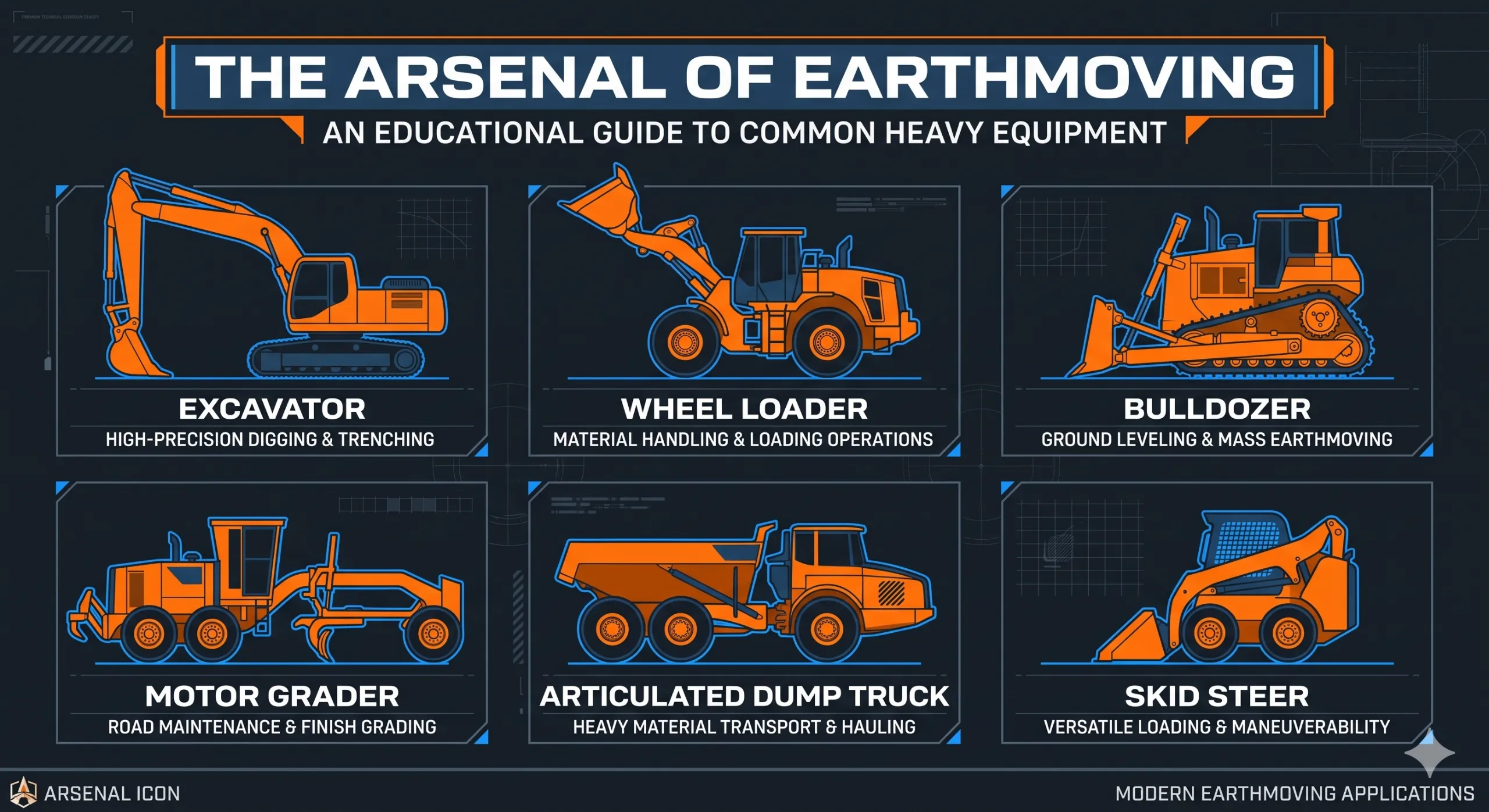
Heavy Equipment Introduction: Understanding The Machines That Build The World
1. Introduction
Look out your window. The road you drive on, the foundation of your home, the copper wiring powering your device, the food on your table, and the massive shipping ports that connect global commerce—none of this exists without heavy equipment.
Humanity’s progress has always been dictated by our ability to manipulate the earth. When human muscle and animal power proved insufficient, we invented the steam shovel. When steam proved too slow and heavy, we harnessed diesel power and hydraulics. Today, the modern world is utterly dependent on fleets of massive, highly complex, purpose-built machinery to sustain our civilization.
If all heavy equipment stopped operating tomorrow, global infrastructure would collapse within weeks. Mining would cease, halting the production of metals and energy. Construction would stop, paralyzing urban development. Large-scale agriculture would fail, triggering global food shortages.
Understanding heavy equipment is not just about knowing the names of big trucks. It is about understanding the mechanical, hydraulic, and electronic ecosystems that drive the global economy. This Heavy Equipment Introduction is your definitive starting point. Whether you are a student considering a trade career, a newly hired apprentice, or an enthusiast wanting to understand the engineering behind the iron, this guide will decode the machines, the industries, and the elite professionals who keep them running.
2. What Is Heavy Equipment?
“Heavy equipment” is a broad umbrella term used to describe massive, heavy-duty vehicles specifically designed to execute construction, earthmoving, mining, forestry, and agricultural tasks.
Defining Characteristics:
- Size & Weight: These machines range from a 3-ton compact skid steer to a 400-ton mining haul truck.
- Power: They are almost universally powered by high-torque, industrial diesel engines designed to run continuously under immense load.
- Purpose: They are engineered for physical work (digging, pushing, lifting, crushing) rather than high-speed transportation.
- Specialized Design: They utilize tracks for extreme traction and low ground pressure, or specialized heavy-duty tires designed to carry massive payloads over brutal terrain.
The Contrast: Passenger Vehicles vs. Heavy Equipment
- Passenger Vehicle: Designed to move 2-5 people from Point A to Point B at high speed on smooth pavement. Focuses on comfort, aerodynamics, and lightweight materials.
- Commercial Truck (Semi/Lorry): Designed to move 40 tons of freight at 65 MPH on paved highways. Focuses on fuel economy over long distances.
- Heavy Equipment: Designed to move 100 tons of abrasive rock through 3 feet of mud at 15 MPH. Focuses entirely on immense torque multiplication, hydraulic fluid power, and extreme structural durability.
3. Why Heavy Equipment Exists
Heavy equipment was born out of mathematical necessity. Human beings have severe physical limitations.
- Productivity Requirements: A human with a shovel can move perhaps 2 cubic yards of dirt in an 8-hour shift. A modern mining shovel can move 60 cubic yards of dirt in a single 30-second pass.
- Safety Requirements: Handling massive steel beams, digging deep trenches, or clearing landslides manually results in catastrophic injury rates. Heavy machinery allows operators to manipulate immense weight from inside a heavily armored, climate-controlled steel cage (ROPS/FOPS).
- Large-Scale Earthmoving: The construction of the Hoover Dam, the extraction of lithium in the Australian Pilbara, or the cutting of the Panama Canal are physically impossible without the mechanical leverage provided by heavy iron.
4. Major Industries That Use Heavy Equipment
Heavy equipment is not limited to roadwork. It is highly specialized by industry:
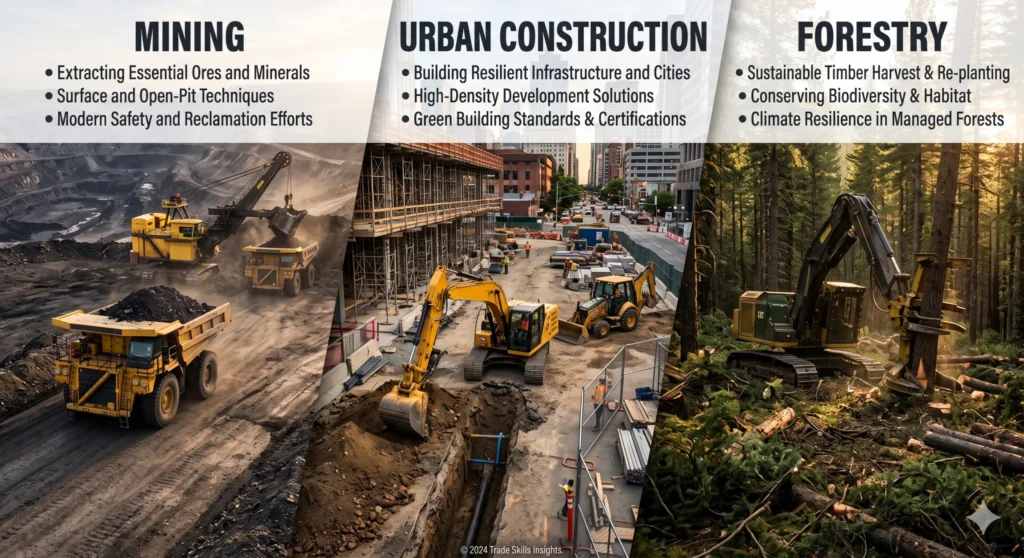
- Construction (Civil & Commercial): Building highways, bridges, skyscrapers, and residential subdivisions. Requires versatile machines like excavators, backhoes, and motor graders.
- Mining (Surface & Underground): Extracting coal, copper, gold, and iron ore. Requires the largest machines on earth: ultra-class haul trucks, electric rope shovels, and autonomous drills operating 24/7.
- Agriculture: Feeding the world. Requires massive tractors, combine harvesters, and specialized tillage equipment designed for minimal soil compaction.
- Forestry: Harvesting timber in rugged, steep terrain. Requires highly specialized tracked feller-bunchers, skidders, and forwarders equipped with massive saw heads and grapples.
- Quarrying & Aggregates: Crushing rock into gravel for concrete and asphalt. Requires heavy wheel loaders and articulated dump trucks working in highly abrasive environments.
- Ports & Logistics: Moving global freight. Requires massive straddle carriers, reach stackers, and container handlers capable of lifting 40-ton shipping containers precisely.
5. Major Types Of Heavy Equipment
To survive in this industry, you must know your iron.
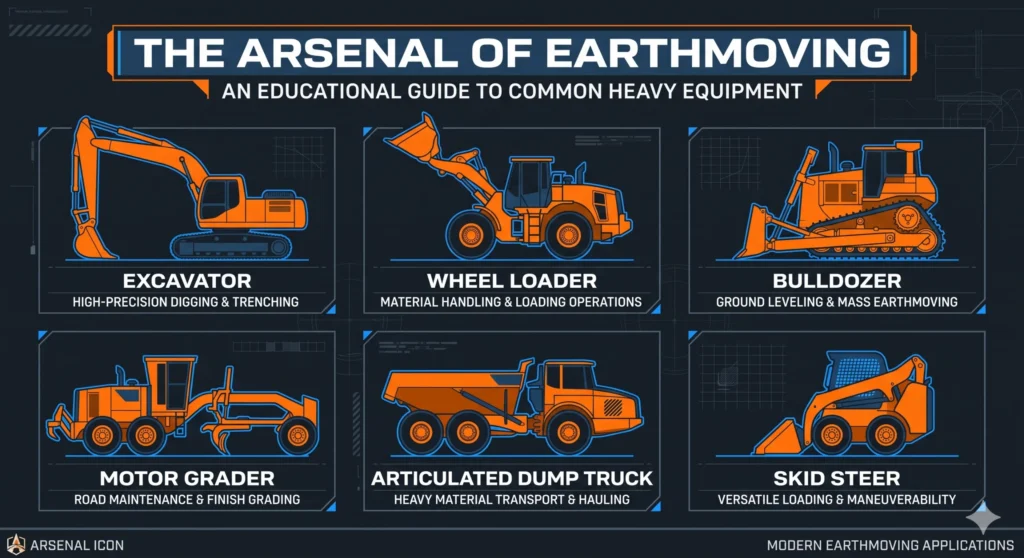
Excavators (Tracked & Wheeled)
- Purpose: The ultimate digging and lifting machine.
- Key Components: Boom, stick, bucket, rotating upper structure (house), and undercarriage.
- Applications: Trenching, demolition, mass excavation, and heavy lifting.
Wheel Loaders (Front-End Loaders)
- Purpose: Scooping and loading loose material (gravel, dirt, snow) into trucks or hoppers.
- Key Components: Articulated steering joint (the machine bends in the middle), massive front bucket, Z-bar linkage.
- Applications: Quarries, batch plants, snow removal, and general construction.
Bulldozers (Track-Type Tractors)
- Purpose: Pushing massive amounts of material and rough grading.
- Key Components: Heavy front blade, rear ripper (for breaking hard ground), steel track undercarriage.
- Applications: Mine site preparation, land clearing, road building.
Motor Graders
- Purpose: Precision leveling and fine grading.
- Key Components: A long wheelbase, a belly-mounted moldboard (blade), and leaning front wheels.
- Applications: Creating the final smooth surface before asphalt is laid, and maintaining haul roads in mines.
Backhoe Loaders
- Purpose: The “Swiss Army Knife” of construction. A tractor with a loader bucket on the front and a small excavator arm on the rear.
- Key Components: Front loader, rear boom/dipper, stabilizer legs.
- Applications: Urban construction, utility repair, plumbing, and landscaping.
Articulated Dump Trucks (ADTs)
- Purpose: Hauling material through extreme mud and rough terrain where rigid trucks would get stuck.
- Key Components: An oscillating hinge separating the cab from the dump body, allowing all six wheels to maintain ground contact on uneven terrain.
Rigid Dump Trucks (Haul Trucks)
- Purpose: Moving massive payloads (up to 400 tons) on maintained dirt haul roads.
- Key Components: Massive V12-V20 engines, mechanical or AC electric-drive powertrains, and tires that stand 13 feet tall.
- Applications: Surface mining.
Skid Steers (Compact Track Loaders)
- Purpose: Highly maneuverable, compact loading and grading.
- Key Components: Fixed wheels/tracks (it steers by skidding the left tires against the right tires), universal attachment plate.
Telehandlers
- Purpose: Lifting material to high elevations. A hybrid between a forklift and a crane.
- Key Components: Telescopic extending boom, forklift tines.
Compactors
- Purpose: Densifying soil, gravel, or asphalt to prevent future settling.
- Key Components: Massive vibrating steel drums or pneumatic tires.
6. How Heavy Equipment Works (The Basics)
To a beginner, a 50-ton excavator looks like magic. To a technician, it is a logical sequence of energy transfer.
- Energy Creation (Diesel Engine): The engine burns diesel fuel, converting chemical energy into rotational mechanical energy (spinning the flywheel).
- Energy Conversion (Hydraulic Pumps): The spinning flywheel drives hydraulic pumps. These pumps take hydraulic fluid from a tank and push it into the system under immense pressure (often 5,000 PSI). The rotational energy is now fluid power.
- Energy Direction (Control Valves): When the operator moves a joystick, electronic signals tell massive hydraulic valves to open or close, directing that high-pressure fluid to specific areas of the machine.
- Energy Execution (Cylinders & Motors): The fluid enters a hydraulic cylinder, pushing the steel rod out (lifting the boom). Or, the fluid enters a hydraulic motor, converting fluid power back into rotational energy to spin the tracks.
7. The Major Systems Inside Heavy Equipment
Modern machines are highly integrated ecosystems. A failure in one system will immediately compromise the others.
- Diesel Engines: The prime mover. Modern engines rely on high-pressure common rail (HPCR) injection and complex exhaust aftertreatment.
- Powertrains: The components that transfer engine power to the ground. This includes torque converters, powershift transmissions, driveshafts, and massive planetary final drives.
- Hydraulics: The muscle. Closed-center load-sensing (CCLS) systems ensure the pump only generates flow when the operator asks for it, saving fuel.
- Electrical Systems & Sensors: The nervous system. Sensors monitor temperatures, pressures, and positions, feeding data to the computers.
- Electronic Control Units (ECUs): The brains. Every machine has multiple computers (Engine ECM, Hydraulic ECU, Transmission Controller) talking to each other over a high-speed CAN bus network.
8. Heavy Equipment Manufacturers
The industry is dominated by massive global corporations, each with distinct specialties.
- Caterpillar (Cat): The undisputed global giant. Famous for iconic yellow iron, massive dealership support networks, and dominance in global mining and earthmoving.
- Komatsu: The Japanese powerhouse. Cat’s primary rival globally, known for pioneering hybrid excavators and autonomous haulage systems (AHS).
- Volvo Construction Equipment (Volvo CE): The Swedish innovator. Famous for inventing the articulated dump truck, exceptional operator comfort, and leading the charge in battery-electric compact equipment.
- Hitachi: Renowned globally for producing some of the most reliable and massive hydraulic mining excavators and shovels on earth.
- Liebherr: German-Swiss engineering. Famous for massive mining trucks, incredible mobile cranes, and high-end hydrostatic drivetrains.
- John Deere: The American agricultural giant that also produces a massive line of highly regarded construction and forestry equipment.
- Sandvik & Epiroc: The Swedish masters of underground mining, producing the world’s most advanced drill rigs, LHDs (Load Haul Dumpers), and rock crushers.
9. Global Trade Terminology: What Are These Mechanics Called?
If you are researching a career in this industry, you will quickly realize that different countries use entirely different job titles for the exact same profession. If you don’t know the local terminology, you will miss international job opportunities.
- USA: Heavy Equipment Mechanic, Diesel Technician, Heavy Equipment Technician.
- Canada: Heavy Equipment Technician (HET – Red Seal), Heavy Duty Mechanic.
- Australia: HD Mechanic (Heavy Diesel), Diesel Fitter, Mobile Plant Mechanic. (HD Mechanics and Fitters in Australia command some of the highest mining salaries on earth).
- United Kingdom: Plant Mechanic, Mobile Plant Fitter, Agricultural & Plant Engineer. (“Plant” is the UK term for equipment).
- South Africa: Earthmoving Equipment Mechanic, Diesel Fitter (Section 13 Trade Test).
- Middle East & Expat Hubs: Heavy Equipment Technician, Field Service Technician.
Regardless of the title, an elite professional in this trade is a Diagnostic Leader who masters engines, hydraulics, and electronics.
10. Careers In Heavy Equipment
This industry offers a massive, highly lucrative career ladder for those willing to learn.
- Apprentice: The starting point. Learning safety, hand skills, preventative maintenance, and basic theory.
- Qualified Technician / Mechanic: Executing major component overhauls, in-frame engine rebuilds, and standard troubleshooting.
- Field Service Technician: The lone wolf. Operating out of a fully equipped 4×4 service truck, traveling to remote sites to diagnose dead machines in the dirt.
- Diagnostic Specialist / Tech Communicator: The elite troubleshooter. Focusing entirely on laptops, oscilloscopes, and multiplexed CAN bus failures.
- Workshop Supervisor / Foreman: Leading the shift, managing quality control, and mentoring apprentices.
- Reliability Engineer: Utilizing oil analysis and telematics data to predict failures before they happen, saving mining companies millions of dollars.
11. Skills Needed To Succeed
Turning wrenches is only 20% of the modern job.
- Diagnostic Thinking: The ability to trace a complex electro-hydraulic fault to its root cause using logic, schematics, and data, rather than guessing. (Internal Link: Master this in the [Heavy Equipment Diagnostic Process]).
- Computer Literacy: If you cannot navigate OEM diagnostic software (like Cat ET or Cummins INSITE) to flash an ECU, you cannot fix modern iron.
- Safety Awareness: Heavy equipment operates with lethal stored energy (5,000 PSI oil, suspended loads). Safety is a professional skill, not a suggestion. (Internal Link: See [Heavy Equipment Safety]).
- Spatial Reasoning: The ability to look at a 2D hydraulic schematic on a laptop and visualize where those hoses physically route inside a 3D machine chassis.
12. Common Myths About Heavy Equipment
- Myth: Heavy equipment mechanics are just “grease monkeys” who hit things with hammers.
- Reality: Modern technicians are highly paid industrial electro-mechanical diagnosticians. They use digital storage oscilloscopes to measure sensor voltages in milliseconds.
- Myth: Diagnostics is just plugging in a laptop and reading a fault code.
- Reality: A fault code only tells you the symptom (e.g., Low Fuel Pressure). It takes a human to figure out the root cause (a cracked suction hose letting air into the system).
- Myth: Autonomous (driverless) equipment will eliminate mechanic jobs.
- Reality: Autonomous equipment eliminates operators. It drastically increases the need for elite technicians who can calibrate the complex LiDAR, Radar, and GPS sensors required to keep the robots running.
13. Future Of Heavy Equipment
The industry is undergoing a technological renaissance.
- Electrification: Compact excavators and loaders are moving to Battery Electric Vehicles (BEV) to eliminate emissions in urban environments.
- Hybrid Systems: Massive excavators are using electric swing motors to capture kinetic energy and store it in supercapacitors.
- Hydrogen Power: OEMs are developing Hydrogen Internal Combustion Engines (H2ICE) for 100-ton haul trucks to achieve zero carbon emissions without the massive weight penalty of batteries.
- AI & Telematics: Artificial intelligence analyzes machine data remotely, predicting that a transmission bearing will fail in 40 hours and automatically ordering the parts to the workshop.
14. What This Means For New Technicians
If you are a beginner, an apprentice, or a student evaluating this trade, understand this: You are entering the industry at the perfect time.
The older generation of mechanics is retiring, creating a massive global skills vacuum. The industry is desperate for young professionals who are comfortable with laptops, software, and electronic networks. If you combine a strong work ethic with a deep understanding of fluid power and electrical logic, you will never be unemployed, and you can write your own ticket to work anywhere in the world.
Modern Trade Skills exists for this exact reason. We are here to develop Diagnostic Leaders rather than Parts Changers. Start with the basics, respect the iron, learn the systems, and the future is yours.
15. Summary & Key Takeaways
- Fundamental Necessity: Heavy equipment is the foundational tool required to build and sustain modern human civilization.
- Specialized Design: Machines are engineered for extreme torque, high-pressure hydraulics, and brutal durability, unlike passenger vehicles.
- Industry Diversity: Mining, construction, forestry, and agriculture all rely on distinct, highly specialized fleets.
- Major Machine Types: Excavators dig, wheel loaders scoop, dozers push, and haul trucks transport.
- Systems Integration: A machine is an ecosystem. The engine, hydraulics, powertrain, and electronics all depend on each other.
- Global Terminology: Depending on your country, you might be a Heavy Equipment Technician, a Diesel Fitter, an HD Mechanic, or a Plant Mechanic.
- The Rise of Electronics: Modern machines are rolling computer networks. The CAN bus is just as important as the diesel fuel lines.
- Diagnostic Leadership: The highest-paid professionals are those who use data and logic to find root causes, not those who blindly change parts.
- Safety is Absolute: The immense kinetic and stored energy in heavy equipment requires elite LOTO (Lock-Out/Tag-Out) discipline.
- The Future is Digital: Autonomy, AI, Telematics, and Hydrogen power are redefining what it means to be a mechanic.
16. FAQ Section
Q1: What is heavy equipment? A: Large, heavy-duty vehicles designed for construction, earthmoving, mining, forestry, and agricultural tasks, characterized by immense torque and hydraulic power.
Q2: What is the difference between construction and mining equipment? A: Scale and environment. Construction equipment is versatile, road-transportable, and smaller. Mining equipment is ultra-class (often assembled on-site) and built to run 24/7 in highly abrasive, stationary environments.
Q3: What skills are needed to become a heavy equipment technician? A: Mechanical aptitude, a deep understanding of DC electrical systems and Ohm’s Law, hydraulic fluid power logic, and strong computer literacy for OEM diagnostic software.
Q4: Which heavy equipment jobs pay the most? A: Fly-In Fly-Out (FIFO) HD Mechanics in the Australian mining sector, Field Service Technicians in remote environments (like the Canadian Oil Sands), and specialized Reliability Engineers.
Q5: What is the future of heavy equipment? A: A shift away from fossil diesel toward Hydrogen Internal Combustion, Battery Electric Vehicles, and highly autonomous (driverless) fleets monitored by Artificial Intelligence.
Q6: What is a Diesel Fitter? A: The Australian, South African, and Commonwealth term for a Heavy Duty Diesel Mechanic, often emphasizing precision mechanical fitting and component rebuilds.
Q7: How do hydraulics work on an excavator? A: The diesel engine spins a hydraulic pump. The pump pushes pressurized fluid through valves. The valves direct the fluid into cylinders, which physically extend or retract to move the massive steel boom.
Q8: Why are machines so reliant on computers now? A: To meet strict environmental emissions laws (Tier 4/Stage V) and to optimize fuel efficiency, engines and hydraulic pumps must be micro-managed by Electronic Control Units (ECUs).
Q9: Do I need to be physically strong to do this job? A: Physical stamina is required, but modern workshops use overhead cranes, hydraulic presses, and ergonomic tooling. Brainpower and laptop skills are vastly more important than brute strength today.
Q10: What is telematics? A: Systems installed on heavy equipment that transmit location, fuel burn, operator behavior, and active fault codes wirelessly to the cloud for remote monitoring by fleet managers.
Q11: What does an OEM Field Service Technician do? A: They operate out of a fully equipped service truck and travel to customer job sites to diagnose and repair broken machines in the dirt, requiring high independence and elite diagnostic skills.
Q12: Can I work on heavy equipment without a college degree? A: Absolutely. The industry relies on vocational apprenticeships, trade schools, and on-the-job competency training, allowing you to earn a high salary with zero university debt.
Q13: What is a powertrain? A: The system of components—torque converter, transmission, driveshafts, and final drives—that takes the rotational power from the engine and transfers it to the wheels or tracks.
Q14: Why is safety so critical in this trade? A: The parts weigh thousands of pounds, the hydraulic oil is under 5,000 PSI, and the electrical systems possess massive amperage. A single mistake can easily result in a fatality.
Q15: What is a “parts changer”? A: A derogatory term for a mechanic who guesses what is wrong with a machine and replaces expensive parts blindly, rather than using diagnostic testing to prove the root cause of the failure.
17. DIGITAL PRODUCT OPPORTUNITIES
Accelerate your entry into the trade with these exclusive Modern Trade Skills digital resources:
- Heavy Equipment Beginner’s Handbook: A highly visual PDF guide detailing the primary components, fluid types, and safety protocols for the 10 most common machines.
- Equipment Identification Guide: A flashcard-style app helping apprentices identify major machine categories, OEM brands, and distinct undercarriage types.
- Career Roadmap Workbook: An interactive planner to help you map your journey from 1st-year apprentice to Elite Diagnostic Leader or Reliability Engineer.
- Equipment Systems Study Guide: A breakdown of how the engine, hydraulics, and CAN bus interact during a standard digging cycle.
- Heavy Equipment Terminology Dictionary: A cross-referenced glossary translating trade slang, acronyms (e.g., LOTO, ECU, DPF), and international job titles.