
Monday to Saturday - 8:00 -17:30

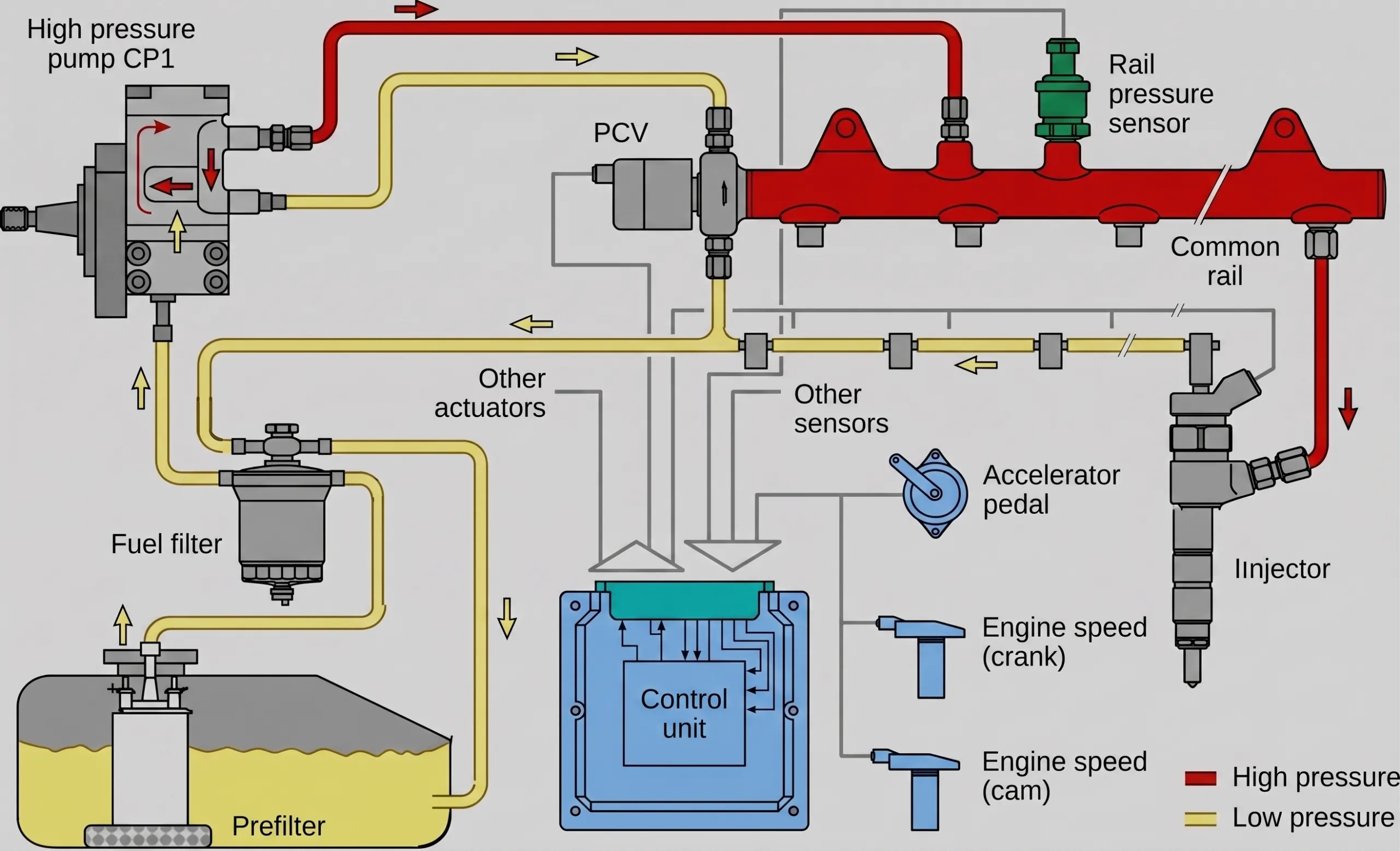
A diesel engine can have good compression and sufficient clean air, but it cannot produce useful power unless the correct amount of fuel is delivered to the cylinder at the correct time and in the correct condition. An engine may have sound mechanical condition, yet a small air leak in a suction-side fuel line or a heavily restricted filter can significantly affect starting and engine performance.
How does fuel travel from the machine’s tank all the way to the injector? Understanding Diesel Fuel Systems is a foundational requirement for any developing technician. This guide traces the complete path of diesel fuel, explaining the components that store, filter, pressurize, and inject fuel into the combustion chamber.
What Is a Diesel Fuel System?
A diesel fuel system is the network of components responsible for storing, cleaning, delivering, pressurizing, metering, and injecting fuel.
Its primary purposes are to:
- Store fuel safely.
- Remove contamination and water.
- Deliver fuel to the engine.
- Create the required injection pressure.
- Meter the quantity of fuel required.
- Control injection timing.
- Inject fuel into the combustion chamber.
- Return excess fuel where required by the design.
Exact architecture varies significantly between engine generations and manufacturers. However, Diesel Fuel Systems play a major role in engine power, combustion quality, emissions performance, and reliability.
Follow the Fuel: Tank to Injector
To diagnose a fuel-system fault, you must first understand how the fuel flows.
While specific designs vary, a typical pathway is:
Fuel Tank → Pick-Up → Water Separator / Primary Filter → Transfer Pump → Secondary Filter → Injection Pump or High-Pressure Pump → Rail or Injector Supply → Injector → Cylinder
Where applicable, the system also includes a return path:
Injector / Pump Return Fuel → Return Circuit → Fuel Tank
Apprentices should learn to physically trace this fuel path on an engine before attempting to diagnose a performance complaint.
The Fuel Tank and Pick-Up System
The journey begins at the fuel tank.
Fuel Tank
The fuel tank stores diesel fuel and may include:
- pick-up connections
- return connections
- drain arrangements
- level sensing
- breather or venting provisions
Correct tank venting is important because fuel leaving the tank must be replaced by air. A blocked or restricted vent can affect fuel delivery.
Pick-Up
The pick-up allows fuel to leave the tank and enter the supply circuit.
Potential problems at this stage can include:
- contamination
- damaged pick-up components
- internal restrictions
- air entry
- blocked tank venting
Why Diesel Fuel Must Be Clean
Modern Diesel Fuel Systems contain precision components that may operate with very small internal clearances.
Clean fuel is essential for protecting:
- pumps
- injectors
- control valves
- sealing surfaces
- other precision fuel-system components
Common contamination threats include:
Dirt and Debris
Abrasive particles can damage precision surfaces and interfere with component movement.
Water
Water can reduce the lubricating properties of diesel fuel and may contribute to corrosion or wear.
Microbial Contamination
Microorganisms can develop where water and fuel coexist under suitable conditions, producing sludge and contamination.
Degraded or Unsuitable Fuel
Fuel degradation can create deposits or other conditions that interfere with filtration and fuel-system operation.
Water and particulate contamination can reduce lubrication, promote corrosion or wear, and damage precision components depending on the severity and system design.
Primary Filters and Water Separation
The first filtration stage may combine:
- coarse filtration
- water separation
- sediment collection
Depending on the design, the assembly may also include:
- a drain bowl
- a water-in-fuel sensor
- other manufacturer-specific features
Exact filter ratings and construction vary by OEM.
Technicians must follow manufacturer servicing procedures when maintaining fuel filters.
Do not pre-fill a new filter with fuel from an uncontrolled container unless the OEM procedure specifically requires or permits it. Poor servicing practices can introduce contamination directly into the clean side of the system.
Transfer Pumps and Low-Pressure Fuel Supply
The transfer pump, sometimes called a lift pump, moves fuel from the tank through the low-pressure supply circuit. Reliable Diesel Fuel Systems depend on a healthy low-pressure supply before pressure generation can occur farther downstream.
Possible designs include:
- gear-driven pumps
- mechanically driven pumps
- electrically driven pumps
- other manufacturer-specific arrangements
The high-pressure side cannot operate correctly if the low-pressure supply side cannot deliver sufficient fuel.
Possible low-pressure problems may include:
- restricted filters
- air intrusion
- weak transfer-pump performance
- blocked tank venting
- damaged hoses
- damaged seals
This is why low-pressure fuel supply should be evaluated before condemning high-pressure components.
Secondary Fuel Filtration
Many engines use additional filtration before fuel reaches precision injection components.
The purpose of the secondary filter is to remove finer contamination and provide additional protection for:
- high-pressure pumps
- injectors
- control valves
Technicians should use filtration that meets the manufacturer’s specification.
Low-Pressure Side vs High-Pressure Side
Understanding Diesel Fuel Systems becomes easier when the system is divided into two main areas.
Low-Pressure Side
Typically includes:
- fuel tank
- pick-up
- primary filter
- transfer pump
- secondary filter
- low-pressure supply plumbing
Its purpose is to provide a steady supply of clean fuel to the injection system.
High-Pressure Side
Depending on system architecture, this may include:
- injection pump
- high-pressure pump
- fuel rail
- high-pressure lines
- injectors
Its purpose is to create and deliver the pressure required for injection.
Safety Warning
High-pressure diesel fuel can cause serious injection injuries.
Follow OEM isolation, depressurization, inspection, and testing procedures.
Do not loosen, crack, block, or improvise repairs on high-pressure fuel lines while the system is pressurized.
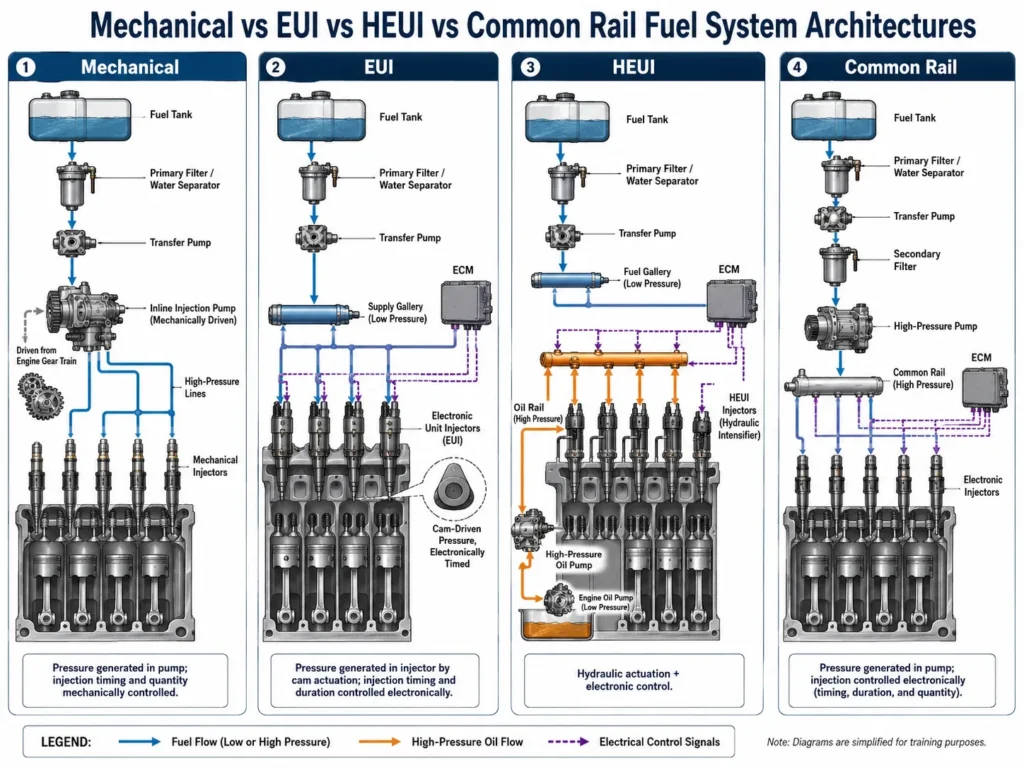
Mechanical Diesel Injection Systems
Mechanical injection systems remain important in many legacy heavy-equipment and industrial fleets.
These systems use mechanically driven components to:
- generate injection pressure
- meter fuel
- determine injection timing
- distribute fuel to the cylinders
Possible architectures include:
- inline injection pumps
- rotary or distributor pumps
- mechanical unit injectors
Mechanical systems are far less common on newer electronically controlled engines, but technicians working with older equipment still need to understand them.
Inline Injection Pumps
An inline injection pump typically uses multiple pumping elements, commonly associated with individual engine cylinders.
The pump is mechanically driven and coordinates pressure generation and fuel delivery with engine timing.
The exact internal design varies by manufacturer and application.
Rotary and Distributor Pumps
A rotary or distributor pump may use a central pumping mechanism that pressurizes fuel and distributes it sequentially to multiple cylinders.
These systems have been used in many smaller and medium diesel-engine applications.
Unit Injector Systems
Unit-injector systems place the pumping and injection functions close to or directly within the injector assembly.
Instead of generating high pressure remotely and sending it through long external high-pressure pipes, pressure generation occurs at or near the injector.
This arrangement can reduce or eliminate the need for long external high-pressure lines depending on system design.
Unit injectors may use:
- mechanical actuation
- electronic control
- hydraulic actuation
This leads to several different injector architectures.
Electronic Unit Injectors
In Electronic Unit Injector systems, commonly called EUI systems, mechanical motion such as a camshaft lobe may generate injection pressure.
Electronic control then determines the injection event timing, duration, or related functions depending on the design.
The Engine Control Module controls an injector solenoid or another actuator to influence fuel delivery.
HEUI Fuel Systems
HEUI stands for:
Hydraulically Actuated Electronically Controlled Unit Injector
HEUI differs from purely camshaft-driven injection systems.
At foundation level:
- Engine oil is pressurized by a high-pressure oil system.
- Pressurized oil acts on an injector intensifier mechanism.
- The injector converts this hydraulic actuation into the fuel pressure required for injection.
- Electronic control determines the injection event.
A developing technician should understand that HEUI combines three systems:
Fuel System + High-Pressure Engine Oil System + Electronic Control
This is why a HEUI complaint cannot always be diagnosed by looking only at the fuel side.
High-Pressure Common Rail Fuel Systems
In a High-Pressure Common Rail system, pressure generation is largely separated from the timing of individual injection events.
The high-pressure pump supplies pressurized fuel to a shared accumulator called the common rail.
Electronically controlled injectors are supplied with pressurized fuel from the rail.
The ECM then controls injection events according to engine design and operating conditions.
The general sequence is:
Low-Pressure Supply → High-Pressure Pump → Common Rail → Injector → Cylinder
This architecture gives the engine-control system greater flexibility over fuel-pressure and injection strategies than many older mechanical systems. In modern electronically controlled Diesel Fuel Systems, common rail architecture allows pressure generation and injection control to be managed as related but separate functions.
What the Common Rail Does
The common rail acts as a shared high-pressure fuel reservoir or accumulator.
Its functions may include:
- providing a shared source of pressurized fuel to the injectors
- maintaining available fuel pressure
- reducing pressure fluctuations
- supporting electronically controlled injection events
The exact rail design and pressure-control strategy vary between manufacturers.
What Diesel Injectors Do
The injector is the final fuel-delivery component before combustion.
Its basic functions are to:
- receive fuel
- meter or control fuel delivery
- open at the commanded or designed time
- deliver fuel through precision nozzle orifices
- produce the required spray pattern for the combustion chamber
Injector types include:
- mechanical injectors
- electronic unit injectors
- HEUI injectors
- common rail solenoid injectors
- piezoelectric injectors where applicable
Different injector architectures achieve these functions in different ways.
Why Fuel Atomization Matters
Liquid diesel must be introduced into the combustion chamber in a form that allows it to mix effectively with hot compressed air.
Smaller droplets generally provide greater surface area for evaporation and mixing.
Several factors influence fuel preparation and combustion, including:
- injection pressure
- injector-nozzle design
- combustion-chamber design
- injection timing
- air movement
- engine operating conditions
Atomization is therefore part of a larger combustion process rather than an isolated injector function.
Injection Timing Explained
Fuel must be injected at an appropriate point in the engine cycle.
As the piston approaches the end of the compression stroke, injection events may begin depending on engine design and operating strategy.
Injection does not necessarily begin exactly at top dead center.
Incorrect timing can affect:
- combustion quality
- engine power
- emissions
- combustion noise
- exhaust temperature
This is why injection timing must be considered together with crankshaft position, engine speed, load, and control strategy.
Multiple Injection Events
Some electronically controlled Diesel Fuel Systems may use more than one injection event during a combustion cycle.
Possible events include:
Pilot Injection
A small injection before the main event may help shape the beginning of combustion and reduce combustion noise.
Main Injection
The main injection provides the primary fuel quantity associated with useful combustion work.
Post Injection
Where used, a later injection may support emissions-control or exhaust-temperature management strategies.
Not every engine uses the same number, timing, or purpose of injection events.
Fuel Return Systems
Not all fuel supplied to engine components is necessarily injected into the cylinders.
Depending on system design, some supplied fuel may return to the tank or supply circuit.
Return flow may support:
- component cooling
- lubrication
- internal leakage flow
- pressure regulation
- other system functions
Return-circuit design varies significantly between fuel systems.
Sensors Used in Electronic Diesel Fuel Systems
Electronic Diesel Fuel Systems rely on sensor information to monitor operating conditions.
Possible examples include:
Fuel Rail Pressure Sensor
Where fitted, measures pressure in the fuel rail.
Fuel Temperature Sensor
Provides fuel-temperature information that may be used by the control system.
Crankshaft Position Sensor
Helps the ECM determine engine speed and crankshaft position.
Camshaft Position Sensor
May help the ECM determine engine phase and cylinder identification.
Injection Actuation Pressure Sensor
Used on some HEUI systems to monitor high-pressure oil actuation conditions.
Not every engine uses all of these sensors.
Fuel-System Actuators
Actuators carry out commands from the engine-control system.
Possible examples include:
- electronic injectors
- fuel metering valves
- suction control valves
- pressure-control valves
- fuel shutoff devices
- HEUI control valves
Their role is to carry out ECM commands by controlling fuel delivery, pressure, timing, or system state according to the design.
Names and operating strategies vary between manufacturers.
How the ECM Controls Fuel Delivery
The Engine Control Module may use information such as:
- accelerator or torque demand
- engine speed
- engine load
- airflow
- intake pressure
- engine temperature
- fuel pressure
- emissions-system conditions
It may then control functions including:
- injection timing
- injection duration
- fuel-pressure targets
- injector events
- protection strategies
- derate strategies
Electronic Diesel Fuel Systems operate as part of a larger interconnected engine-control network.
The fuel system cannot be understood correctly in isolation from the rest of the engine.
Air Intrusion vs Fuel Restriction
When testing the low-pressure fuel supply, technicians should distinguish between two different conditions.
Restriction
A restriction limits fuel flow.
Possible causes include:
- restricted filters
- blocked pick-up
- damaged hoses
- tank venting problems
- contamination
Air Intrusion
A leak on some suction-side or low-pressure fuel circuits may allow air to enter even when little or no fuel is visibly leaking out.
Air intrusion can affect:
- priming
- starting
- fuel delivery
- pressure generation
- engine performance
A useful diagnostic question is:
Is the fuel supply restricted, or is air entering the system?
That distinction can help guide the next stage of testing.
Why Fuel Contamination Matters
Fuel cleanliness is a system requirement, not simply a filter issue. Because of these small internal clearances, contamination control is fundamental to the reliability of Diesel Fuel Systems.
Contamination can include:
- dirt
- water
- degraded fuel
- biological contamination where applicable
These contaminants can affect:
- pumps
- injectors
- valves
- filters
- sealing surfaces
Maintaining fuel cleanliness involves more than changing onboard filters.
The complete contamination-control chain may include:
- bulk fuel storage
- transfer equipment
- machine fuel tanks
- servicing practices
- filtration
- handling procedures
A clean filter cannot compensate for poor fuel-handling practices elsewhere in the system.
Diagnostic Leader Perspective: Do Not Blame the Injector First
When an engine develops:
- hard starting
- low power
- rough running
- misfire
- abnormal smoke
- fuel-pressure complaints
do not automatically replace the injectors.
A Diagnostic Leader does not assume the injector is at fault. The diagnosis is built from evidence. Diagnosing Diesel Fuel Systems correctly requires following the entire fuel path rather than judging one component from a single symptom.
Ask systematically:
- Is clean fuel available?
- Is the tank venting correctly?
- Is the low-pressure supply healthy?
- Are the filters restricted?
- Is air entering the supply system?
- Is the required pressure being generated?
- Are pressure readings believable?
- Is the injection system being controlled correctly?
- Is the problem actually fuel-related?
An injector fault should be a conclusion supported by testing and evidence, not a starting assumption.
Connect Fuel Diagnosis to the Combustion System
A diesel engine depends on the interaction of:
Air + Compression + Fuel + Correct Timing
Symptoms can overlap between systems.
For example, low power may result from:
- insufficient air
- insufficient fuel
- incorrect electronic control
- poor mechanical condition
- exhaust restriction
- other system faults
Smoke colour alone should not be treated as a final diagnosis.
Black smoke, for example, may result from:
- insufficient air
- excessive fuel delivery
- poor atomization
- combustion problems
- other engine-system faults
The technician must test the complete combustion system rather than diagnosing from one symptom alone.
Common Diesel Fuel-System Problems
Possible problem areas include:
- contaminated fuel
- water contamination
- restricted fuel filters
- air intrusion
- damaged supply hoses
- weak transfer-pump performance
- high-pressure pump problems
- injector faults
- pressure-control faults
- sensor faults
- wiring faults
- return-circuit problems
- incorrect or poor-quality fuel
This is a list of possible fault areas.
It is not a diagnostic flowchart.
Testing is still required to identify the root cause.
Common Apprentice Mistakes
Mistake 1: “Hard starting means bad injectors.”
Correction: Hard starting can involve fuel supply, pressure generation, air intrusion, compression, cranking speed, sensors, electrical control, or other causes.
Mistake 2: “Low rail pressure means the high-pressure pump is bad.”
Correction: Low measured pressure may result from problems elsewhere in the supply, return, control, sensor, or injection system.
Mistake 3: “Black smoke proves over-fueling.”
Correction: Smoke should be interpreted alongside airflow, load, combustion, fuel delivery, and overall engine condition.
Mistake 4: “A new fuel filter is automatically safe to install any way I want.”
Correction: Fuel-filter installation and priming must follow manufacturer procedures to protect system cleanliness.
Mistake 5: “All diesel injection systems work like common rail.”
Correction: Mechanical, EUI, HEUI, and common rail systems generate and control injection pressure differently.
Mistake 6: “The fault code tells me which part to replace.”
Correction: A fault code identifies a detected condition or circuit problem. Further testing is required to determine the root cause.
Frequently Asked Questions About Diesel Fuel Systems
What is the purpose of a diesel fuel system?
A diesel fuel system stores, filters, delivers, pressurizes, meters, and injects fuel into the combustion chamber according to the engine’s design.
What is the difference between the low-pressure and high-pressure fuel sides?
The low-pressure side moves clean fuel from the tank toward the injection system.
The high-pressure side creates and delivers the pressure required for injection.
What does a diesel fuel injector do?
The injector controls the final delivery of fuel into the combustion chamber and produces the spray pattern required by the engine design.
What is a common rail fuel system?
A common rail system uses a high-pressure pump to supply pressurized fuel to a shared rail.
Electronically controlled injectors receive fuel from this rail, allowing injection events to be controlled separately from pressure generation.
What does a high-pressure fuel pump do?
It receives low-pressure supply fuel and pressurizes it to the level required by the injection system.
What is HEUI?
HEUI stands for Hydraulically Actuated Electronically Controlled Unit Injector.
It uses high-pressure engine oil to actuate an injector intensifier mechanism that produces the fuel pressure required for injection.
Why do diesel engines use fuel filters?
Fuel filters remove contaminants that could damage precision components inside Diesel Fuel Systems.
Some systems also use water-separation stages.
Can air entering the fuel system cause hard starting?
Yes.
Air intrusion can interfere with priming, fuel delivery, and pressure generation, which may contribute to starting problems depending on the system design.
Does low fuel pressure always mean a failed pump?
No.
Low pressure may result from:
- restricted filters
- inadequate low-pressure supply
- air intrusion
- internal leakage
- control problems
- sensor faults
- injector-related leakage
- pump problems
Testing is required to identify the cause.
Why is fuel cleanliness important?
Many modern Diesel Fuel Systems use components with very small internal clearances.
Contamination can cause wear, sticking, leakage, poor control, and premature component failure.
Final Message: Follow the Fuel
To troubleshoot effectively, visualize the complete pathway:
Fuel Tank → Pick-Up → Primary Filter / Water Separator → Transfer Pump → Secondary Filter → Injection Pump or High-Pressure Pump → Rail or Injector → Cylinder
When troubleshooting Diesel Fuel Systems, follow the fuel before replacing parts.
Ask:
- Is clean fuel available?
- Can it leave the tank?
- Can it pass through the filters?
- Is air entering the system?
- Is the low-pressure supply healthy?
- Is injection pressure being generated?
- Are the sensors believable?
- Is the injector receiving the correct command?
- Is the fault actually in the fuel system?
Trace the system. Test the condition. Prove the fault.
That is systems thinking.
That is how a technician develops into a Diagnostic Leader rather than a parts changer.
References and Further Reading
For engine-specific fuel-system layouts, filtration specifications, priming procedures, pressure requirements, component testing, and safety procedures, technicians should consult the appropriate manufacturer technical information.
Useful technical source categories include:
- Bosch diesel-system technical literature
- Cummins technical information
- Caterpillar technical and service information where publicly available
- OEM Operation and Maintenance Manuals
- OEM service and training information
- SAE International technical resources
Modern Trade Skills Institutional Reference
Modern Trade Skills Handbook Version 1.0
Institutional reference for the Modern Trade Skills Diagnostic Leader philosophy, systems-thinking framework, and apprentice-development principles.