Monday to Saturday - 8:00 -17:30

1. Introduction
Walk into any heavy equipment workshop in the world—from a massive mining infrastructure facility in the Australian Pilbara to an OEM dealership in North America—and you will notice a stark divide on the shop floor. On one side are technicians who have been in the trade for twenty years but are still performing basic preventative maintenance (PM) and heavy component R&R (Remove and Replace). On the other side are technicians with perhaps only seven years of experience who are managing complex multiplexed CAN bus failures, earning premium salaries, and leading the diagnostic strategy for the entire fleet.
Why does this disparity exist? Because many technicians believe that technical success comes from mechanical skill alone. They judge their progress by how fast they can swing a wrench or strip a diesel engine.
But modern machinery has evolved. What makes a good diesel technician today has very little to do with turning spanners.
There is a critical difference between experience (repeating the same basic tasks for a decade), competence (the ability to follow a manual safely), and expertise (the ability to diagnose and solve a problem that no one else can). Simply replacing failed parts does not create a valuable technician; it creates a parts changer. This comprehensive guide, written from the perspective of an OEM Service Manager and Reliability Engineer, breaks down the exact traits, habits, and cognitive skills that transform an average mechanic into an elite, globally employable heavy equipment professional.
2. The Myth Of The “Good Mechanic”
For generations, workshop culture has glorified the wrong metrics. We must dismantle the myths of what makes a “good mechanic.”
- Fast Wrench-Turning: Speed is a liability if it compromises precision. A technician who rebuilds a final drive in record time but skips the rolling torque preload measurement has just guaranteed a catastrophic failure within 500 hours.
- Knowing Part Numbers by Heart: Memorization is not diagnostics. Knowing the part number for a fuel injector is irrelevant if you cannot diagnose the fuel rail pressure variance that destroyed it.
- Working Long Hours: Brute force and 80-hour workweeks are often signs of inefficiency, poor troubleshooting, or a lack of proper tooling.
- Physical Strength: Modern workshops use overhead cranes, hydraulic presses, and specialized pullers. Brainpower, laptop literacy, and multimeter proficiency have replaced pure physical strength as the ultimate shop floor currency.
These traditional qualities alone do not create elite technicians. They create mechanics who can execute a repair only after someone else has figured out what is broken.
3. The Evolution Of The Diesel Technician
To understand the modern skillset, you must look at how the profession has evolved.
- Generation 1: Mechanical Technicians (Pre-1990s). Equipment was governed by mechanical physics. Fuel injection was controlled by flyweights; transmissions were manual or simple powershift. You diagnosed faults with a pry bar, a pressure gauge, and a good ear.
- Generation 2: Mechanical + Hydraulic Technicians (1990s–2000s). The introduction of complex load-sensing hydraulics and early electronic unit injectors. Technicians had to learn fluid dynamics and basic electrical theory.
- Generation 3: Systems Technicians (Present). The era of electro-hydraulics, Tier 4 Final emissions, autonomous guidance, and multiplexed networks. Today’s equipment is essentially a server rack on tracks.
If a Generation 3 technician cannot read a CAN bus waveform on a digital oscilloscope, they cannot fix the machine. The physical iron is now entirely subservient to the electronic brain.
4. Trait #1 – Diagnostic Thinking
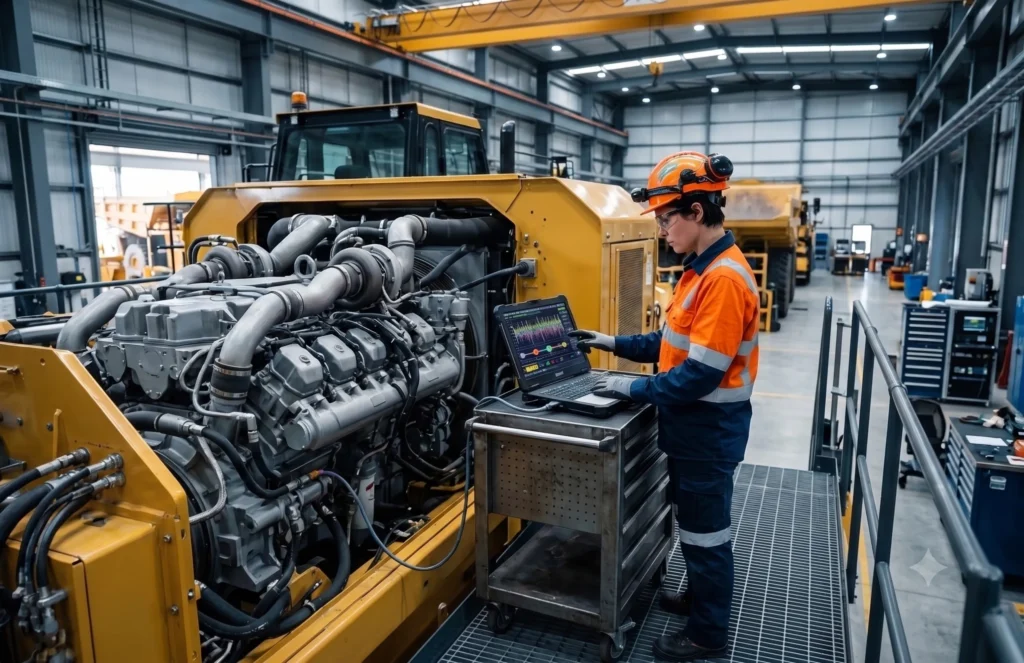
The highest-paid technicians are not the best mechanics; they are the best problem-solvers. Diagnostic thinking is the ability to use logic, data, and testing to isolate a fault.
- Symptom Versus Cause: A parts changer sees a burned clutch pack and replaces it. A diagnostic thinker knows the burned clutch is just the symptom. The cause is a leaking Teflon seal on the clutch shaft dropping apply pressure from 350 PSI to 150 PSI.
- Evidence-Based Troubleshooting: Elite technicians do not guess. They rely on the [Heavy Equipment Diagnostic Process – A Structured Framework For Eliminating Repeat Failures]. They state a hypothesis and prove it with live data (e.g., verifying a hydraulic pressure drop under stall load).
- Logical Fault Isolation: If an engine cranks but won’t start, the diagnostic thinker splits the system: Is it lacking air, fuel, compression, or timing? They test each branch logically rather than throwing parts at the engine block.
5. Trait #2 – Systems Thinking
Modern heavy equipment does not operate as a collection of independent parts; it is an integrated, communicating ecosystem.
- Cross-System Interaction: A technician who lacks systems thinking will spend three days trying to figure out why an excavator’s main hydraulic pump will not stroke up. A systems thinker checks the Engine Control Unit (ECU) data and realizes the engine has an active fault code for a faulty intake manifold temperature sensor, causing the engine ECU to broadcast a “derate” message to the hydraulic controller via the J1939 CAN network.
- The Big Picture: Engines, hydraulics, electronics, and sensors constantly negotiate power distribution. You cannot master one system while remaining ignorant of the others.
6. Trait #3 – Understanding Failure Chains
When a component fails, it triggers a domino effect. Understanding this sequence separates the professionals from the amateurs.
- Primary vs. Secondary Failures: If a primary failure (a stuck bypass valve in the engine oil cooler) occurs, it causes a secondary failure (engine oil temperature spikes), which causes a tertiary failure (main bearings spin due to loss of hydrodynamic oil film).
- The Cost of Ignorance: If a technician rebuilds the engine but fails to trace the failure chain back to the stuck bypass valve, the rebuilt engine will destroy itself during the initial dyno test. You must trace the chain upstream to the initiating defect.
7. Trait #4 – Technical Curiosity
Elite technicians possess an insatiable need to understand how things work, not just how to fix them.
- Asking “Why?”: When a component is removed, the curious technician disassembles it on the bench to find the internal failure point. They ask: Why did it fail? What changed in the operating environment? Was it operator abuse, poor lubrication, or component fatigue?
- Lifelong Learning: Technology changes every six months. The good diesel technician reads OEM service letters on their lunch break, studies hydraulic schematics at home, and actively pursues factory training. Complacency is career suicide.
8. Trait #5 – Electrical And Electronic Competence
In the modern era, if you are afraid of electricity, you are obsolete.
- Beyond the Test Light: You cannot diagnose a 5-volt reference sensor circuit with an incandescent test light; you will fry the ECU driver. You must master the digital multimeter (DMM).
- Voltage Drop Testing: Resistance is the enemy of heavy equipment networks. Elite technicians know that [How Poor Electrical Diagnostics Cause Wiring Harness Failures In Heavy Equipment] is rooted in technicians failing to perform loaded voltage drop tests to find corroded grounds.
- Sensor Logic: Understanding how 3-wire active sensors pull down 5V references to communicate physical realities to the ECU is mandatory.
9. Trait #6 – Documentation Skills
A job is not complete until the paperwork is finished. Documentation is not an administrative burden; it is a critical diagnostic and legal tool.
- Service Reports: “Machine broke. Fixed it” is a backyard repair standard. A professional writes: “Complaint: Low power under load. Investigation: Graphed live fuel rail pressure, noted actual pressure dropping 10,000 PSI below desired pressure during stall test. Root Cause: High-pressure relief valve bypassing. Correction: Replaced valve, verified pressures in spec.”
- Reliability and Warranty: Without meticulous documentation, OEMs will reject warranty claims, and Reliability Engineers cannot track Mean Time Between Failures (MTBF) to adjust preventative maintenance intervals.
10. Trait #7 – Communication Skills
Technicians do not work in a vacuum. Your ability to communicate dictates your career ceiling.
- Interviewing Operators: The operator is your first sensor. A good technician asks precise, non-leading questions: “Does the vibration happen in all gears, or only in 3rd gear lock-up?”
- Interacting with Engineers and Management: When requesting technical support from an OEM factory engineer (a DSN/TSR request), you must be able to articulate the exact live data, fault codes, and schematic test points you have already verified.
11. Trait #8 – Professional Discipline
Discipline is what ensures a machine leaves the bay and operates for 10,000 hours without an infant mortality failure.
- Contamination Control: A disciplined technician never leaves open hydraulic hoses uncapped. They understand that ISO 4406 dirt particles will destroy a load-sensing variable displacement pump instantly.
- OEM Standards: They do not use standard breaker bars on torque-to-yield head bolts. They follow the manual precisely.
- Tool Control and Cleanliness: A chaotic, dirty toolbox reflects a chaotic, dirty mind. Elite diagnosticians keep their work areas sterile to protect the integrity of the repair.
12. Trait #9 – Safety Leadership
In heavy industry, safety is not a poster on the wall; it is a leadership trait. A technician who takes shortcuts with safety is a liability who will eventually kill themselves or a coworker.
- Lockout/Tagout (LOTO): A professional refuses to turn a wrench until all hazardous energy (electrical, pneumatic, kinetic) is physically locked out and verified zero-energy.
- Stored Energy: They understand that a suspended boom or an accumulator holding 5,000 PSI of nitrogen-charged hydraulic fluid is a lethal weapon that must be blocked and bled.
- Setting the Standard: Good technicians stop unsafe work, even if it means confronting a senior mechanic or a screaming production supervisor.
13. Trait #10 – Ownership And Accountability
Mistakes happen in heavy equipment repair. How a technician handles a mistake defines their character.
- Standing Behind the Work: A professional owns the repair from start to finish. If a machine comes back on a rework, they do not blame the operator; they investigate their own assembly process.
- Learning from Mistakes: Hiding a stripped thread or a dropped dowel pin guarantees a catastrophic failure in the dirt. An accountable technician raises their hand, reports the mistake, and fixes it properly in the bay.
14. Why Some Technicians Never Progress
It is common to see mechanics stall out at year five of their careers. The reasons are entirely behavioral:
- Blaming the Equipment: “These new electronic machines are just junk.” This is an excuse for failing to understand the technology.
- Refusing Training: Skipping after-hours schematics classes or refusing to learn the new OEM software platform.
- The “Parts Cannon”: Firing parts at a fault code until the light goes out, rather than performing a root cause analysis.
- Poor Attitude: Being uncoachable. If a foreman cannot teach you, they will stop trying, and your career will stagnate.
15. What Workshop Managers Look For
When a Workshop Manager, Maintenance Superintendent, or OEM Service Manager is looking to promote a technician to a leading hand or diagnostic role, they are evaluating ROI (Return on Investment).
- First-Time Fix Rate: Does this technician fix the machine correctly the first time, preventing costly rework and downtime?
- Mentorship: Do they actively teach the apprentices around them, elevating the competence of the entire shop floor?
- Cool Under Pressure: When a $5 million autonomous drill rig goes down and the mine manager is screaming, does the technician panic and guess, or do they calmly pull out their laptop, open the schematic, and methodically trace the fault?
16. What Global Employers Look For
The international recruitment market is ruthless. If you are applying for expat roles in Australia, Canada, the Middle East, or Africa, local “wrenching” experience is not enough.
- The Expat Expectation: When a company pays $20,000 in flights, visas, and camp accommodations, they expect an elite problem solver who can operate completely independently in the dirt.
- Safety and Culture: Global Tier-1 miners demand uncompromising safety records and the ability to respectfully mentor diverse national workforces.
17. Reliability Engineering Perspective
Reliability engineers view the fleet through data. They love elite diagnostic technicians because these technicians feed them accurate data.
- Preventing Failures: A good technician takes a pristine Scheduled Oil Sample (SOS) without contaminating it. The engineer uses that sample to detect microscopic bearing wear, allowing the team to replace the component during a planned PM window rather than suffering an unplanned failure in the pit.
- Machine Availability: Elite technicians directly impact the bottom line by keeping machine physical availability above 90%. They do this by eliminating secondary failures through systems-thinking and thorough diagnostics.
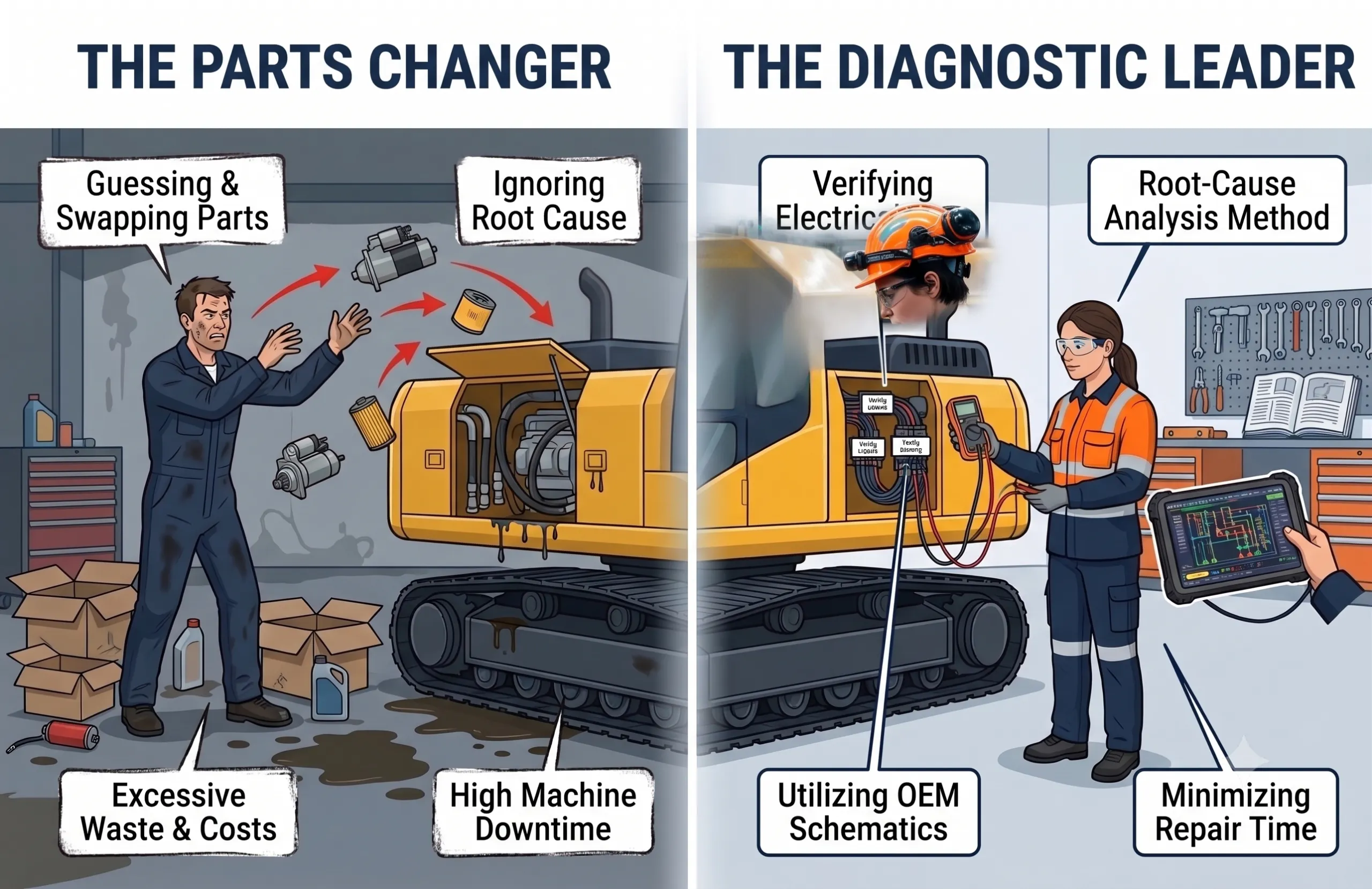
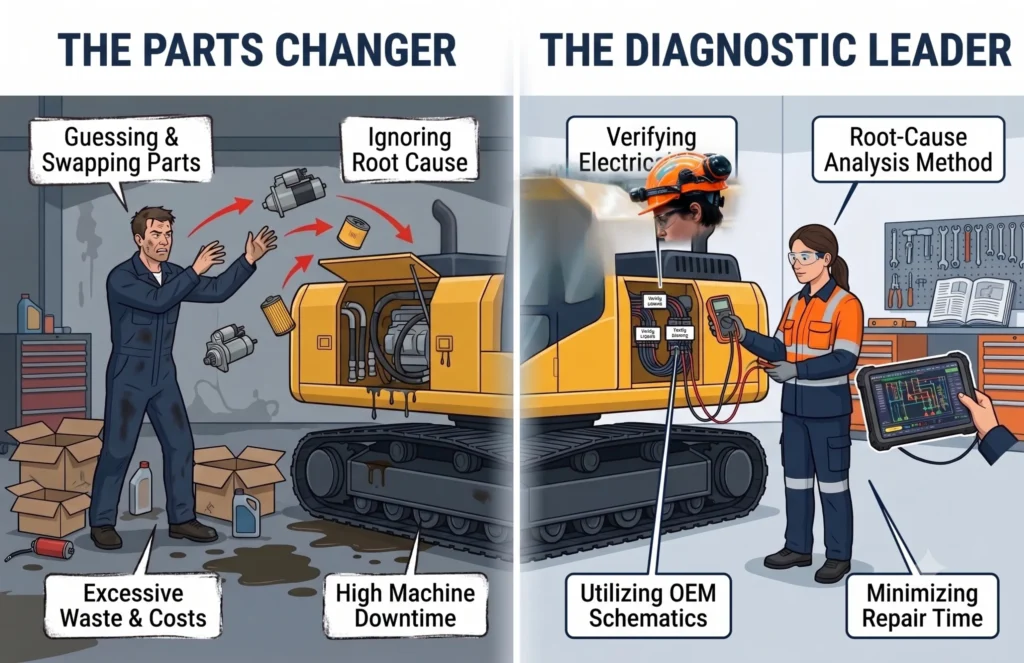
18. Diagnostic Leader Versus Parts Changer
To truly understand what makes a good technician, review this definitive contrast in behavior and mindset.
| Trait | The Parts Changer | The Diagnostic Leader |
| Fault Codes | Treats the fault code as the diagnosis. | Treats the fault code as a symptom to investigate. |
| Testing | Uses a basic 12V test light. | Uses a DMM and digital storage oscilloscope. |
| Manuals | Ignores the service manual. Relies on memory. | Reads the theory of operation and system schematics. |
| Parts | Replaces the suspected part immediately. | Proves the part has failed before removing it. |
| Failure Analysis | Throws the broken part in the scrap bin. | Disassembles the broken part to find the root cause. |
| Hydraulics | Turns relief valves blindly to increase power. | Uses flow meters to calculate volumetric efficiency. |
| Electrical | Pierces wires with probes, inviting corrosion. | Uses OEM breakout T-harnesses to protect seals. |
| Documentation | “Serviced machine. Replaced sensor.” | Detailed complaint, cause, and correction narrative. |
| Safety | Skips LOTO to “save time.” | Physically verifies zero energy before every job. |
| Cleanliness | Leaves hoses open to the atmosphere. | Caps and plugs all lines; uses kidney-loop filtration. |
| Torque | Uses an unregulated impact gun on everything. | Uses calibrated torque-turn methods per OEM spec. |
| Intermittent Faults | Clears the code and sends it back to work. | Graphs live data and performs harness “wiggle tests.” |
| Accountability | Blames the operator or the “junk” machine. | Owns the repair and verifies the fix under load. |
| Mentorship | Hoards knowledge to protect their job. | Teaches apprentices to build a stronger team. |
| Mindset | “I turn wrenches for a paycheck.” | “I solve complex industrial problems.” |
19. Self-Assessment Scorecard
Rate yourself honestly on a scale of 1 to 10 in the following categories.
- Diagnostics: I isolate root causes before replacing components. ( __ / 10)
- Electrical Knowledge: I am fluent in Ohm’s Law, voltage drop testing, and CAN bus logic. ( __ / 10)
- Hydraulics: I can read ISO schematics and troubleshoot closed-center load-sensing pumps. ( __ / 10)
- Communication: I effectively interview operators and clearly brief supervisors. ( __ / 10)
- Documentation: My service reports are detailed, accurate, and legally defensible. ( __ / 10)
- Leadership: I actively mentor junior technicians and set the standard for the bay. ( __ / 10)
- Safety: I never compromise on LOTO, isolation, or contamination control. ( __ / 10)
- Professionalism: My toolbox is organized, my uniform is clean, and I respect OEM procedures. ( __ / 10)
Interpretation:
- 70–80: You are an Elite Diagnostic Leader ready for global deployment or senior management.
- 50–69: You are a strong technician, but you need to transition away from mechanical wrenching and focus heavily on electronic/hydraulic theory and leadership.
- Below 50: You are operating as a parts changer. You must urgently seek training in electrical diagnostics and diagnostic methodology to secure your future.
20. Career Development Roadmap
A career in heavy equipment is not a flat line; it is a ladder.
- Apprentice: Focus on mastering hand tools, safety, shop etiquette, and preventative maintenance fundamentals.
- Technician: Focus on heavy mechanical overhauls (engines, transmissions, final drives) and mastering the OEM service manual.
- Senior Technician: Transition to diagnostic proficiency. Master the multimeter, pressure gauges, and flow meters.
- Diagnostic Specialist (Tech Communicator): Step off the heavy tools. Focus entirely on laptop diagnostics, multiplexed networks, telematics, and advising other technicians on complex faults.
- Workshop Foreman / Leading Hand: Manage shift workflow, ensure safety compliance, and mentor the team.
- Workshop Manager: Manage facility profitability, customer relations, tooling budgets, and technical training matrices.
- Reliability Engineer: Use big data, telematics, and oil analysis to predict failures and rewrite maintenance strategies to eliminate downtime globally.
- Technical Consultant: Travel internationally as an OEM factory representative or independent auditor.
21. What This Means For Your Career
- For Apprentices: Stop worrying about how fast you can do a job. Worry about how accurately you can do it. Learn to use a multimeter immediately.
- For Technicians: Refuse to be a parts changer. If you don’t know how a system works, open the manual and read the “Theory of Operation” section before you touch a wrench.
- For Supervisors: Protect your diagnostic thinkers. Do not let production pressure force them into taking backyard shortcuts.
- For International Job Seekers: Update your CV. Stop listing your duties (e.g., “rebuilt engines”) and start listing your diagnostic achievements (e.g., “Troubleshot and resolved chronic Tier 4 emissions derates using OEM software and live data graphing”).
22. Summary And Key Takeaways
- Mechanical skill is the baseline, not the peak. Diagnostic thinking is the ultimate currency.
- Speed kills reliability. Taking the time to test and verify is always faster than doing the job twice.
- Understand the system. Modern machines are electro-hydraulic ecosystems; an electrical fault will manifest as a hydraulic symptom.
- Trace the failure chain. Never replace a primary component without finding the initiating defect that caused it to fail.
- Always ask why. Technical curiosity drives lifelong learning and career progression.
- Electricity is mandatory. If you cannot read an electrical schematic, you cannot fix modern equipment.
- Paperwork is diagnostic. A brilliant repair is useless if it is not documented accurately for warranty and reliability tracking.
- Communication builds trust. How you speak to operators, engineers, and management defines your professional reputation.
- Discipline equals reliability. Following OEM standards ensures components survive their intended lifecycle.
- Safety is leadership. Strict LOTO compliance protects lives and sets the culture of the workshop.
- Own your mistakes. Accountability builds respect; hiding errors destroys careers.
- Stop firing the parts cannon. Prove a component is dead with physical data before ordering a replacement.
- Managers promote problem solvers. ROI is generated by technicians who achieve high first-time fix rates.
- Global employers want diagnostic leaders. Expat roles require independent, safe, and highly articulate problem-solvers.
- It is a cognitive profession. The highest-paid technicians use their laptops and brains far more than their breaker bars.
23. FAQ Section
Q1: What is the most important skill for a modern diesel technician? A: Diagnostic methodology and systems-thinking. The ability to logically trace a fault through electrical, hydraulic, and mechanical systems using data and schematics.
Q2: Why do parts changers get stuck in their careers? A: Because they only provide value when the problem is obvious. When complex, intermittent network failures occur, parts changers cost the company massive amounts of money in unnecessary parts and downtime.
Q3: Do I need to be an IT expert to be a modern technician? A: You don’t need to write code, but you must be highly digitally literate. You must be comfortable navigating complex OEM diagnostic software, flashing ECUs, and interpreting live data graphs.
Q4: How do I improve my diagnostic skills? A: Stop guessing. Force yourself to read the “Theory of Operation” in the service manual for every system you work on. If you understand how it is supposed to work, you can easily identify why it is failing.
Q5: Why is contamination control considered a leadership trait? A: Because it requires discipline when no one is watching. A leader caps hoses and kidney-loops oil because they understand the microscopic damage dirt causes, regardless of the time pressure they are under.
Q6: What makes a technician globally employable? A: International employers want independent diagnostic ability, a flawless safety record, the ability to write comprehensive reports, and the patience to mentor a local national workforce.
Q7: How important are communication skills for a mechanic? A: Essential. If you cannot explain a technical failure to a non-technical Mine Manager or articulate test results to a factory engineer, your diagnostic skills are practically useless.
Q8: What is root cause analysis? A: It is the process of identifying the absolute origin of a failure. E.g., The symptom is a blown turbo. The root cause is a clogged air filter that caused the turbo to overspeed and fail.
Q9: Why do workshop managers value documentation so highly? A: Because documentation secures warranty claims, provides a legal defense in safety incidents, and feeds data into the company’s reliability and preventative maintenance algorithms.
Q10: Can a technician really become a Reliability Engineer? A: Absolutely. Many of the best Reliability Engineers started on the tools. They combine their deep, practical understanding of how iron fails with data analytics to optimize fleet performance.
24. Digital Product Opportunities
To help you and your team transition from parts changers to elite professionals, Modern Trade Skills recommends these resources:
- Diesel Technician Self-Assessment Workbook: A 50-point interactive PDF to audit your diagnostic, electrical, and hydraulic proficiency against OEM standards.
- Diagnostic Leadership Development Guide: A strategic roadmap detailing how to master digital multimeters, oscilloscopes, and OEM software platforms.
- Workshop Professionalism Checklist: A supervisor’s tool for auditing bay cleanliness, LOTO compliance, and service report quality.
- Career Progression Planner: A 5-year goal-setting template mapping the exact certifications and skills required to move from Technician to Reliability Engineer.
- Global Employability Scorecard: A rigorous benchmarking tool to evaluate if your technical and communication skills are ready for the lucrative international expatriate market.
Great content! Keep up the good work!
Thank you very much.